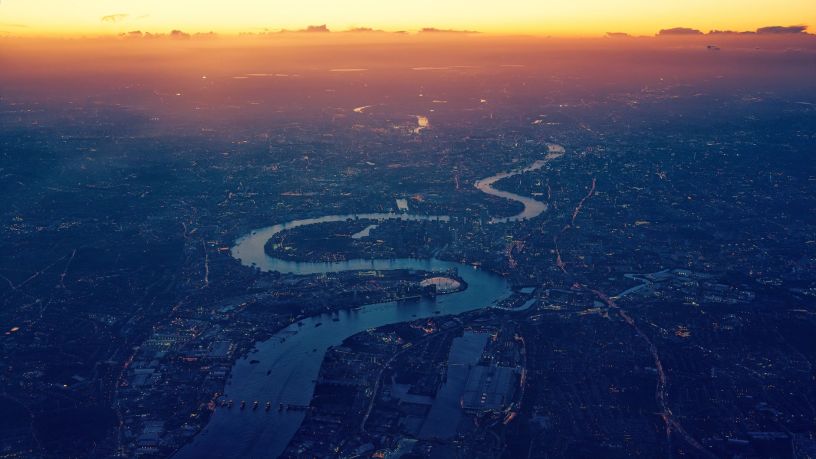
When I think of shipbuilding, I see in my minds eye the North-East or the Clyde. Yet, Thames shipyards, including four Naval Dockyards, built many thousands of ships over four centuries. We can think of East Indiamen setting sail for the spices of the east, or whalers, but more-so mail steamers, wherries and tea clippers. It was said that standing on Greenwich Hill you could see hundreds of yards stretching west to Chiswick and east towards the sea. With men like Maudslay, Thames yards were ahead of the game with steam power until the proximity of raw materials passed the advantage further north. Here are some of the larger yards and the men who ran them.
The Blackwall Shipyard
The yard was laid out in or just after 1587 and is sometimes called the East India Yard. That merchant company was formed in 1599 and employed large numbers of East Indiamen many of which were built at Blackwall. The shipbuilders clearly had a strong connection with the company. In the eighteenth century the connections were with the great and the good; manager Philip Perry was said to be on good terms with Prime Minister Pitt.
Banbury offers some quantitative detail. The Brunswick dock was opened in 1789 with its mast house completed two years later. The main mast of a 74 gun ship was 3ft in diameter, 108 ft high and weighed 9 tons. The ability to lift this vertically into a hull required the extraordinary structure of the mast house, essentially a very tall build beside the dock.
Wigram, Green & Co took over the yard in the early nineteenth century and they became the byword for conservative shipbuilding: ‘bluff-bowed Indiamen or Blackwall Frigates with stern windows, make-believe gunports and quarter galleries’.
The yard achieved renewed fame when it was split between R&H Green and Money Wigram. They were both shipowners who built ships. Greens built mail ships and, for the Crimean War, gunboats. They went on to build torpedo boats and ended with ferry boats and paddle steamers. Greens had stayed with wooden construction until 1866. but Wigram embraced iron from the time the partners spilt. The yard finally closed in 1893.
John Scott Russell & Co
I have chosen this yard and more so this man since, in my piece on Brunel and the account of the Great Eastern, Scott emerges somewhat tarred. In contrast, Philip Banbury, in his book Shipbuilders of the Thames and Medway, is at pains to be balanced and concedes that the massive Great Eastern project was indeed subject to much argument between Brunel as designer and Scott Russell as builder. I surmise that at least part of this stems from Scott Russell’s academic background. He had been Professor of Natural Philosophy at Edinburgh and wrote extensively on ship design. Banbury sees in the Great Eastern evidence of Scott Russell’s work on the wave principle as set out in his Modern System of Naval Architecture. He had taken over the yard from William Fairbairn in 1844 and went on to be joint designer of the Warrior, the greatest warship of the day.
The Great Eastern offers a link to Marconi for this giant ship laid the first trans Atlantic cable to carry telegraph messages. Marconi did of course follow telegraph with wireless.
John Penn – engineer
I have written elsewhere of the John Penn company, but who was John Penn? The son of a millwright, so a jack of all trades, for there were wind mills, water mills and treadmills, grinding grain, powering bellows for blast furnaces and powering cranes. John Penn junior continued to make treadmills for prisons and eight man treadmills to work cranes capable of lifting a ton. He set up an engineering works on Blackheath Hill and so his mighty steam engines had to be transported to the river to be lifted into the waiting hull. His boiler works were at Deptford. The works were said to be a model of efficient manufacturing capable of producing 8 tons propeller bosses and propeller blades of 5 tons or more. Penn, working with Francis Pettit, solved the problem of the propeller shaft letting water into the ship by use of lignum vitae, a very hard wood whose sap self lubricates.
John Penn retired in 1874 with successive generations running the company until it ceased in 1912. William Hillman, the motor engineer, served his apprenticeship with John Penn.
Thames Ironworks and Shipbuilding Company
The company occupied thirty acres in West Ham and five acres across the river Lea in Blackwall. It had eight slip-ways and two dry-docks. In addition to shipbuilding, it had a civil-engineering business which built Hammersmith Bridge, an electrical department, cranes and marine engines. Banbury shines his spotlight on it when twenty-three year old Arnold Hills joined in 1880. These were times of punishing strikes which caused great hardship to the work force. Hills was determined to end the confrontational approach adopted by his fellow managers in other yards. It worked, and Thames enjoyed good relations. In 1898 the company was reconstituted as Thames Ironworks Shipbuilding and Engineering Company to take over John Penn. The writing was on the wall, the northern yards were seriously undercutting those on the Thames. Thames ironworks in particular suffered from a crowded and disorganised site and ceased activity after 1912.
I noted in my piece on Barnes Wallis that he had started his career at Thames but had been bored with too little to do.
Maudslay Sons & Field
Henry Maudslay I have written about at length in relation to machine tools. Joshua Field was a Portsmouth dockyard draughtsman. They joined together to build steam engines in the early nineteenth century. Their first marine engine appeared in 1814 and they went on to become the only Thames Yard to receive Admiralty contracts. They developed engines for paddle steamers and then propellor driven ships. They provided the engines to Brunel’s Great Western. Their engine works were where County Hall now stands on the south embankment of the Thames.
John Thornycroft
Banbury suggests that Thornycroft belonged to the third generation of the Industrial Revolution engineers. The first like Trevithic, George Stephenson and James Watt were largely self tought. The second, such as Robert Stephenson and the young Rennies were educated in classical subjects. The third generation benefitted from technical schools like Regent Street Polytechnic which Thornycroft attended.
Thornycroft began building fast agile craft in 1862 when he was eighteen. It was about the size of a narrow boat but both much faster and lighter. The design soon developed into the torpedo boat and this too developed into three classes: the largest which was fully seagoing; a medium size which could be launched from the shore to attack coastal shipping and the smallest which would be carried by and launched from a larger ship. Thornycroft built some seventy five, the largest being 96ft, 48 ohp and capable of 21.8 knots. These were sold around the world and bought largely for show rather than used in anger.
Their threat was real and Thornycroft and others built larger torpedo boat destroyers which soon became known simply as destroyers and were also agile and heavily armed. He went on to manufacture steam and then petrol powered wagons. The shipbuilding business moved to Southampton and vehicles to Basingstoke.
Further reading- (this book is packed with wonderful detail)
Banbury, Philip, Shipbuilders of the Thames and Medway (Newton Abbot: David & Charles, 1971)