
Oxford and Cambridge Universities, unlike the Scots, French and Germans, rather looked down on manufacturing preferring to teach the classics and didn’t offer science degrees until after 1870. Cambridge had offered lectures on pure mathematics, but not on anything applied.
Eric Hobsbawm in his book, The Age of Revolution makes the point that none of the inventions which enabled the early industrial revolution was really high tech. He is then scathing on the subject of the English education system, which in his view was only saved by the presence of Scots from their schools and universities, and he lists James Watt, Thomas Telford, Loudon McAdam and James Mill as some of their success stories. The French had their Ecole Polytechnique and the Germans Bergakademie, but the English stuck fast to classical education at Oxford and Cambridge, fearing, he suggests, the genie of science.
Yet, the British middle classes had developed an appetite for science and there sprung up around the country series of lectures on new and not so new discoveries which would attract good audiences. In the nineteenth century, and earlier in some places, voluntary Literary and Philosophical Societies were formed where interested people could meet to discuss matters of arts and sciences; the modern divide between arts and sciences hadn’t yet fossilised. During the period often referred to as ‘the long 19th century’ (c.1780-1914), Lit & Phils could be found all over England, Wales, Scotland and Ireland. Speakers would attract large audiences on a whole range of subjects.
There was a genuine concern for the education of manual workers and, for these, Mechanics Institutes began to emerge to offer teaching in science. There seems to have been no overall pattern with credit being given to George Birkbeck for the London institute, to John Anderson for Glasgow with a Birmingham establishment also staking a claim. Whilst the avowed purpose was to give relevant education to manual workers, it is suggested that the outcome was to support clerical and more highly skilled manual workers.
Colleges also began to appear with curricula aimed at vocations.
This was far from the whole story. The string upon which Charlotte Bronte’s story of Shirley hangs was the revolution taking place in industry, where machinery was massively increasing the productivity of men and also removing low-skilled jobs and replacing them with those demanding of higher skills. The workers in Shirley didn’t see it that way; they believed that machines were robbing them of their jobs.
The Mechanics Institutes and equivalent bodies around the country had, for twenty years or so, been giving working men the opportunity to learn the skills that they would need in the new industrial world. London’s Working Men’s College was different. It didn’t lecture; it taught. FD Maurice believed that if ‘knowledge and culture, science and literature are any good, that good is apart from any trace of utility’.
In 1854 F.D. Maurice, who was then the Chaplain of Lincoln’s Inn and Dean of King’s College, conceived the idea of The Working Men’s College, first at Red Lion Square and then in Great Ormond Street, largely through the means of evening classes, which would bring education within the reach of working men.
The booklet produced on the foundation of the college notes that the Reform Act of 1832 had done nothing for working men and it was only the subsequent reform in 1867 that broadened the suffrage to include householders who rented rather than owned their property. There had been a great deal of agitation for a clear voice for the working man.
Those offering education at the college included John Ruskin but also Ford Madox Brown, Edward Burn Jones, Dante Gabriel Rossetti and Lowes Dickinson, who, the booklet states, taught there for some sixteen years. One of Dickinson’s many portraits was of Maurice. Of Ruskin’s involvement, the author of the booklet writes, ‘It helped the enterprise as a whole by letting the world know that one of the greatest Englishmen of the time was in active sympathy with it’. It is clear that Ruskin was thoroughly active in the project. He taught sketching and mentored a number of his students, one of whom (George Allen) would, much later, become his publisher. A further name that appears in the Working Men’s College is that of Charles Kingsley, then a clergyman, he who would go on to write Alton Locke and also The Water Babies with all its Darwinian imagery.
I explore below some of the towns which had institutions and societies tracing some of the history.
Aberdeen
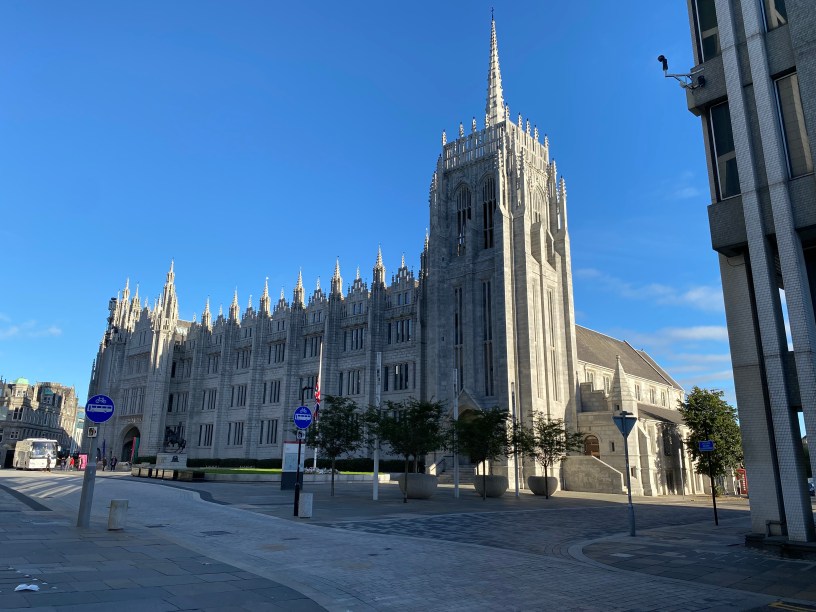
Marischal College (the page image) was founded in 1593 as Aberdeen’s second university; Kings College having been founded in 1495. The merchant, Robert Gordon, was educated at Marischal and in 1729 founded Robert Gordon’s hospital for sons and grandsons of burgesses who were too poor to maintain them at school.
In 1824, a Mechanics Institute opened and in 1884 this transferred to what was then Robert Gordon’s College. In the twentieth century, Robert Gordon’s became a technical college and then much later a university. I write in this blog of how Alexander MacRobert was both educated there and later taught.
Birmingham
Osborne in his book Iron, Steam and Money in is full of praise for the English inventors who discovered their advances through years of practical experience. In the 1820s, 1830s and 1840s the new patents in cotton spinning numbered fifty-one, eighty-six and 156 respectively.
A further aspect can be seen in groupings such as the Lunar Society in Birmingham. Here, manufacturers like Wedgwood, Boulton and Watt came together with scientists including Erasmus Darwin, Joseph Priestley and, on occasions, Benjamin Franklin and Richard Arkwright to explore new ideas.
A Lit & Phil Society was formed in the 1790s which spawned the Brotherly Society which became a Mechanics Institute.
Josiah Mason’s Science College was founded in Birmingham in 1875. It became part of the University of Birmingham which had a specialism of Metallurgy.
Yet even the University of Birmingham was resistant to embrace manufacturing. There is the story of the University of Birmingham being offered £120,000 to set up a production engineering degree. The University powers-that-be couldn’t quite stomach something so close to the shop floor that they eventually accepted the money but for a chair of Engineering Production.
Bristol
A Lit & Phil was formed in the 1790s
Edinburgh
A Lit & Phil was formed in the 1790s and the first ‘real’ Mechanics Institute in 1821 as the Edinburgh School of Arts.
Glasgow
Professor John Anderson made a bequest in 1796 which enabled the founding of an institution aimed at natural philosophy and its applications in industry with Dr Thomas Garnett as its first professor. It became the Glasgow Royal Technical College. The Glasgow Mechanics Institute was formed in 1823.
Leeds
The University of Leeds, officially founded in 1904, originated from the 1874 establishment of the Yorkshire College of Science, designed to provide technical education for the local cloth trade
Leicester
A Literary and Philosophical Society was established in 1835 and still offers annual public lectures. A Mechanics Institute functioned in the city for about forty years from the 1830s.
The School of Textiles in Leicester celebrated its centenary in 1983-84 with the publication of a short history. The focus was on knitting, and the founding of the college was initiated by yarn merchants witnessing the quality of continental competitors which benefitted from formal technical education. In the second half of the twentieth century the focus moved to artificial fibres, machinery capable of producing whole garments, and textile and knitwear design.
Liverpool
A Mechanics and Apprentices Library and Reading Room was formed in 1823.
London
The Royal Institution, still loved for its Christmas lectures, was founded by Count Rumford in 1799 and later appointed Dr Thomas Garnett from Glasgow as its professor. A London Mechanics Institute was formed in 1824 in Chancery Lane and attracted Dr Birkbeck as a lecturer; it later took his name and moved to its present site.
Manchester
A Literary and Philosophical Society was established in 1781.
A Mechanics Institute was formed in 1824 with founders including machine tools inventor Richard Roberts, engineer William Fairbairn and John Dalton later known for Atomic Theory.
Owen’s College for the teaching of engineering science was founded by a group of Manchester engineers including William Fairbairn and Joseph Whitworth who were both strongly committed to making education widely available.
Newcastle
The Lit & Phil had been meeting since 1793 in various locations around Newcastle to discuss and debate the matters of the day, their collection of books grew and artefacts and curiosities were gathered. By the early 19th century it had become a home for inventors, pioneers and visionaries and a focal point for the industrial revolution.
It officially opened its handsome neoclassical home in 1825. George Stephenson demonstrated his ‘miners safety lamp’ to the Society in 1815 and Joseph Swan lit a public room with electric light for the first time here in 1881.
Past presidents include 1855–1859: Robert Stephenson and 1860–1900: William, Lord Armstrong
In the late nineteenth century John Hancock became secretary of the society and, with his brother Albany a celebrated naturalist, arranged for the purchase of land at Barras Bridge to house the society’s growing natural history collection. This is now known as the Great North Museum.
Sheffield
A Mechanics and Apprentices Library was formed in 1823.
York
It was not a great hub of manufacturing like Sheffield or Birmingham, yet it was chosen as the venue for the first meeting of the British Association for the Advancement of Science at the invitation of the Yorkshire Philosophical Society. York then had little industry, but it did have a community passionate about discovery, whether of the city’s history or the world around.
Further reading
- https://www-historytoday-com.lonlib.idm.oclc.org/archive/feature/extraordinary-rise-and-inexplicable-decline-lit-phils
- Kelly, Thomas. “The Origin of Mechanics’ Institutes.” British Journal of Educational Studies, vol. 1, no. 1, 1952, pp. 17–27. JSTOR, https://doi.org/10.2307/3119430. Accessed 9 Mar. 2026.

