
This was surely the powerhouse for the Industrial Revolution in Britain, with abundant coal, iron ore and limestone, a canny workforce and some of our best engineers. The coalfields of Northumberland and Durham were the biggest source of coal in the UK the total production of which in 1913 was 287 million tons with the mighty USA a short distance behind. The output of the Durham field alone was 41 million tons. The region produced iron and steel and played a big part in shipbuilding.
Berwick on Tweed
In 1850 Robert Stephenson built the Royal Border Bridge at Berwick, connecting London and Edinburgh.
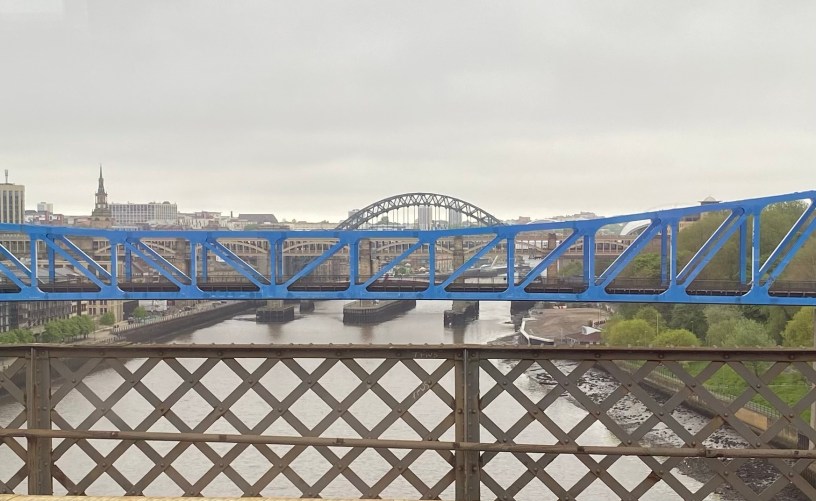
Newcastle upon Tyne and Gateshead
A shipbuilding town built on coal. Home to William Armstrong’s engineering ventures which joined with Vickers to become a giant of engineering, shipbuilding and armaments. CA Parson steam turbines were invented and built in the city and transformed both the generation of electricity and the way ships were powered. You can find more in How Britain Shaped the Manufacturing World and by following this link.
South Shields
Barbour have made wax jackets since 1894.
Sunderland
On the river Wear, home to builders of clippers for fast carriage of tea and silk. Now home to Nissan UK and its electric car and battery plant. I write much more in How Britain Shaped the Manufacturing World and in this link.
Washington
A new town designated in 1964 home to a BAE Systems munitions factory derived from the Second World War Royal Ordnance engineering factory at nearby Birtley. You can read more by following this link.
Jarrow
Home to Palmer Shipbuilding and Iron Company. This was one of the companies which in the 1930s was deemed surplus to the nation’s needs. Palmers with eighteen berths and one hundred and thirty one thousand capacity closed in 1935. Vickers later brought it back for repair work.
Blyth
A major port for the shipment of coal. Nearby Cambois was home to a Glaxo primary manufacturing factory
County Durham and Durham
The county was home to one of Britain’s largest coal fields and a good deal of the industry of the area development round the need to transport that coal to market. The first water powered pump to clear a mine of water was introduced in Finchdale in1486. In recent times, there was some diversification. Phillips (formerly Mullard) made colour TV tubes at their Durham factory.
Consett, the Derwent Valley and Shotley Bridge
The Derwent Valley was rich in coal, iron ore and limestone and made it the perfect place for iron and steel production. I write more in this blog piece.
Hartlepool
A shipbuilding and iron and steel town built on the carriage of coal by rail from the Durham coalfields to the sea. Still home to a Tata steel plant. You can read more in this link.
Peterlee
A new town designated after the Second World War in 1948. You can read more in the link.
Middlesborough
On the south of Teeside, and so in Yorkshire. One of the 19th century towns created by the railways. Along with neighbouring Hartlepool, Stockton and Darlington historically focused on shipbuilding, coal and iron. You can read more by following this link.
Billingham and Wilton
ICI built massive chemical plants forming the core of the British chemical industry. Read more in this link.
Stockton
One end of the first railway, this town on the winding river Tees. was important for its engineering skills. You can read more in this link.
Darlington
The North Eastern Railway workshops moved here from Gateshead. Whessoe foundries and engineering had their home here. Cummins Inc set up their diesel engine factory here in 1965. Dorman, Long continues to trade as DLT Engineering with the Whessoe Technology Centre at Darlington, head office in Northamptonshire and operations in China and India. Here is the link to DLT. Rothmans made cigarettes here.
Barnard Castle
Glaxo’s first factory producing penicillin. I write more in Vehicles to Vaccines.
Newton Aycliff
New Town designated in 1947. Home to a Royal Ordnance shell filling factory in the Second World War to which the government persuaded the British Bakelite company to move in the late forties. Home now to Hitachi Europe, one of the few remaining UK railway locomotive works, and the government owned semiconductor plant, Octric. You can read more in this link.
 British Manufacturing History