
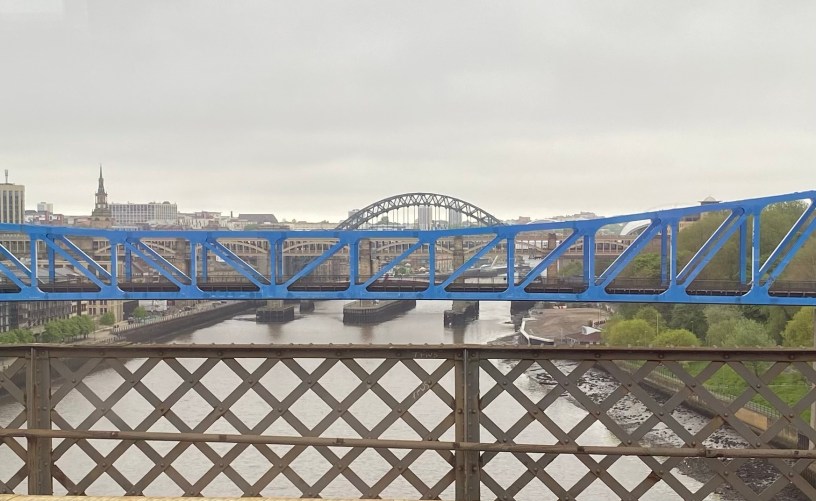
Coal was at the heart of the economy of Tyneside which, with its long navigable estuary, was able to ship many of the millions of tons produced by the Northumberland coalfield. The presence of so many mines grew generations talented engineers who rose to the challenge of tackling flooding and poor ventilation that made mining so dangerous. They also addressed the economic imperative of cost effective transport. The answer was steam as I wrote in How Britain Shaped the Manufacturing World (HBSTMW) and men like William Brown and George and Robert Stephenson.
William Brown, working as a colliery viewer near Newcastle, turned his skills to the building of Newcomen engines which had already been used successfully in the Cornish tin mines, but also and importantly casting the cylinders in iron, rather than copper. Brown was also casting, in iron, the pipes feeding the steam engine.
It is well known that the eminent scientist Humphrey Davy invented the safety lamp, but George Stephenson produced a lamp equally safe only a few weeks later and this was widely used. Stephenson with his son Robert did go on to produce the Rocket in 1829 and many more railway locomotives. Again, I cover this at some length in HBSTMW. R&W Hawthorne also manufactured first class steam locomotives not least for the Stockton Darlington railway. In 1885 the company merged with shipbuilder Andrew Leslie & Co. Hawthorne’s railway heritage can be trace through to English Electric in the 1950s.
Shipbuilding was at the heart of the Tyne with the river in the mid nineteenth century ‘positively bristling with ship yards’. Of these the most famous were T&W Smith, Wood Skinner, Wigham Richardson, William Cleland & Co, John Couts, Andrew Leslie & Co and one of the most successful, Charles Mitchell, with his yard at Walker. Mitchell added to his success by marrying Anne Swan through whom he acquired two brothers in law Charles and Henry Swan. Charles Swan merged with the Sunderland George Hunter, to form Swan Hunter; Henry later took over the Mitchell yard.
William Armstrong trained as a solicitor but was irresistibly drawn by the power of water which he had witnessed in his walks across Northumberland. He went into business first in hydraulics and then became a master of the technology of big guns which he explored at Elswick working closely with Mitchell. The two companies eventually merged in 1882. Armstrong presented the patents for the new big gun to the nation, and he was appointed to the government position of Engineer to the War Office of Rifled Ordnance. The government then awarded a contract to the Elswick Ordnance Company, which had been set up by Armstrong but in which Armstrong no longer had any financial interest. He was rightly included as one of the ‘Deadly Triumvirate‘. He later merged with Joseph Whitworth of Manchester and together they joined with Vickers of Sheffield. I write about all three at some length in HBSTMW. The Newcastle works later built tanks, made presses for the newspaper and motor industry, and rolling mill equipment for the steel industry. Vickers Armstrong built naval ships in the Second World War and in the postwar period re-equipped the yard, with up to date machinery including piped oxygen for welding, to build liners.
Like a number of other cities, Newcastle boasted its Lit and Phil Society, founded in 1793. One lecturer was Joseph Swan who demonstrated the electric light bulb at the same time as Edison was revealing his work on the other side of the Atlantic. Pragmatism prevailed and the two came together in the company known as Ediswan.
The shipbuilding and engineering industries were fertile ground for CA Parsons who invented the revolutionary steam turbine, equally useful in propelling ships and powering electricity generators. German born John Merz married into the Wigham Richardson family and with his brother championed the production of cheap electricity to power the growing city and its industries.
Over the river in Gateshead iron foundries prospered and R.S. Newall manufactured steel rope for mines, railways and ships rigging. The production of Alkali using the Leblanc process was championed by local entrepreneur William Losh. This was followed by soap works and a chemical plant run by Christian Allhusen which covered a massive 137 acres of the south shore. By the time of the electrical revolution the highly polluting Leblanc process was replaced by that invented by Solvay but this gravitated towards the Cheshire salt fields. Tyneside would get their own back when cheap electricity attracted Castner Kellner from Cheshire.
Gateshead was also home to the workshops of the North Eastern Railway Company which at one time employed 3,300 men before it moved to Darlington. R&W Hawthorn manufactured steam locomotives. Clarke Chapman built steam engines and later nuclear generation plant, and, together with Hebburn engineers A Reyrolle & Co, CA Parsons and others, joined to become Northern Engineering Industries which was bought first by Rolls-Royce and then by the German Siemens. I write about these energy companies in Vehicles to Vaccines.
In the early twentieth century the Wigham Richardson yard specialised in cable laying ships, Armstrong Whitworth focused on the Russian market and, at their naval yard, produced warships not only for the Royal Navy but also for Norway and Japan. Swan Hunter and Wigham Richardson built the renowned RMS Muretania at their Wallsend yard. I write of their contribution to the First World War effort in Ordnance. In the interwar years, Swan Hunter Wigham Richardson ranked second to Harland & Wolff (Belfast and the Clyde) in gross tons launched. They exported some 44% of their production. Lithgow on the Clyde ranked third just above William Gray in Hartlepool/Sunderland.
Much of Armstrongs merged with Vickers in 1927 in order to rationalise arms production. At that point Armstrong in Newcastle ranked fifth and Vickers a long way down at 11th just above John Brown on the Clyde.
The interwar years saw the demand for coal plummet which drew the response of reduced wages and lay offs which in turn partly provoked the National Strike of 1926. Tragically the strike handed export markets to competing coal producing countries, Germany and Poland, and so the decline of coal began. Along with coal, ship building suffered. Jarrow was home to Palmers shipyard which closed in 1936 creating mass unemployment and triggering the Jarrow march. Some help was provided through the Special Areas (Development and Improvement) Act of 1934, but the days of being the workshop of the world would never return.
The demands of rearmament began to show their teeth in 1935, particularly with the need for gun mountings for the massive guns which were to be installed on the new battleships under construction. Vickers made mountings at Barrow and Elswick. They also worked on new battleships, collaborating with Beardmore, Firth-Brown and English Steel on armour plate. The total Vickers workforce at the start of the war was 64,000. Vickers, and the other shipyards geared to naval construction, expected orders for large battle ships. A few came, but the experience of war, particularly the Atlantic convoys, underlined the greater need for smaller faster ships, but also for submarines and other specialist vessels. For Vickers this provided work for Barrow. The same experience underlined the need for substantial repairs and Vickers Palmers yard was kept busy. Vickers were kept at full capacity with machine and gas operated guns, field artillery, large artillery pieces and ammunition of all kinds.
After the war, Newcastle works built tanks, made presses for the newspaper and motor industry, and rolling mill equipment for the steel industry. In terms of new products, ‘Clearing’ presses became very important for the motor industry with orders from Morris, Pressed Steel, Rootes, Vauxhall and Ford. Another important area was printing presses, and Vickers eventually bought George Mann & Co of Leeds manufacturers of offset litho presses. In a related area, they bought Powers-Samas accounting machine manufacturers of Croydon.
The Elswick works manufactured Valentine and Matilda tanks and a whole range of Ordnance. Vickers also took the management of three Royal Ordnance Engineering factories at Nottingham, Derby and Manchester
I write of the post-war story of British shipbuilding in Vehicles to Vaccines.
At nearby Fawdon, Rowntree manufactured Fruit Gum, Pastilles and Jelly. Imperial Tobacco built a factory at Heaton in the forties to make Wills cigarettes. There were, and are, many independent smaller manufacturing businesses, not least Jackson the Taylor which merged with Burtons. William Hunter invented Lucazade in 1927 and sold his business to Beecham in 1938.
In South Shields, Plessey built a factory to manufacture electronic telephone exchanges. In the nineties, the German Siemens set up a plant to manufacture semi-conductors but, with falling demand, it closed after two years. Siemens Energy now occupies the former CA Parsons site which they bought within the NEI Group from Rolls-Royce. I write of this in Vehicles to Vaccines. in 1920 GEC had the Glass Works in Lemington-on-Tyne
Further reading
- Moffat, Alistair and George Rosie, Tyneside – A History of Newcastle and Gateshead from Earliest Times (Edinburgh: Mainstream Publishing, 2005)
- How Britain Shaped the Manufacturing World
- Vehicles to Vaccines
- Henrietta Heald , William Armstrong, Magician of the North
- Anthony Slaven, British Shipbuilding 1500-2010 (Lancaster: Crucible, 2013)

