If I look at the years from the start of the Industrial Revolution up to the Festival of Britain, I can draw up a list a relatively well known names of the movers and shakers of British Manufacturing. Indeed I have identified many of them in this blog and written about them in How Britain Shaped the Manufacturing World
Looking at the years since then, I have found names perhaps not as well known, many of which I remember from years gone by, but whose efforts and talents shine out.
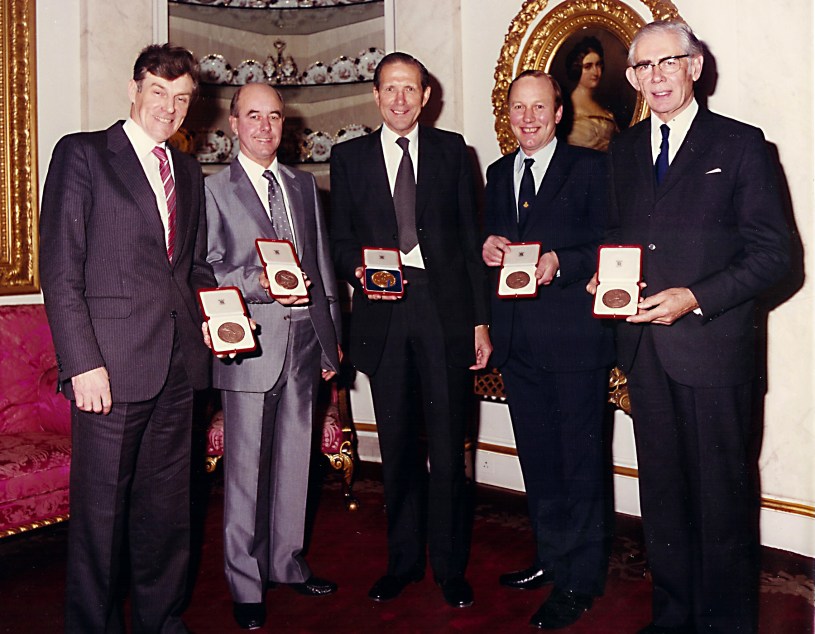
Kelvin Bray was managing director of Ruston Gas Turbines (and its successors) for a quarter of a century. The company manufactured gas turbines which would be used by 80% of the world’s oil industry. Kelvin was a Grammar School boy who unusually for the time won a scholarship to Kings College, Cambridge. He went on to work on the development of the gas turbine from Frank Whittle’s jet engine. The company, now under the ownership of Siemens, continues to manufacture gas turbines in Lincoln for world markets. The image is of Bray and his colleagues receiving the MacRobert award.
John Harvey-Jones of ICI had the job of rebuilding the chemical giant after the recession of the seventies. His approach was to allow one thousand flowers to bloom knowing that that way the successes of the future would be found. Affirmation of his approach is perhaps found in ICI’s offspring Astra-Zeneca and its lifesaving Covid vaccine. The ICI bureaucracy remained to be tackled later.
David McMurtry at Renishaw in 1973 invented a touch-trigger probe to meet an inspection requirement of the Olympus engine which powered Concorde. His company, Renishaw plc, has since grown into a major international force leading amongst much else additive manufacturing – the 3D printing of complex components.
William Weir of Weir Group was not only a member of the founding family of the company that bears his name, but he led that company through challenging times and then wrote a very personal account of its history. William Weir was the grandson of the company’s founder and worked in the business from 1954 until he relinquished the post of chairman.
Arnold Weinstock at GEC made money. He took over both AEC and EE and created a massively strong company. He was followed by George Simpson who made fatal decisions in the dot com boom which led to the end of what was then GEC Marconi. The company’s defence interests then combined with the rump of the British aircraft industry and the remnants of the Royal Ordnance factories to become the highly successful defence manufacturer BAE Systems
Oliver Littleton, at AEI which manufactured the first jet engines, wrestled with the impossible task of bringing together long standing rivals, British Westinghouse and British Thompson Houston.
George Nelson of English Electric was a truly energetic entrepreneur. English Electric would manufacture iconic aircraft and railway locomotives, as well as giving birth to ICL, not least because Nelson had had the wisdom to buy Marconi.
Jules Thorn was the driving force behind Thorn Electric making television widely available and forming the powerhouse of Thorn EMI
George Turnbull was a gifted manager and engineer who had served his time with Standard Triumph. Following the creation of BLMC, he was asked by Donald Stokes to tackle the underperformance of Austin-Morris. He was successful and Austin-Morris was producing half of the profits of the group. His reward was to tackle the Leyland truck and bus business, once more with success. On the reorganisation of the BL group in 1973, Turnbull was passed over for the role of deputy CEO and so the expectation of becoming CEO in due course. He left, and took up the challenge of creating a world class motor company out of the Korean Hyundai. Success followed him once more. For BLMC the story would be less promising.
Sir John Parker studied naval architecture and mechanical engineering at Belfast College of Technology and at Queen’s University Belfast also learning on the job at Harland and Wolff. His first management role was at Austin Pickersgill after which he returned to Harlands as CEO from 1983 to 1993. He then moved to Babcock International from 1994 to 2000 first as CEO and then also as chairman. In his first stint at Harland, he championed the introduction of computers. At Babcock he transformed a revered but troubled engineering company into one focused on naval shipbuilding and repair
Dr Richard Beeching is remembered for closing a great many stations and miles of track. What he also did was to modernise the railways in its management of its workforce, in containerising freight and improving the experience of the traveller with more comfortable trains.
Joe Bamford created and his son developed a massive fiercely independent but private company. In terms of size and privacy they might rank alongside Ineos and Tata. They have a passion for engineering innovation.
Anita Roddick founded the Body Shop which championed women, sought natural ingredients, demanded fair trade and refused animal testing.
Laura Ashley was born in Dowlais, Glamorgan in 1925, moved to London, but was evacuated back to Wales during the war. She trained as a secretary and worked first in the War Office and then for the Women’s Institute and it was their exhibition at the V&A which inspired her to try her hand at fabric printing in her Pimlico basement kitchen. From this beginning, she and her husband Bernard created a fashion following counter to the swinging sixties trend, and which espoused something altogether more homely.
Michael Perrin was an ICI chemist who had been involved first with the discovery of polythene and then with the nuclear bomb project. He moved out of research into a more managerial role in which he excelled. He was appointed chairman of the Wellcome Foundation in 1953. Research was key. He championed the company’s investment, whilst at the same time distributing millions to the Wellcome Trust for medical projects.
These are just some of my selection of post war manufacturing heroes; there are many more most of whom are unsung.
Further reading: Vehicles to Vaccines