
Iron ore was smelted by burning charcoal in the Weald and as forests were denuded, smelting spread to other forested areas. Eventually it became clear that an alternative to charcoal was needed. The Earl of Dudley’s son ‘Dud’ claimed to have smelted iron ore with coal but there is no evidence of this. Dud was born in 1599 and Abraham Darby in 1678 both close to Dudley Castle. Abraham’s father was a nail-maker and locksmith and so it is almost certain that Abraham would have been aware of Dud’s experiments. He was certainly aware that an alternative to charcoal had to be found.
Abraham was apprenticed to Jonathan Freeth, a maker of malt mills in Birmingham. Of great significance the fuel used to make malt mills was coke which provided the heat of coal but without the impurities. Once free, Abraham made his way to Bristol where he set up as a malt mill maker where he soon joined forces with a fellow Quaker to form the Bristol Brass Wire Company where he further advanced his metal casting skills.
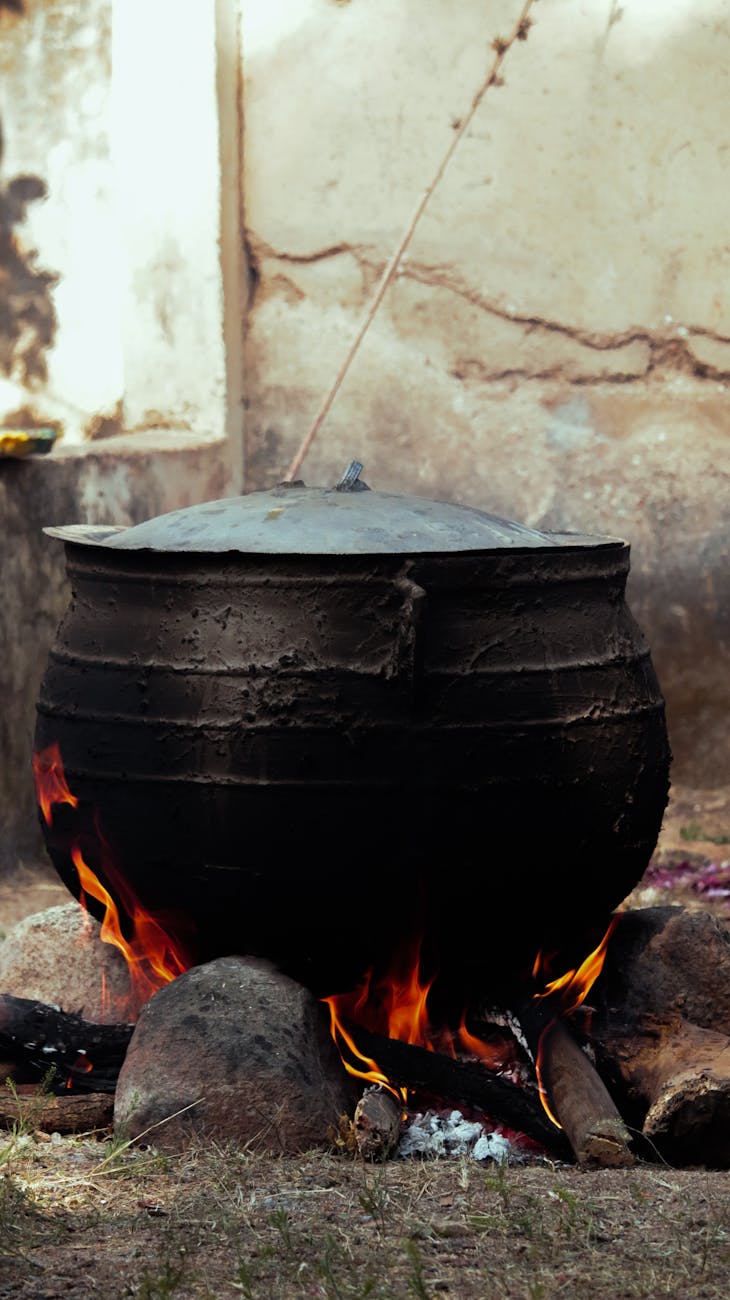
Possibly because of his Quaker upbringing, Abraham had a strong social conscience and he would see possibly most of the population of Bristol too poor to buy the pot bellied cooking vessels he cast from brass. Something cheeper was needed. There started his experiments smelting iron ore with coke. I tell more in my piece on Coalbrookdale where he established his business. His cooking vessels became very popular as did his much larger vessel for heating quantities of water, known as coppers after the material from which they were first made.
Why is that the English struggle so to embrace change? It was clear to Abraham that one reason for Dud’s failure was the resistance of smiths to pig iron smelted with coal. Abraham found that pig iron smelted with coke was met by the same resistance. He was blessed with wisdom and decided not to fight the smiths, but rather to focus on casting, where his skills lay. The core business was the casting of cooking pots of all sizes for which he made a variety of moulds. In time the more adventurous smith would take his pig iron and find that it was entirely suitable. It would not be until Henry Cort at Fareham and his puddling process that production of wrought iron really took off.
Abraham Darby died at the age of thirty-nine in 1717. There followed a succession of Darbys for the next one hundred and fifty years. Abraham Darby had unlocked the industrial revolution now that large quantities of iron could be produced. In time wrought iron would be perfected and in due course be super-ceded by steel. Iron enabled the building of steam power, railways, bridges and so much more.
A Newcomen engine was erected near Dudley in 1712 and by 1716 ‘fire engines’ as they were known were at work in Warwick, Stafford and Flint. Coalbrookdale cast their first iron pipes in 1718 and their first cylinder four years later. Iron cylinders were cheaper than those made of brass and could be much bigger. A large cylinder was cast for Killingworth High Pit where George Stephenson worked. James Watt used Coalbrook cylinders as did Trevithick who also benefitted from cast iron rails. Thomas Telford was inspired by Coalbrook casting and Dr Roebuck at Carron modelled his works on the Coalbrookdale example.
Further reading
L.T.C. Rolt, Great Engineers (London: G. Bell and Sons, 1962)

