
Isambard, born in 1806, was the only son of Marc Brunel the celebrated engineer of the Thames Tunnel. Marc was French and as a royalist fled France after the Revolution spending six years in the USA where he built a reputation which would carry him safe through Francophobe London. He had brought with him the design for a machine to manufacture pulley blocks for sail ships. He eventually found an engineer, Henry Maudsley, capable and willing to put plans into practice. I tell elsewhere of the success of the project and how it was followed by a successful venture into sawmills in Battersea.
All the while Isambard was undergoing his education in France and receiving a technical education in part under the eye of the the eminent French watchmaker, Louis Breguet. and in part from regular visits to Maudsley’s workshop. He inherited his father’s skills at drawing and grew into a determined young man.
His first test came from the Thames Tunnel, a pioneering project to create a tunnel under the tidal Thames. The project was beset with challenges not least the lack of reliable information about the geology nor the extent of dredging of the river. It was a project that attracted some of the great engineers of the age. The Rennies tried and failed; Richard Trevithick took over but also without success. Marc Brunel, with the twenty year old Isambard at his side, brought a new approach to the tunnelling with a machine built by Maudsley. He was joined by William Armstrong and others. Progress was followed by disaster, regrouping and further progress and further disaster. Eventually the project was placed on hold for seven years.
There is a record of Isambard experimenting with the use of Portland cement in repairing the tunnel in 1829. Recent excavations by the University of Bristol in Bristol docks reveal that Brunel again used Portland Cement in his works on the house built for the construction of the engine of his SS Great Britain in 1839, still some five years before the full commercial exploitation of the new cement. This was a man at the forefront of technology.
This jumps ahead a little for Isambard was first occupied in early stages of building the Clifton suspension bridge and then work on Bristol docks both of which lead to the opportunity to pitch for the London to Bristol railway, named by Brunel The Great Western Railway. I write about this in the context of Swindon where the GWR workshops were based. It was a gargantuan task.
1841 was a good year for the Brunels. The Thames Tunnel was completed much to Marc’s relief, and Isambard’s phenominal work in digging the Box tunnel finally connected London to Bristol. These were both ground breaking projects and demanded not only skill but incredible determination.
The Great Western Railway made its way southwest of Bristol as the South Devon Railway. Here we come to an aspect of Brunel that perhaps marks him out as a visionary. He could appreciate the drawbacks of locomotives even on the broad gauge which he favoured. They were too heavy and insufficiently powerful. Elsewhere engineers were exploring what became known as the atmospheric engine which relied on a central pipe running between the rails evacuated of air by steam pump stations as intervals along the line. A piston attached to the underside of the rolling stock would run inside the pipe pushed by atmospheric pressure against the vacuum. In a few test installations it was seen to work, but not without serious drawbacks. The Stephensons were not convinced but Brunel tried the arrangement on a stretch of the line around Totnes. The systems proved impractical and conventional locomotives were used. The concept is perhaps now employed on monorails using electricity rather than air.
Brunel had other fish to fry. As those of us who know the train line into Cornwall will vouch, there are many valleys to cross. The GWR company knew there wasn’t the likely income to justify stone viaducts and so Brunel used Baltic pine capable of lasting thirty years or more to build astonishing geometrical structures. Sadly all have now been replaced by stone or steel.
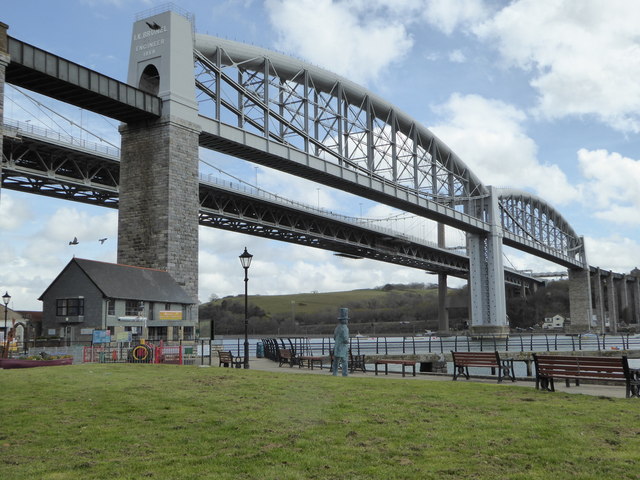
In May 1859 the most revered of Brunel’s work, the bridge over the Tamar at Saltash was opened. It followed the principles espoused by Robert Stephenson at Menai, but over the Tamar the tubes were oval (measuring 12ft 3 in high and 16ft 9 in across) and carried the weight of the track hanging underneath. Whenever our young family drove across the much later road suspension bridge I would ask my children who it was who built the rail bridge: Isambard Kingdom Brunel.
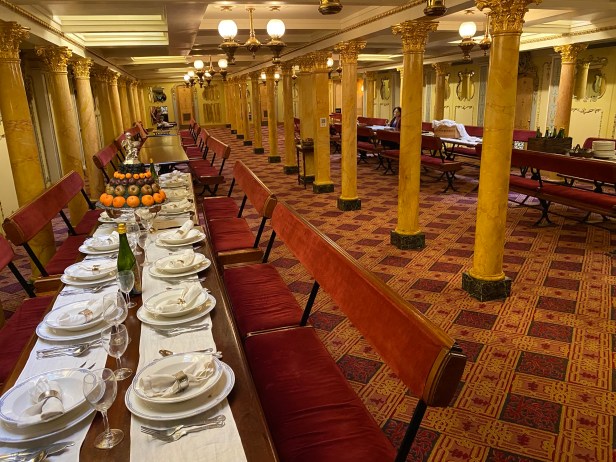
I mentioned the SS Great Britain which was possibly the pinnacle of Brunel’s shipbuilding prowess. He had built the Great Western Railway; a logical extension was to go further west across the Atlantic to New York. The answer was the SS Great Western built of timber in Bristol powered by engines fitted by Maudsley Son and Field in Blackwall. The largest ship built to date, embraced the technology that Brunel had learnt from his work on bridges. A problem remained: conventional wisdom was that the amount of coal needed for an Atlantic crossing would be too great for a ship to carry. If the ship were to be increased in size, its hull would have too great a drag. Brunel disagreed and proved his point magnificently. The SS Great Britain of which I wrote in this link about Bristol was the logical extension in strength, speed and luxury.
It was probably inevitable that the pinnacle would be followed by disappointment. The Atlantic had been conquered. Now trade was growing between Britain and Australia, but how might a steam ship travel that far let alone return? Brunel had the answer in what became known as the Great Eastern which was big enough to carry sufficient coal for both the outward and return journeys, incidentally supplied by William Cory whose name appeared elsewhere in my researches. He drew on his experience with the Great Britain and Saltash Bridge to design a robust hull. He looked to James Watt & Sons for the engine to power the screw. This alone was insufficient and so paddles were added with engines by Scott Russell. The whole structure was so vast that it took the whole of the Napier Yard at Millwall with the Scott Russell yard used for fabrication. Iron came from Beale & Co of Parkgate Ironworks, Rotherham. The Naysmith steam hammer was brought to bear on the massive castings. The Tangye Brothers of Cornwall Works, Birmingham came in the nick of time with their powerful and effective hydraulic presses which proved vital in the final launch. As with everything Brunel touched, detailed planning was present throughout. He had at his side trusted lieutenants: Captain Claxton who had masterminded the erection of the Menai bridge and Daniel Gooch who had built so many locomotives.
Reading Rolt’s account of the build all was well except for the main contractor Scott Russell who did what contractors so often do, play a blame game. The problem with this was that the project was at the very forefront of shipbuilding technology where collaboration rather than exhausting confrontation is vital. The last straw was the monumental task of the launch which Brunel had planned but was denied sufficient time to for testing by lenders whose patience had come to an end. To add to this were a hostile press and crowds of onlookers hungry to see failure. All of this took an awful toll on Brunel’s health and he died before the ship was successfully launched. To me one bright star was the presence of Robert Stephenson at his side; they may have been business rivals but their personal friendship endured.
Further reading
L.T.C. Rolt, Isambard Kingdom Brunel (London: Longmans, 1957)
 British Manufacturing History