
My exploration of British manufacturing has been sector by sector and chronological. It is time now to begin to join up the dots and explore those towns where manufacturing takes place or in some case took place. I begin with the city where I now live and seek of offer a flavour of manufacturing in this great city.
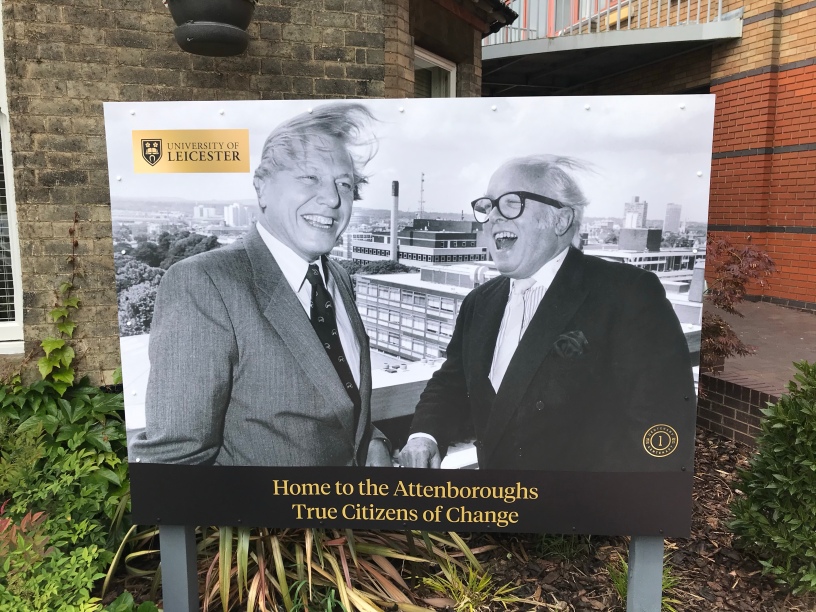
The image is of those famous sons of Leicester, David and Richard Attenborough, pictured at the University of Leicester.
Leicester’s traditional industry was hosiery with its origin in hand knitters who would work from their own homes in the city and around the county engaging the whole family in their enterprise. In this they were similar to the spinners and weavers of wool in and cotton in Lancashire.
Knitted hose began to take the place of stockings made from cloth in the Elizabethan age; Shakespeare makes reference to stockings in Henry IV (pt2, act 2, scene 2). The principal place of the trade was London close to those members of the population best able to afford that more expensive knitted product. Slowly, the hand knitted stocking gave way to the stocking knitted on a frame. In what were known as the Home Counties, framework knitters were to be found in Buckinghamshire and Surrey. Further north, into the Midlands, framework knitters began to appear in Leicester, Nottingham and Derby.
In Henson’s History of the Framework Knitters, it is suggested that by the mid-eighteenth century, a move had taken place towards the midland towns with the number of frames in Leicester exceeding those in London. It is suggested that wage costs were the significant driver and further moves would have taken place but for the demands of fashion. For the elegant in London it was essential that stockings should be a perfect colour match, something achievable only with the cloth and hosiery trades side by side. Frames were used to knit hosiery from wool, cotton and silk, with the latter producing the finest garments. By the mid nineteenth century, Nottingham had outgrown Leicester and Derby was fast catching up.
Leicester suffered from stiff competition from America where a degree of mechanisation had been introduced. We can see mechanisation seeping into the Leicester industry a little later than its northern counterparts essentially because of the greater complexity of knitting a stocking. When it came, it was from over the Atlantic where Americans had found solutions. In terms of local industry, Siobham Begley, in her book The Story of Leicester, writes how the Loughborough firm of Paget introduced power-run frames, Leicester’s Matthew Townsend invented the latch needle and Loughborough man, William Cotton, built on these developments with his Cotton Patent machine. Slowly machines were introduced and frame workers began to work in groups in a workshop setting. Pay for frame workers was bad until Corah built their factory at St Margaret’s, where, it was said, rates were 25% higher. Further impetus to the factory system came with the Education Acts where child labour was restricted and so home working became less economically viable.
The introduction in 1849 of circular sock knitting machines from America enabled the production of socks on a single simple to operate machine
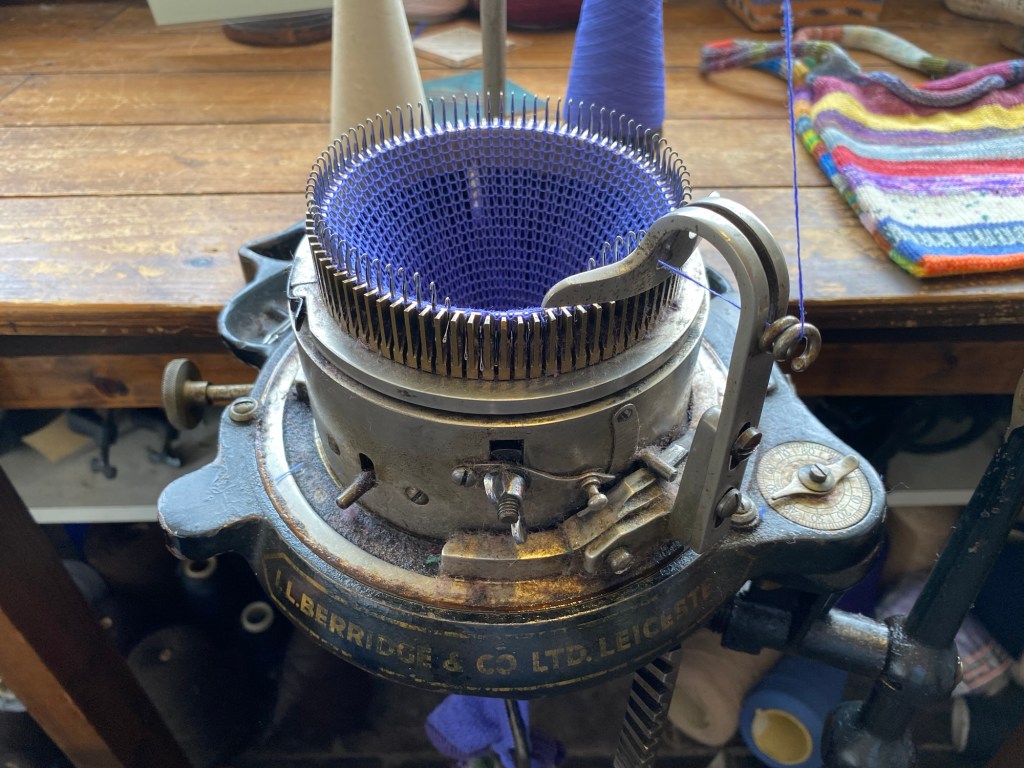
The machines made under licence by Berridge of Leicester were invented by Griswold. Socks were produced in very large numbers for the troops fighting in the trenches in the First World War.
Following on from hosiery came shoe making, especially for children’s shoes. This trade had prospered in nearby Northampton where it concentrated on men’s boots. Employment in Leicester’s shoe industry gradually grew and eventually overtook that in Northampton. As with hosiery, mechanisation crept in. Begley singles out Thomas Crick in Leicester making a breakthrough by riveting soles to shoes instead of stitching them. He went on to produce a machine which was later steam powered. Factory based production followed, boosted by the move of Leeds based Stead and Simpson to Leicester using an American invention, the Blake sewer, which could produce three hundred pairs of shoes a day. Leicester held on to the tradition of outworking, long embraced in hosiery, until the push of mechanisation from American essentially forced the move to factory working by the end of the nineteenth century.
In the mid nineteenth century ancillary businesses began to appear producing gussets and elastic web. More significantly, engineering businesses emerged with a focus on machinery for hosiery and shoe manufacture. Richard Rodger, in Leicester A Modern History, writes of some 7,000 male engineering workers in 1900. He lists some of the companies. Pegg’s dyeworks equipment, Phoenix Foundry for heavy casting for railways, Gimson’s Vulcan foundry on Welford Road, Gent’s clocks, Taylor & Hobson lenses and optical equipment, Pearson & Bennion boot and shoes machinery which became part of the British United Boot and Shoe Company, Wolsey Hopkins, Bentley Engineering and Mellor Bromley machines. Bentleys produced their own sock knitting machine, the Komet, in 1930 and some 100,000 of these were sold up until 1982. It is fair to assume that these engineering skills encouraged Imperial Typewriters to set up in Leicester. Machine tool manufacturers Jones & Shipman set up in Leicester as did Wadkin which specialised in wood working tools. The power for these industries came from coal either directly or through electricity generation. The result was a smoke filled atmosphere made worse by coal used for domestic heating.
Picking up on the name Gimson, there are some intriguing connections. The Gimson company built the massive pump engines to address the problem of the city’s sewerage. The engines can be seen in the city’s Abbey Pumping Station. Josiah Grimston provided much of the cost of the Secular Hall. He also commissioned the building of a delightful arts & crafts cottage at Stoneywell.
Later additions to the Leicester manufacturing scene include Thorn Lighting. This factory on Melton Road was occupied by AEI in 1946. It had previously been a shadow factory during the war. AEI became part of GEC which placed its lamp businesses into a joint venture with Thorn of which Thorn eventually took control. The building was demolished and the site is now a Sainsbury supermarket.
The city is also famous for Walkers Crisps and Foxes Glacier Mints.
I tell in Vehicles to Vaccines how the British commitment to excellence in textiles is evidenced by the presence of colleges devoted to teaching skills to those employed in the industry. One such was the School of Textiles in Leicester which celebrated its centenary in 1983-84 with the publication of a short history. The focus was on knitting, and the founding of the college was initiated by yarn merchants witnessing the quality of continental competitors which benefitted from formal technical education. In the second half of the twentieth century the focus moved to artificial fibres, machinery capable of producing whole garments, and textile and knitwear design. Textile manufacturing continues in Leicester albeit in reduced volumes given to move to sourcing from low wage economies.
The then village of Whetstone, six miles to the south of Leicester, became home to Power Jets which built the jet engine conceived and designed by Sir Frank Whittle. I write of this in How Britain Shaped the Manufacturing World. The factory was subsequently part of English Electric and is now occupied by Babcock.
GEC had a major presence in the city with GEC-Elliott Automation process, marine and telemetering systems and GEC Turbines and Nuclear equipment.
Further reading:
Gravenor Henson, Civil, Political and Mechanical History of the Framework Knitters in Europe and America (Nottingham: Richard Sutton, 1831, reprinted 1970)
Siobhan Begley, The Story of Leicester (Brimscombe: The History Press, 2013), p.122.
Richard Rodger and Rebecca Madgin Ed’s. Leicester a Modern History (Lancaster: Carnegie Publishing, 2016)
You can read more in my books How Britain Shaped the Manufacturing World and Vehicles to Vaccines
 British Manufacturing History