
“Out of this war will come great good. It has blown the cobwebs out of us and has given us a much needed spring cleaning. To my mind the broom has not yet swept clean enough. It has only started. Its handle has to be much, MUCH longer. People do not yet perhaps, realise how clean it must still sweep. We are a great people. But we are still a little slow to change.”Sir William Rootes in an interview with Scope magazine in September 1944.
The Britain that woke on the morning of 15 August 1945 was exhausted from six years of total war. Every sinew of manufacturing industry had been strained to the limit in aid of the war effort. Now came the massive task of rebuilding, hardly a conducive atmosphere for the country which had shaped so much of the manufacturing world. Yet, in spite of all the hardship that the British people would face over the coming few years, manufacturing industry and government were up for the challenge.
The Attlee government, which came to power just over a month before the war ended, had, in its manifesto, declared that ‘only if public ownership replaces private monopoly can industry become efficient’. It inherited a good deal of government control of the economy and was determined to use it to restore the country to prosperity. It didn’t start well, for on 24 August 1945, President Truman announced that Britain’s lend-lease arrangements with the United States would come to an end immediately. From then on, Britain would have to pay dollars for its imports.
The targets for nationalisation were Cable & Wireless, the Bank of England and the Railways and Road Haulage; Coal, Gas and Electricity; Iron and Steel, but not shipbuilding. It represented a massive task, but one that was not to be from a standing start. There had been a good deal of governmental control during the war and in the interwar years attempts had been made to rationalise railways and the coal mines.
Another target for nationalisation was Power Jets Ltd, the company formed to exploit the jet engine. The management at Ruston & Hornsby was keen to keep at the forefront of technology and saw, in the jet engine, huge potential aside from aviation. Managing Director, Victor Bone, asked Chief Engineer, Oswald Wans, to investigate the potential for gas turbines using jet technology. Wans’s report was presented to the board and two Ruston engineers were sent to Power Jets to learn more. A gas turbine division was set up under Bone’s son and work was started on a prototype for a 750kw gas turbine. There were inevitable teething troubles, but an engine was ready for the Olympia exhibition in 1953. The company had planned a bit of theatre by rigging up the engine with an electrical generator. A strike by London Electricity Board employees made the theatre all too real, as the Ruston Gas Turbine powered the lighting for the whole of Olympia. Rustons would go on to develop gas turbine technology and I write about this in Vehicles to Vaccines.
The armament factories did not fall silent as they had in the 1920s; the Labour government was committed to a really quite large Army, Navy and Airforce. A core of Royal Ordnance Factories were kept open and, some which had closed, reopened in 1951 in response to the Korean war. Following the war, a British military presence was maintained in Germany (The British Army of the Rhine), in the Middle East and Asia. In addition, NATO was formed in 1949 with Britain as a key participant. All this needed supplying and the many factories which had supplied so well during the war maintained their production. Possibly the most iconic product was the Centurion Tank, which had been designed during the war, but only entered service shortly after. It was still in service some fifty eight years later in Iraq. It was manufactured by the Royal Ordnance Factories, Vickers and Morris.
I write of shipbuilding and the aircraft industry
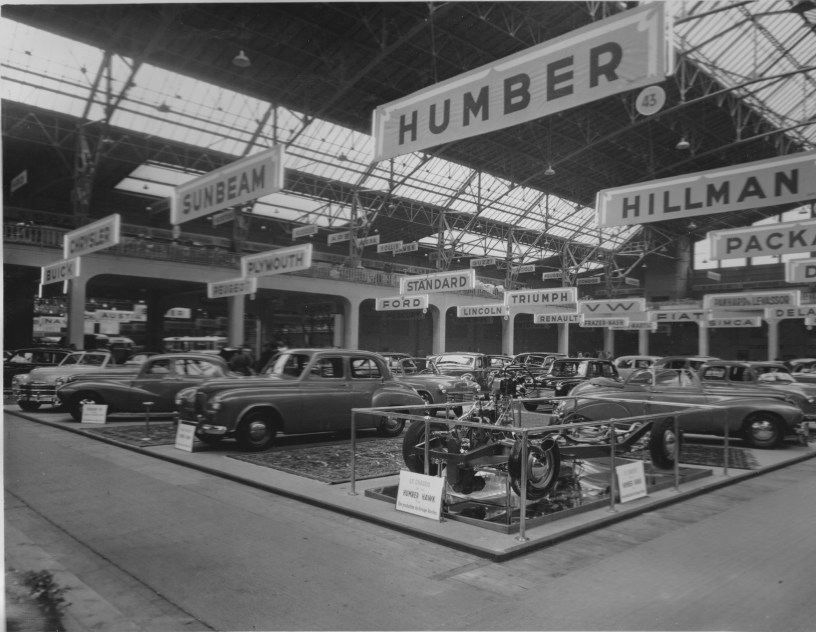
Turning now to the motor industry, in his seminal book, The Car Makers, Graham Turner wrote, ‘when the [second world] war ended, the motor manufacturing industry stood helpless before an unparalleled situation: there was a raging demand for cars in a world where there were few cars to be had.’ Turner gives the figure for total production of cars in 1943 as 1,649. However, the motor industry had been massively busy during the war with all manner of armaments and had both workforce and factories ready to make for the civilian market. But that was not what happened; the government had other priorities and engaged the motor industry as possibly the key element in its drive for exports.
The toy industry that emerged from the war, in a sense, had all the benefits and none of the disadvantages of its full-size counterparts. Germany and Japan were prevented from supplying toys leaving the UK industry, which was already strong, free to supply a market that would grow steadily for the next twenty years. Toy shops began to fill up towards the end of the forties. Frank Hornby, who had launched his 12 volt DC Hornby Dublo in 1938, in the post war period watched as it gained popularity. Hornby continued also to manufacture Meccano and Dinky toys. The post was boom encouraged new entrants but few survived, a notable exception being Lesney. Rodney and Leslie Smith set up in a disused pub to manufacture small diecast toys sold in matchboxes. Rosebud was manufacturing some ten million dolls a year, many for export. Export was very much the watch word and thanks particularly to core players like Lines Brothers, by the late fifties, Britain was the largest exporter of toys in the world.
I then write of the electrical manufacturers, chemicals and pharmaceuticals.
On financing industry, the Labour government adopted a key recommendation from the 1931 Macmillan committee had which looked at the difficulties businesses faced in raising capital. In particular, Macmillan recognised a gap, which came to be known as the Macmillan Gap, of up to £200,000 where raising money was particularly difficult. The Macmillan committee’s report had followed the formation of Bankers Industrial Development Company by the Bank of England to provide finance for basic industries such as iron and steel. The Attlee government created the Finance Corporation for Industry, chaired by Sir Ronald Weeks, to provide larger investments again mainly for steel but also oil. For the Macmillan Gap, ICFC (The Industrial and Commercial Finance Corporation) was formed under the chairmanship of Lord Piercy to provide finance for small and medium sized companies seeking funds in the range £5,000 to £200,000. In the 1950s, ICFC set up offices around Britain with teams who got to know their business communities and who provided vital support to growing businesses. ICFC joined with FCI to become FFI in 1973 and later became 3i and still works with independent businesses. The ethos of ICFC from the beginning was that the investor needs to know well the business in which he invests, but also to understand the industry and markets. Investments were intended to be long term.
You can read more in How Britain Shaped the Manufacturing World and explore the period since 1951 in Vehicles to Vaccines.
 British Manufacturing History