
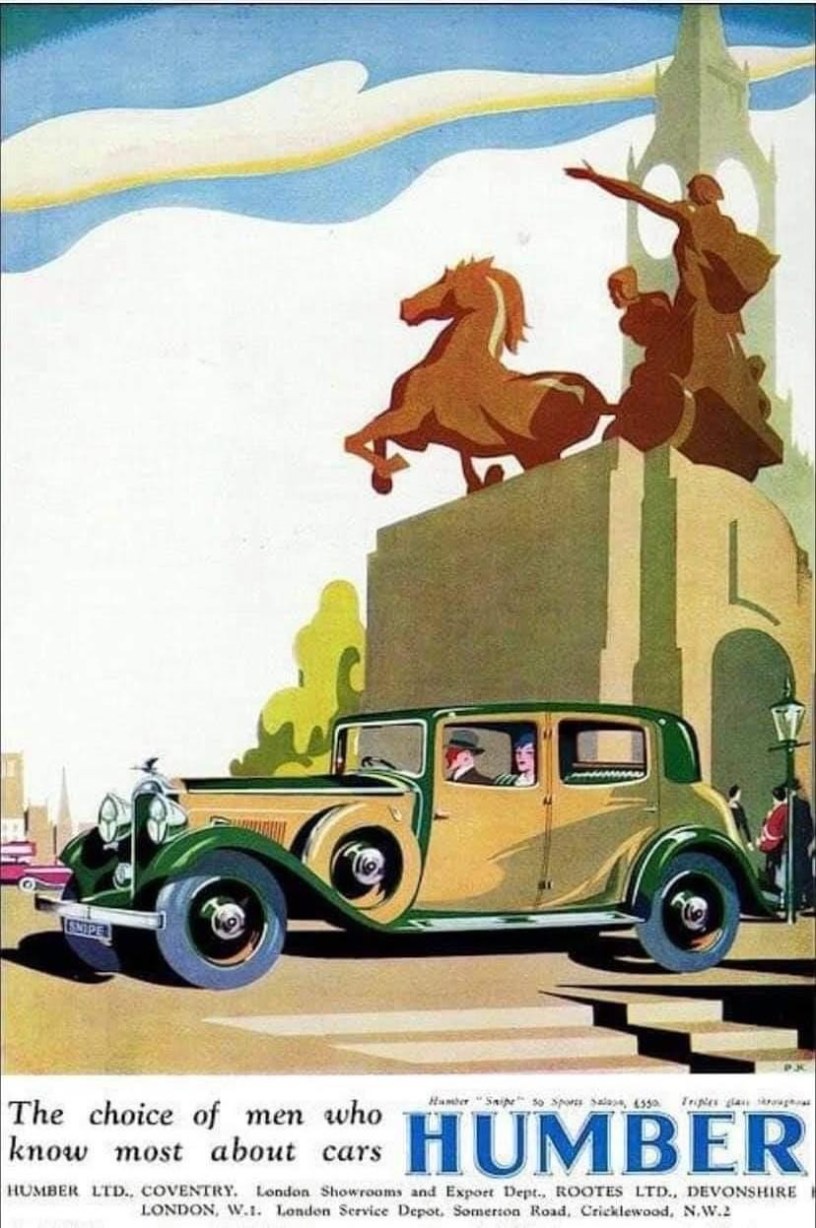
‘Nothing about it could be bettered. everything opens and closes like the case of a good watch. The fit of the bonnet sides is a positive sermon. There is nothing to pinch or scratch even the most careless of inquisitors. Yes, a Humber job throughout, amply powered, elaborately equipped and most nicely finished. £645 certainly, which is a lot of money nowadays, but when Humber Ltd have to fight for business on the basis of price only, Heaven help all that is best the British motor business.’ Edgar Duffield writing of the 1926 15/40.
This observation about Humber cars, to me, points to a correction of the course that the industrial revolution had been taking in Britain. The early days, with textiles, were all about producing large quantities at low prices. My suspicion is that the experience of precision manufacturing in the Great War had given British engineers renewed confidence that they could produce the best the world had to offer. They may not have the education systems of France or Germany, or the market for mass production that the USA had, but they had supreme skills. The quote is about Humber, but it could just as well have been made about Rolls-Royce, Bentley, Napier or Rover. Equally it could have been made about British ships which were finished to astonishingly high standards. The problem was that the world had moved on, leaving British behind. As we have seen, the first decade of the interwar years is a story of struggle, although, early on, the signs were promising; it was also a time of sowing seeds for what was to come.
It would be wrong to split the period between the two world wars cleanly between the old staple industries and those new and perhaps more exciting. Coal would remain the main source of power, but much else beside. I write about the creation of the national grid, the power for which came principally from coal. I write too about the chemical industry which also looked to the by-products of coal. Its link to precision manufacturing could be found in the cavernous railway company workshops around the land. I write about the growth of the motor industry below, but it would be wholly misleading to overlook the steam railway engine. The name, Sir Nigel Gresley, adorns British Railways locomotive number 60007. Nigel Gresley was one of the later railway engineers. He was born in 1876 and educated at Marlborough before taking up an apprenticeship at the Crewe Railway works. He worked his way up to becoming the Chief Mechanical Engineer of the London and North Eastern Railway who works at Doncaster built both the Flying Scotsman and the Mallard. The Flying Scotsman was the first steam passenger locomotive to travel at over one hundred miles per hour and the Mallard holds the record of one hundred and thirteen miles on hour for the fastest steam locomotive in the world. This was engineering of the highest order.
Turning the focus to electricity, the large generator and cable companies would play fundamental roles in the setting up of the Central Electricity Generating Board in 1926 and the construction of the National Grid. In the aftermath of the First World War, there were many private generation companies providing electricity to their local consumers at a variety of voltages and a few DC, rather than the majority on AC. Rationalisation was vital and took place with remarkable energy, and people witnessed the ‘march of the pylons’ as electricity was brought to very nearly all parts of the British Isles. John Stephenson in his book, British Society 1914-1945, offers some figures: in 1920 there had been 730,000 electricity consumers in Britain, by the end of the thirties there were almost nine million. Key for industry was that it could set up anywhere, not just near to sources of power.
GEC had prospered during the First World War and was ready to supply a nation hungry for innovation with some of what they craved. It now owned Osram and so could supply electric light. It added to this electric cleaners and cookers and much bigger industrial cooking appliances. In 1918 it had bought the heavy engineering company, Fraser & Chalmers and so was prepared to play its full part in the National Grid project. GEC had travelled a long way since its formation and its immediate post-war activity built on its wartime production. In 1920 the company produced a collage of images of its many factories. These included the Conduit Works; the Carbon Works; the Switchgear Works; the Engineering Works, all at Witton; the Turbine Works, Erith; the Cable Works, Southampton; the Meter Works, Birmingham; the Accessories Works, Southwark; the Telephone Works, Manchester; the Instrument Works, Salford; the Art Metal Works, Birmingham; the Magneto Works, Coventry; the Glass Works, Lemington-on-Tyne; the Robertson Lamp Works, Hammersmith and the Osram-GEC Lamp Works, Hammersmith. In 1923 it set up a research centre in Wembley.
These are just brief extracts from the chapter. I go on to write about the other electrical engineers, radio makers, the motor companies, chemicals and pharmceuticals. These were exciting times (if you were in work)
You can read more in How Britain Shaped the Manufacturing World. There is also an essay I wrote looking at which places did well in the interwar years.
 British Manufacturing History