
I include here extracts from my chapter on manufacturing for the Great War.
‘It is safe to say that no English city was so completely absorbed in munitions production as Coventry…It was not merely a question of adaptability of existing facilities. New factories sprang up in such numbers and on such a scale as to change the whole face of the city in the matter of a few months. New suburbs grew up like mushrooms, thousands of strangers of both sexes flocked to Coventry from all parts of England in answer to the call for munitions.’ From The Official Handbook of the City of Coventry written shortly after the end of the war. Whilst, in no way wishing to detract from Coventry’s proud boast, it is probably true to say that the whole of the country would eventually flex its muscles in support of the war effort. Perhaps British manufacturing’s time had come.
In looking at the shipbuilding areas, we should not forget that companies like Vickers, Armstrong, Beardmore and the Coventry Ordnance Works were also making a great many guns for the army. Scott writes, both ‘ Vickers and Armstrongs were gun-makers before they were battleship builders. Whatever may have been the official Admiralty doctrine, a battleship was to them only a means of bringing guns into range, just as her armour was a means of protecting guns and gunners.’ Crucially, both companies built fifteen inch guns which outclassed the enemy. Vickers built submarines, many heavily armed; Armstrong was the bigger supplier of guns. Their roles were crucial. Nothing though would have been possible without the production of a great deal of steel, and GKN in South Wales was one of the many producers. These were busy places
Any discussion of British manufacturing and the First World War would be incomplete without the story of the tank. I pondered where to place it in this chapter and decided upon shipbuilding, for it was the Admiralty, rather than the War Office, which championed its development. I, and indeed many others, have written extensively about the tank, so I shall focus here on how its fits within the wider manufacturing story. It begins, I’m pretty sure, in the Lincolnshire town of Grantham. That is of course far from strictly true, since the idea of a military vehicle to carry and protect its occupants is centuries old; the imperative came from the muddy bloody fields of Flanders where infantry men were being mowed down in their thousands by machine guns. There were many technical issues to wrestle with, but first and foremost that of just how to navigate muddy land with a heavy vehicle. Hornsby in Grantham manufactured and supplied farm machinery: steam tractors, steam threshers and such like. The problem was that all too often they would get stuck in the mud. The solution conceived by Hornsby was the track, on which the wheels would run, the track being continuously laid and re-laid. In 1908, Hornsby produced a 70 hp. vehicle that ran on chain tracks, and it was demonstrated at the Royal Review showing how well it could cross soft muddy ground; the Prince of Wales was said to have been impressed. This counted for nothing, since the Generals did not share his view and declined to take the vehicle any further.
We have to cross the Atlantic to for the next part of the story, since Lincolnshire farmers were possibly too stuck in their ways to see the advantages of tracked vehicles. Not so the Americans and their machinery supplier, Holt. It seems that many engineers in many countries were searching for the truly functional track mechanism. Holt had developed a tracked vehicle and, when this was demonstrated on Thanksgiving Day in 1904, an artist observed that it moved just like a Caterpillar. Holt filed a patent with the name Caterpillar and the rest, as they say, is history. Holt still was not satisfied and travelled to England to look at a good number of patents and the one he chose was Hornsby’s. Hornsby granted a licence to Holt for the exploitation of their patent in the USA and Canada. Hornsby didn’t stop there, but developed their caterpillar track in conjunction with the Lincoln engineer, William Foster, and together made a huge steam powered tracked vehicle for use in the extreme cold of Dawson City. With the coming of war, Hornsby concentrated on oil and gas engines and left all ideas of the tank to others.
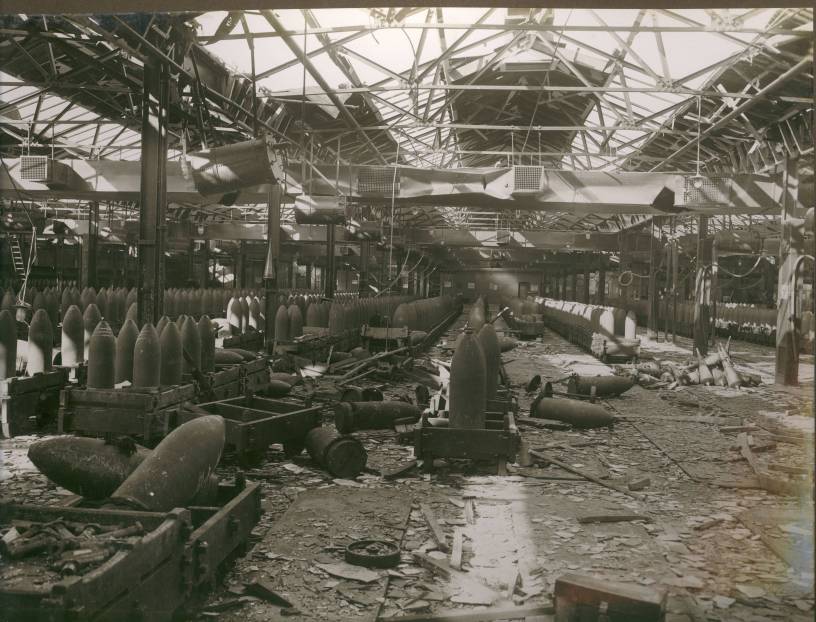
A key aspect of the work of the Ministry of Munitions was the manufacture of ammunition, and a key part of the process was the manufacture of nitrates needed for explosives. In my earlier research, I focused on shell filling because my grandfather had worked as a supervisor in the massive shell filling factory at Chilwell. I had read about Viscount Chetwynd (the founder of Chilwell) and how he had researched various methods of filling shells. In particular he explored the percentage mix of the constituent parts (Ammonium Nitrate (Amatol) and TNT). His research led him to Northwich and the Ammonium Nitrate factory of Brunner Mond. The Chilwell factory suffered a devastating explosion the result of which is show in the image. A great many lives were lost.
I then write on the controlled establishments, the development of aircraft manufacturing and the role of the motor companies.
You can read more in How Britain Shaped the Manufacturing World.
 British Manufacturing History