
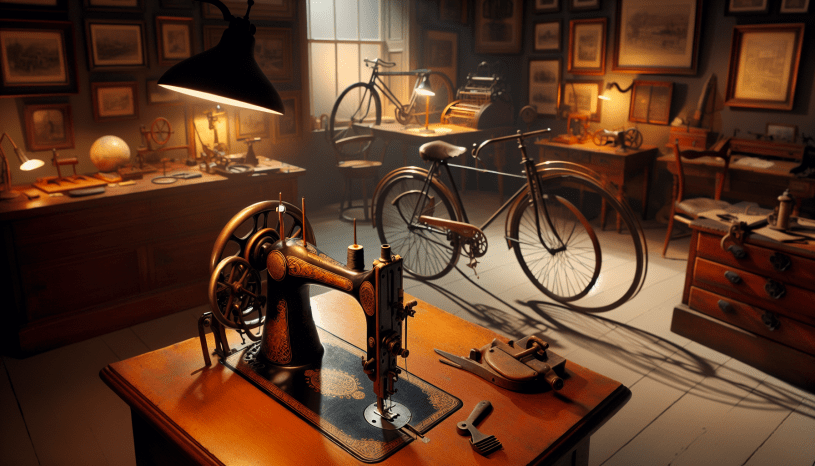
Things mechanical had been made by skilled and inventive people for centuries. The clock and watch are perhaps the most visible, but there were also many tools used in the workshops of Birmingham, for example, which meant that in Britain there were skilled ‘mechanics’ a plenty. The story of British clockmaking is told in a lovely short book by Kenneth Ullyet, British Clocks and Clockmakers. It is a story of craftsmen, taking an idea which came from Italy and developing it in a very British way. He tells of the City Livery Company of Clockmakers, aimed at keeping foreign craftsmen at bay, but also of the famous clockmakers, not least Harrison and his chronometer which mastered the calculation of Longitude. Whilst Britain had many skills, it didn’t have a watch or clock manufacturing industry of any magnitude. The same was true of the sewing machine. As I shall show, it was in the bicycle that British manufacturing once again came to the fore.
In Class 6 of the Great Exhibition catalogue, I came across an entry for C.T. Judkins of Manchester who was displaying a sewing machine capable of sewing five hundred stiches per minute. The relevance of such a machine shouts loud and clear when we look back at the 1851 census and the ‘third of a million milliners, dressmakers and seamstresses’. A sewing machine would have transformed their lives, but also massively have increased capacity for making clothes. The story is of course not that simple. We have seen with iron production that many failures come before, eventually, someone succeeds. This is very much the case with the sewing machine. Alex Askaroff has written a number of books on the subject and in his Brief History quotes one of the sewing machine pioneers with the words with which I began this chapter.
Turning now to the bicycle:
Hillman and Herbert was a company that caught my eye, and I went to the Hillman owners website where they set out the history. ‘During the 1860s Josiah Turner and James Starley formed the Coventry Sewing Machine Company and recruited skilled engineers from the London area to join them, one of these was named William Hillman’. William Hillman had been born in Lewisham in South London and had worked with the marine engine builder John Penn before his move to Coventry. Another engineer, who joined the Coventry Sewing Machine Company having worked for Penn, was George Singer. Many years later, Singer Motors would also become part of the Rootes Group. George and Isaac Singer were not related!
William Hillman had become friends with William Herbert, who was working as an engineer in nearby Leicester. In 1875, Hillman invented a roller skate and, through Herbert’s good offices, sold it successfully to the Leicester skating rink. Herbert was the brother of the machine tool maker, Alfred Herbert. Hillman and William Herbert decided, from this experience, that they had complimentary skills and the set up the Premier Works in Coventry. This business manufactured sewing machines and soon, using Hillman’s skills both as a cyclist and an engineering, produced both a Premier Bicycle and a Tricycle. They were both great successes and sold in good numbers. A few years later, they brought out the Kangaroo Bicycle which was the first, or one of the first, safety cycles with a chain drive. A.E. Harrison suggests that the first safety cycle was produced by John Kemp Starley, the son of Hillman’s former employer, trading as Starley & Sutton; Manners supports him in this, adding that the cycle was named the Rover. It was later improved by Woodhead, Angois and Ellis of Nottingham, which would later become the world famous Raleigh Company.
As before, these are extracts from my book How Britain Shaped the Manufacturing World.
 British Manufacturing History