
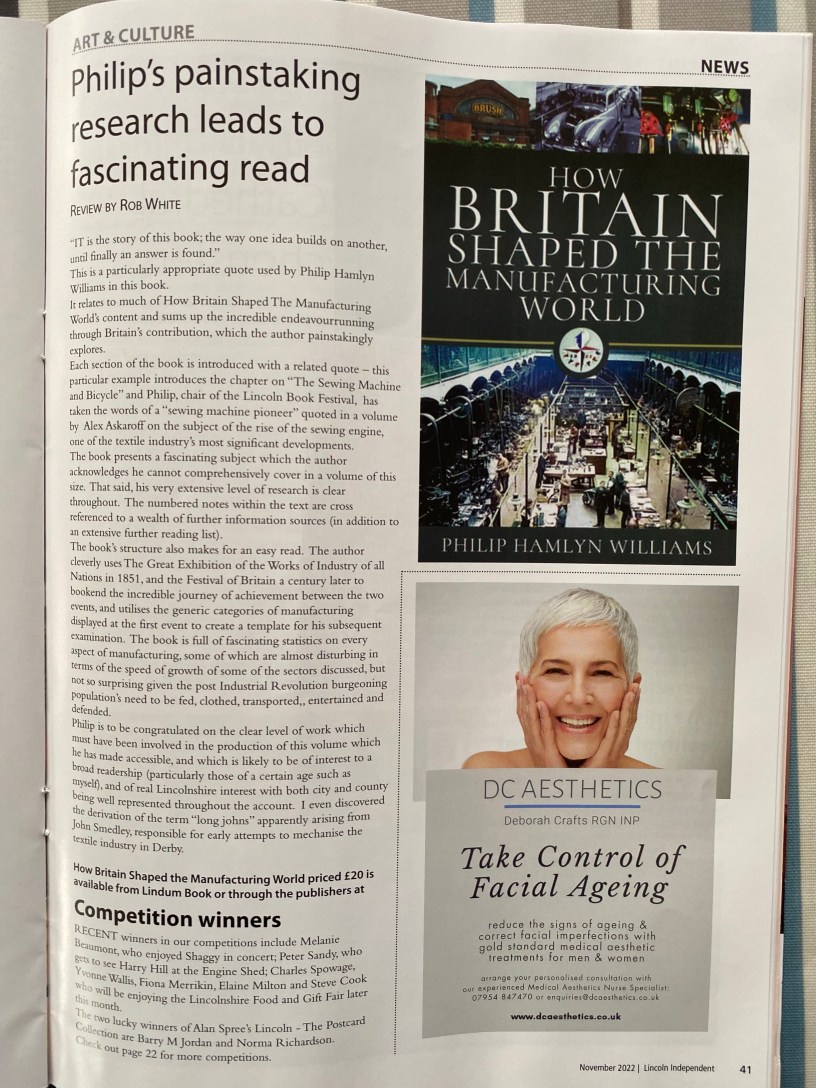
…if you are interested in facts about some of the lesser-known names in British manufacturing, this might be the book for you.
Jenni Hyde – The Historian Magazine.
A clever idea to bookend the story of British manufacturing between the 1951 Great Exhibition and 1951 Festival of Britain. Based on extensive research and linking a whole plethora of British industries, this makes fascinating connections between the various drivers of the British manufacturing industry in the period.
Andrew Lownie – author and literary agent
I wanted to read How Britain Shaped the Manufacturing World by Philip Hamlyn Williams because I studied economic history last year and I liked the subject a lot. On top of that the author’s great grandfather exhibited at the Great Exhibition of 1851. That made the book too enticing to miss and I’m glad I didn’t because it’s great.
The book covers the period from 1850 to 1950, the last chapter being on the Festival of Britain of 1951. It’s a wonderfully circular structure, to start with the Great Exhibition and finish with the Festival of Britain. With wars, including both world wars, and disruption to supply chains, advances in technology, changes in manufacturing, this book had to cover a lot of information and it does it beautifully. It’s easy to read, explained clearly and engaging.
Many topics are covered, from steam power which was still in its infancy in the 1850s to the Mallard of the 1930s, covered developments in communication, the sewing machine, bicycles, cars and aeroplanes. He covers the chemical and pharmaceutical industries, which were interesting to read about. Germany had a leading role when it came to dyestuff, but the war changed that, of course.
This is a very good book, one I would recommend to anyone, without any doubt
What a really fascinating book that looks at the manufacturing world from the 1850’s through to the 1950’s. Piggybacking on the industrial revolution that saw Britain expand and grow greatly, saw the expansion of the manufacturing industries such as Coal, Metals, Textiles, Glass, Electrical and so on. It was really interesting and reading about some big companies and industries and how they started, some are now long gone but some are still around today.
This book begins from the Great Exhibition at Crystal Palace and continues for the next 100 years and covers the inter-war years too. There were some nice photographs to accompany the text which I probably would have liked to have seen more of. But overall, this has been an interesting read and I would recommend it to others if you enjoy this period of history.
The History Fella
This is a brilliant book. I am reading it and find it both very enlightening and absolutely full of information. Recommend it!
Neil Main – Managing Director Micrometric Ltd
The subject is fascinating; covering the period between the Great Exhibition and the Festival of Britain would seem to be an impossible task, but you have done it very well indeed. There are some great photographs.
Richard Pullen – author of The Landships of Lincoln
Rating: 5 out of 5 stars
Fascinating book.
Well written and brings life the amazing work many people did within manufacturing.
I never knew Britain had such a wide history.
Karen Bull – NetGalley
When Phil asked me to write the forward to his book, I was not prepared for the scale, scope, detail and insights I would gain through this magnificent body of work.
Phil covers the changing industrial and manufacturing landscape between the two great exhibitions of 1851 and 1951, the latter being the year I was born.
Household names, emerge, merge and disappear as the reader is taken on a wonderful journey from our seafaring and exploring past, through a depression and two world wars to the wonderful exhibition of 1951 which displayed the strength and depth of our industrial capability.
Paul Barron CBE DSc from the foreword he wrote for the book.
 British Manufacturing History