
When cotton cloth began to be imported, it started a clothing revolution, but really much more. Cotton would have so many uses, ‘from bandages and belting for machinery, and sheets and pillowslips, to exquisite ballgowns’. It had only been available for the rich, until ‘the first chintzes were unloaded from the East India Company ships in the early seventeenth century’. For the rich, it added variety to the wardrobe; for the poor, it meant clothing that could be washed. The importing of finished cloth was followed by the bringing into the country of raw cotton which would be spun and woven here. The port of entry was, certainly to begin with, London, but this was followed by imports into the other major ports: Bristol and Liverpool, and the spinning and weaving took place nearby. Liverpool, with its hinterland of Lancashire, would soon rise to prominence because Lancashire’s damp climate was particular suited to cotton and its rivers could provide power from water wheels as processes became more mechanised. That, though, was for the future, for none of this would have happened had there not been in these islands a long tradition of spinning and weaving, and, of course, this began with wool.
The spinning and weaving of wool had been an industry in most parts of our island for longer than modern English had been spoken. In the Middle Ages, the best sheep were said to be those in these islands, but the best weavers were Flemish, and so fleeces were exported in vast quantities, so vast that they became an easy target for taxation. This encouraged the growth of local spinners and weavers, aided by an influx of Flemish wool workers fleeing persecution.
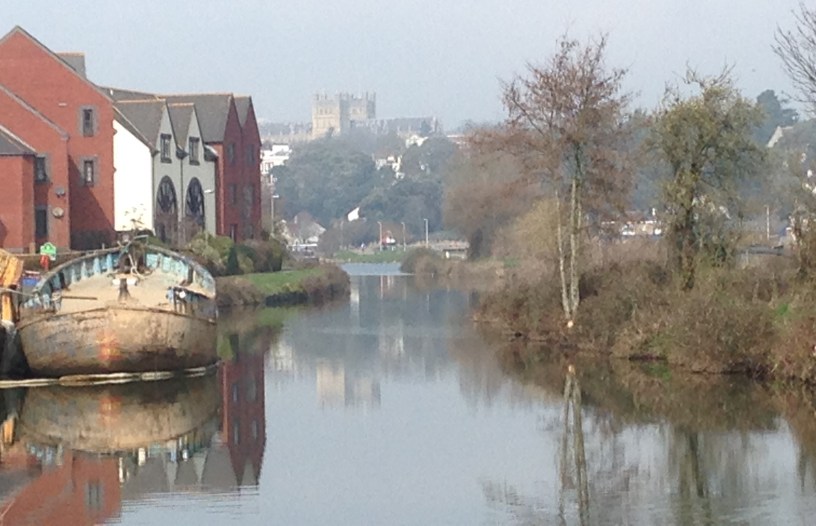
As a result, wool cloth markets developed around the country, in Norwich, Bristol, Gloucester and Kendal. More importantly, this country gained a great many skilled spinners and weavers. As was the case with many trades in the Middle Ages, tradespeople gathered together in guilds for mutual support and to protect their interests. In the case of wool, these were found in towns such as Exeter (as in the image), Honiton, Norwich and Beverley, and, by the sixteenth century, they became an obstacle to growth. The response was for the trade to establish itself in the West Riding of Yorkshire which had no such controlling bodies and where wool families could prosper. The importance of the wool trade to the economy was underlined in 1614 by an Act of James I which prohibited the export of raw wool. For the next two centuries all wool ‘clipped in England was processed in England too’.
The skills in spinning and weaving wool and also flax were equally applicable to cotton, which had been spun and woven for an equivalent number of centuries in the countries where the cotton plant thrives. High on this list was India, in the seventeenth century, well under the cosh of the East India Company which was all too happy to make money from the export of wonderfully coloured Indian cotton to the fashionable British and European markets. Cotton fabrics, and indeed those from wool, were produced in many parts of India, in Bengal and the city of Cawnpore which would become known as the Manchester of India.
In time, British merchants saw a money making opportunity if, rather than importing finished goods, they could import raw cotton and manufacture it in Britain. So, alongside finished products, raw cotton began to be imported. The early sources were the Levant, essentially what we now know as Turkey, the West Indies and Brazil. These would soon extend to the southern states of America and India. This trade was not unopposed, for cotton textiles were stiff competition for the native wool and linen. The Calico Acts were introduced in 1721 to prohibit the import of printed fabrics, and this soon extended to a prohibition of the wearing of calico prints. Production thus shifted to heavier fustian fabrics, woven from a mix of cotton and wool or flax, used as outerwear for men. The repeal of the Calico Acts opened the flood gates for more and more cotton. Mary Rose, in her History of the Lancashire Cotton Industry, offers some figures for millions of pounds of raw cotton imports. In 1720-29 it was mere fourteen, by 1780 this had grown to forty-eight. The import of finished cotton goods by the East India company was banned in 1813. Imports of raw cotton increased to 934 millions of pounds by 1820 and by 1850 it would rise to 4,072.
These paragraphs are extracts from my book. In the chapter I go on to explore mechanisation in the textile industry and economic and social factors. You can read more in How Britain Shaped the Manufacturing World. I write about the British textile industry after 1951 in Vehicles to Vaccines. An interesting adjunct is the way the textile trade was financed and I will address this in a forthcoming post.
 British Manufacturing History