
I wrote about iron and coal, steel and steam in How Britain Shaped the Manufacturing World. The purpose of this post is explore briefly this history geographically since it was very much the presence of sources of energy and raw materials which dictated the location of these industries and the communities which gathered round them.
My starting point though is of the non-ferrous metals: copper, tin, zinc and lead, for their use was widespread from early times, indeed from the bronze age. Bronze articles have been discovered in England made from copper, most likely from north Wales (the Great Orme at Llandudno) and tin possibly from Cornwall. Cornish tin, and probably copper, mining was certainly going apace in the eighteenth century; the work of Newcomen and Boulton and Watt on steam powered pumps is evidence of the challenge of flooding but also the prospect of rich returns. Copper was also found in Alderley Edge in Cheshire and in South Wales; it is still mined on Anglesea. There are periodic resurgences of Cornish tin mining. Zinc was mined in the Medips and Bristol became a centre of zinc smelting. Zinc, and earlier on Calamine ore, combines with copper to make brass. It also has healing qualities and is used in the treatment of wounds. Lead mining was big business in Derbyshire and South Yorkshire and also in the northeast.
The mining of non-ferrous metals is now mainly overseas, but with the input from a number of British companies including RTZ, Johnson Matthey and Weir Group.
Aluminium had been first named by Sir Humphrey Davy, although he never succeeded in extracting the metal from alum (bauxite) Its production history in the UK dates back to the late nineteenth century when smelters were built in Scotland at Foyers and Kinlochleven powered by hydroelectricity. Production has now moved to Canada and the nordic countries. I write more on metals in Vehicles to Vaccines.
Coal was to be found close to the surface in northeast England, often on beaches, hence the full name sea-coal as opposed to char-coal. In time coal was discovered elsewhere, but Northumberland and Durham remained a major producer of coal and this industry triggered the development of coastal towns for the shipping of coal to the markets demanding it. We can think of Newcastle itself, but also Blyth, South Shields, Sunderland, Hartlepool and Middlesbrough. The Yorkshire coalfield was huge as were those of the East and West Midlands. The northwest from Cheshire up to Cumberland were major producers with towns like Wigan. South Wales and the Clyde provided vast quantities for iron and steel. There was a much smaller coalfield in southeast Kent.
The production of iron required ore and a source of energy for smelting, which originally was wood and then charcoal. Forested areas like the Weald and Forest of Dean but also the Furness peninsula in the northwest were perhaps typical of early iron making. The area around what is now Sheffield had for many years produced cutlery from a variation on iron which became known as steel. Iron works were often located near fast flowing water to power grinding mills but also, later, the air blast for furnaces a technique brought to the Weald by the French in the seventeenth century.
In the eighteenth century, Abraham Darby in Coalbrookdale in Shropshire kicked into play a revolution in iron making, having discovered the way of substituting coke for charcoal which was becoming scarce as the forests were felled.
The industry then spread into what became known as the Black Country around Wolverhampton and West Bromwich. There was an astonishingly rich seam of coal some ten yards thick with ironstone with a metallic content of 30% or more. Importantly, Henry Cort’s puddling furnace developed in Fareham enabled the production of malleable wrought iron. It was this that provided Wolverhampton, Dudley and Birmingham with the material they needed for their metal industries.
The link was cemented between coal and iron, and iron works began more and more to be located near to abundant coal for coking as well as iron ore. In time larger establishments emerged such as those around Merthyr Tydfill in South Wales and Carron near Falkirk in Scotland. The Furness peninsula was also exporting ore to Scotland for smelting as well as to nearby Workington.
The demand for iron led to production beginning in other places. The northeast had Gateshead on the Tyne with iron works, and the Cleveland Hills near Middlesbrough were found to have rich reserves which also supplied nearby Consett. Reserves of ore were discovered near to the Clyde and the Carron works joined in iron production there. Yorkshire ore was smelted at the furnaces built at Scunthorpe in Lincolnshire and in Sheffield.
South Wales and Monmouthshire were the largest pig iron making districts in Britain from 1820 to 1860. Swansea would become even more important for tin plate. Merthyr Tydfill would later be joined by Llanwern on the outskirts of Cardiff and works at Ebbw Vale. I write of these developments in Vehicles to Vaccines.
The Clyde was in close competition with South Wales and the Black Country having discovered hot blasting using rich black band ore and splint coal.
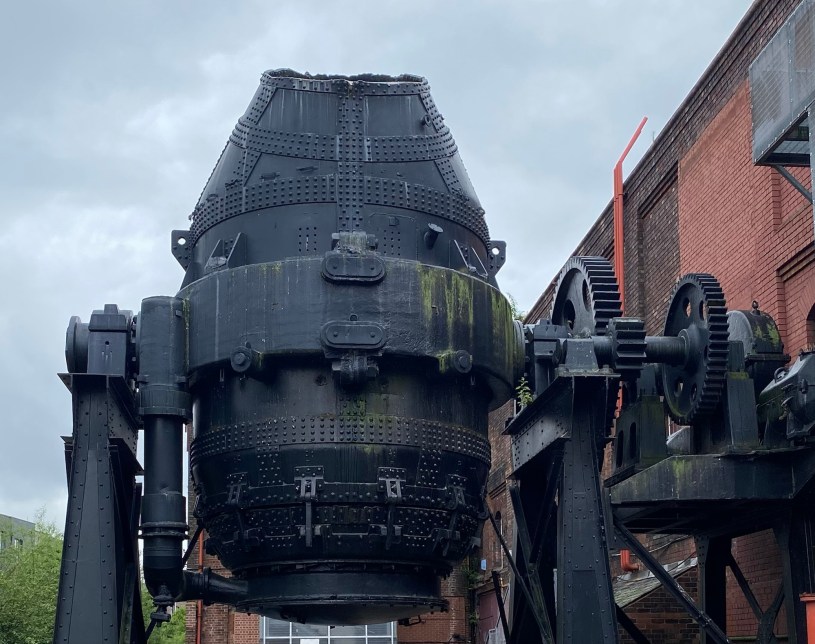
Henry Bessemer’s invention of a way to make steel in quantity was a game changer, closely followed by Siemens Martin open hearth furnaces and later by oxygen furnaces. Steel production centred on Sheffield but also Middlesbrough and spread to the other iron producing areas increasingly using imported ore. In the twentieth century, the iron ore of Northamptonshire was exploited at the Corby Ironworks.
Further reading:
- Osborne, Roger, Iron, Steam & Money, (London: The Bodley Head, 2013 Kindle edition
- Carr, J.C. and Taplin, W., History of the British Steel Industry (Oxford: Basil Blackwell, 1962)
- Vehicles to Vaccines and How Britain Shaped the Manufacturing World
 British Manufacturing History