
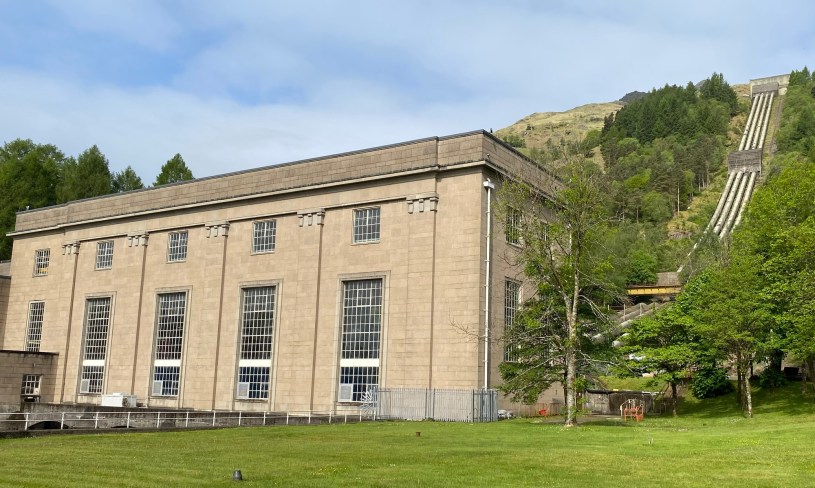
To many this area is synonymous with the Clyde and shipbuilding. Interestingly it was also where Singer set up their first UK sewing machine factory. The image is of hydroelectric power on Loch Lomond
Glasgow
It is said that one half of the world’s shipping was once built on the Clyde. Nearby Ardgowan had an industrial alcohol distillery run by the Distillers Company. There were and indeed are whisky distilleries in many places in Scotland. I write about how Distillers brought many of them together and diversified into industrial alcohol in Vehicles to Vaccines. You can read about Glasgow’s remarkable history by following this link.
Renfrew
The American Babcock & Wilcox boiler makers established in 1895. They built tanks and other armaments in both world wars. They provided the boiler for the Battersea power station and the ICI complex at Billingham.
Inverclyde and Greenock
Texas Instruments took over the National Semi Conductor plants which manufactured in Greenock from 1970 until 2014. IBM also had a major presence in Greenock since 1953.
Prestwick
Home to Scottish Aviation, a company dating from the thirties when Prestwick airport was bought for pilot training. During the Second World War, the USAF used the airport and Scottish Aviation provided maintenance. After the war the company repurposed surplus aircraft before going on to build their own military aircraft. The factory is now part of Spirit Aerosystems and, at the time of writing, possibly Airbus.
Motherwell
Colvilles at their Motherwell works were set to become a major steel producer. In the sixties, Colvilles Ltd at Ravenscraig had the largest hot strip steel mill in western Europe. It closed in 1992. Honeywell Controls set up here after the end of the Second World War.
Lanark
David Dale founded the New Lanark mill in the late eighteenth century using imported cotton and technology borrowed from the Lancashire cotton masters. Dale was committed to provided better working conditions and this was taken further by his son in law Robert Owen.
Irvine
New Town designated in 1966. Hosted a Royal Ordnance explosives factory in the Second World War. Beecham built a factory to manufacture antibiotics.
Coatbridge
A steel town now known for Tablet, the sugar bar made by Lees of Scotland.
Kilmarnock
W.B Dick and John Kerr formed a partnership in 1875 which became Dick Kerr later merged into English Electric and then GEC. The company Dick, Kerr & Co manufactured locomotives and some ships. In time it expanded into electrical engineering and competed for generation projects. It set up a subsidiary in 1898 in Preston
Cumnock
Home to Emergency One Fire Appliances
Cumbernauld
One of the new towns designated after the Second World War in 1955. Home to Smurfit Kappa packaging and Alexander Manufacturing, one of the last remaining luxury garment manufacturers in Scotland. Burroughs later Unisys was one of the first manufacturers to set up. Honeywell were in nearby Newhouse. AG Barr manufacture Irn Bru
Paisley
90% of the world’s cotton thread was made here including by Thomas Coats. The town also made imitation Cashmere shawls which bore its name. In nearby Linwood, the Rootes Group manufactured their Hillman Imp and in Inchinnan Dunlop produced tyres. Both of these investments came with the encouragement of government; neither succeeded. I offer some thoughts on government intervention in this blog.
Ardeer
The first dynamite factory was established here by Alfred Nobel, later part of ICI. I tell more of the story of Nobel and explosives in this link.
Fort William
The British Aluminium Company began production at Foyers and Kinlochleven in the late nineteenth century powered by hydroelectricity. Later Fort William hosted hydroelectricity and aluminium production.
Dumfries
Glaxo set up a primary manufacturing unit at nearby Annan. British Aluminium embarked upon a third major hydro-electric scheme in Lochaber, the first of three phases of which completed in 1924. In the late nineteenth century Britain had produced one third of the world’s total production, but other countries had caught up.
Girvan
Nestle manufacture milk chocolate crumb for incorporation into confectionary.
 British Manufacturing History