
Coal, iron ore, copper and tin were the raw materials that made Wales key to the British industrial revolution. Slate from North Wales covered many British roofs. Before all of this Wales was predominantly agricultural with an economy revolving around annual fairs and periodic local markets. Woollen cloth was woven from locally reared sheep in very much a cottage industry. There were big land owners but no great wealth.
There was a massive coal field bordered by Merthyr Tydfil in the north, Kidwelly in the west and Pontypool in the East reaching the coast in the south around Swansea bay and then heading inland eastward toward Caerphilly. Iron, copper and tin ore were also to be found. Landowners and occupiers would access coal and other minerals close to the surface essentially for their own use; there was simply not the transport to trade further afield. War changed this settled picture with increased demand particularly for iron. Technical developments were crucial: the blast furnace, Darby’s discovery of how coal could be used to smelt ore and Cort’s puddling method for wrought iron. In relation to coal, it was Newcomen and then Watt who enabled the sinking of ever deeper pits. The canals offered vital transport; the image is of the Pontcysyllte Aqueduct. A.H. John in his The Industrial Development of South Wales 1750-1850 highlights the remarkable fact that the capital to develop coal, tin and copper mining came from England as did the funding of most of the iron industry. One result of this was that the Welsh iron industry in particular was in much larger units that the contemporary businesses in industrial England.
Further reading: A.H. John, The Industrial Development of South Wales 1750-1850 (Cardiff: Merton Priory Press,1995, 1950)
Merthyr Tydfil
Once known as the Iron Capital of the World, Merthyr was home to the Dowlais Foundry and Engineering Company which made iron using the Northern Coal measures some twenty miles inland of Cardiff and Newport. It became part of GKN and I write about this in How Britain Shaped the Manufacturing World. In the nearby village of Hirwaun, Radio and Allied had a manufacturing base in a former Royal Ordnance Factory; this would be the start of Arnold Weinstock’s long relationship with GEC and I write of this in Vehicles to Vaccines. I write more on Merthyr in this link.
Ebbw Vale
Ebbw Vale Steelworks was at one time the largest in Europe. It had moved from using local ore for iron production to ore from Middlesbrough and Northampton to make steel, the local ore being unsuitable for steel making. In 1920, the steel works had employed 34,000 people but had then declined and closed in 1929. As a result of a government initiative, Richard Thomas & Co, the biggest tinplate manufacturer, took over the steel works and production of tinplate expanded not least for the growing canning industry. In the thirties it introduced a wide strip mill which revolutionised production. The production of 5,000 tons a week was used in the adjoining tinplate works but also to be galvanised and corrugated. It was at one time under the control of the Darby family and had fought Bessemer over patent rights.
Newport
At the mouth of the river Usk, Newport remains a general cargo port. It has one of the few remaining transporter bridges which crossed the river. Historically, it exported coal and tinplate. Richard Thomas and Baldwins of Spencer Works, Llanwern was set up to produce tinplate taking advantage of the proximity of the coast and hence the ease of imports. The Inmos semiconductor factory was built here and later became Newport Wafer Fab.
Cwmbran
A new town designated after the Second World War. Ferranti based their software development, naval and civil computer systems there. Lucas managed a shadow factory making aircraft turrets, and later Girling made shock absorbers. As a new town it provided home for some workers at the nearby Panteg steelworks.
Pontypool
British Nylon Spinners opened a factory in 1947 to produce nylon yarn. Pilkington Brothers had a glass works there.
Glascoed
BAE Systems’ former Royal Ordnance munitions factory is the major manufacturing employer.
Cardiff
The capital city of Wales. In 1891, the Dowlais Company set up steel making at East Moors to have better access to imported ore, its reserves at Merthyr Tydfill being unsuitable for steel making. The company had acquired suitable iron ore reserves at Bilbao in Spain. A Royal Ordnance engineering armaments factory was based here in the Second World War and produced 21,200 guns including 7,250 tank guns and 1875 anti-tank guns. Also in WW2, Plessey machined equipment for the RAF. Matsushita TV factory was set up in the sixties. Robert Bosch set up a factory in nearby Pontyclun Miskin Business Park but left in 2011 when the space was taken by Renishaw for Healthcare product manufacturing. Also in healthcare, Amersham International had a presence here. The Royal Mint is at Llantrisant.
Bridgend
Sony set up a TV factory here and eventuallu employed 2,500 people in Wales. I write in Vehicles to Vaccines about the encouragement government gave to Japanese manufacturers. Ford set up a motor factory here in 1980 and a supply chain gathered including machine tools makers, mostly SMEs.
Swansea
The home of tinplating and related steel production largely because of its status as a major commercial centre. You can read much more by following this link
Port Talbot
The Steel Company of Wales’s Abbey Works at Port Talbot was huge. It stemmed from the success of Siemens in steel making for tinplate at nearby Swansea. In 1831 William Llewellyn founded the Aberdulais tinplate works. The steel works now owned by Tata is in process of conversion to smelting with electric arc furnaces.
Llanelli
A centre for lead, copper (after 1804), and tinplate (after 1847). Llanelli also became a port for the anthracite coalfield. South Wales produced nearly all the anthracite mined in the UK. A large cold-reduction mill at Trostre, using steel strip from Port Talbot, made Llanelli again a centre of tinplate manufacture, primarily for packaging. The town also has a small steel fabrication industry. TNT was manufactured in the Second World War at the Royal Ordnance factory at Pembrey on the South Wales coast between Llanelly and Kidwelly. Covering five hundred acres of dunes, it was originally owned and run by Nobel before being taken over by the War Office in the First World War. Pembrey also had a shell filling factory. The Japanese Calsonic Kansei (Marelli) set up a car components plant.
Pembroke
For over a century of active service, the Royal Dockyard saw the construction of five Royal Yachts and 263 other Royal Naval vessels. The last ship built there was launched in April 1922. The Valero Oil refinery was established by Chevron in 1964 and taken over by Valero in 2011.
Milford Haven
In the late nineteenth and early twentieth centuries, the town was one of the main UK fishing ports employing some 4,000 people. The Suez crisis of the fifties led to the use of much larger oil tankers for which new terminals were required. Milford Haven fitted the bill and the Esso Oil Refinery opened in 1960 to be followed by BP in 1961, Regent (now Valero) in 1964, Gulf in 1968 and finally Elf in 1973.
Newtown
The wool industry had been significant in Wales since the time of the Cistercian monks in the twelfth century. Fulling mills began to appear wherever there was fast running water and by the late nineteenth century there were 250 mills in west Wales. Also in the nineteenth century Sir Pryce Pryce-Jones opened a large woollen mill in Newtown selling by mail order. I wrote of current wool manufacture in Melin Tregwynt in Vehicles to Vaccines. Foxford woollen mills founded in 1892 in county Mayo is one of the few remaining mills.
Flint
The first artificial silk mill, the Aber Works, was opened in Holywell by a German company in 1907. The First World War saw its German employees interned and the mill was taken over by Courtaulds to manufacture rayon as it became known. Further mills were added: the Castle Works and Deeside Mill. The mills employed thousands so much so that the Flint football team were known as the Silkmen. Production ceased in 1980.
Deeside
There was John Summers and Son’s Steelworks on Deeside which closed in 1980. Toyota engine plant built in the early 1990s to supply the Burnaston assembly plant.
Broughton (North Wales)
Vickers set up a factory at Broughton in 1940 producing Wellingtons and Lancasters. A Broughton built Lancaster now forms part of the Battle of Britain Memorial Flight. After the War, the factory was bought by de Havilland, producing the very successful Mosquito. In the 1960s, the company became part of Hawker-Siddeley Aviation, before becoming part of British Aerospace in 1977. Today, the Broughton facility is owned by the multi-nationally owned Airbus and is one of the biggest employers in the area, producing wing components
Wrexham
The town boasts the Pontcysyllte Aqueduct and Canal designed by Thomas Telford (shown in the image). The steel works at nearby Brymbo was founded in 1796 and was only closed in 1990. At one time it experimented with a method of making steel from high phosphorous ore. The Royal Ordnance factory producing cordite closed after the Second World War. Wrexham attracted new industries, including engineering, packaging, pharmaceuticals, electronics, optical fibres and chemicals. In 1978 Kellogg created a new manufacturing plant which was to take over production from Trafford Park in Manchester. JCB manufactures transmissions at a factory here.
Llandudno
Some of the first British copper mines were on the Great Orme, one of the hills bordering the seaside town. Inland was the great slate mining district.
Anglesea
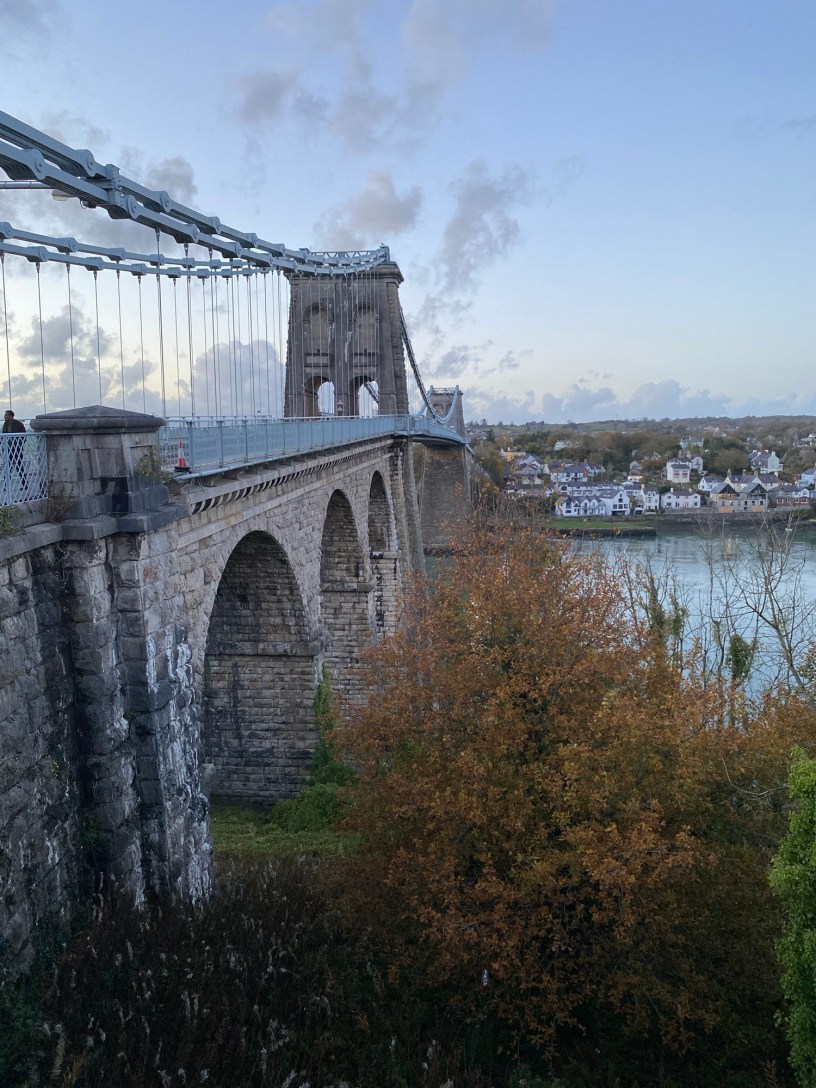
Once the largest copper mine in the world. There is evidence of a Roman presence here for it was the place they defeated the Druids. Robert Stephenson built the bridge over the Menai Strait connecting London to Dublin by train and sea. He followed the wrought-iron and stone suspension bridge built by Thomas Telford in 1826 as part of the post road linking the two capitals.
 British Manufacturing History