
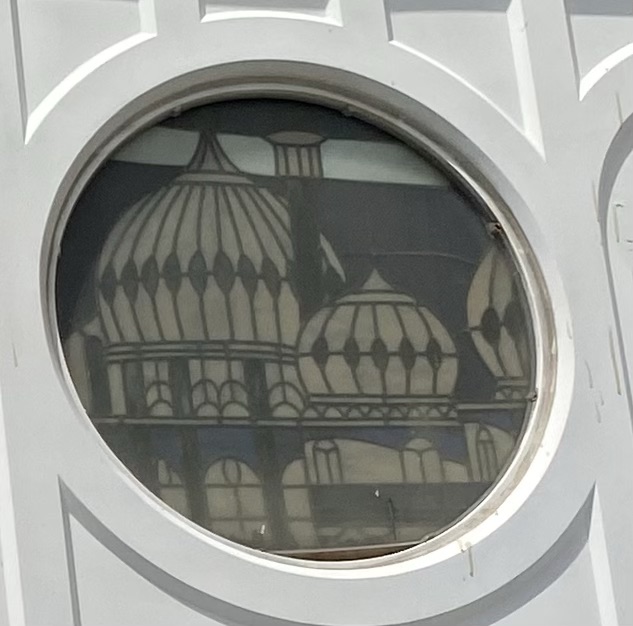
The south east, mirroring Metroland, welcomed businesses moving out of London and the many new businesses setting up with good access to airports and seaports, plus importantly inward investment largely from the USA. Historically Kent and Sussex had contained the Weald which was the birth place of Britain’s iron industry. In common with much of the country these counties were also home to millions of sheep and so wool played a big part in their economy. The image is of the Brighton pavilion domes depicted in one of the windows on Brighton pier.
Reigate and Redhill
Home to Windmills, Redland Tiles and Monotype. I write more in this link.
Crawley
One of the new towns designated after the Second World War. These towns were intended to have a good number of SME manufacturing businesses and looking at Dun & Bradstreet, Crawley would seem to be an exemplar. I write more on Crawley in this link. In nearby Brockham, in 1945 the Beecham Research Laboratories were established and in 1947 moved to a bespoke site open by Sir Alexander Fleming.
Chiddingford and Wealden Glass making
It is possible that Romans made glass in Britain but the evidence points more to its being imported. The first evidence of British glass making is to be found in 1226 in the village of Chiddingford where Laurence Vitearius was granted 20 acres of land in which he made window glass probably for Salisbury Cathedral. I write more about the British glass story in this link.
Heathfield and Wealden Iron and Gun casting
Home to the iron foundry of the Fuller family where they cast cannon for the Board of Ordnance. I write more of the Wealden Iron and Gun casting industry in this link.
Buxted
The first blast furnace to be installed in England in 1491. Much later the mass production of poultry.
Horsham
At one time home to five breweries.
East Grinstead
At nearby Gravetye, iron masters cast cannon. Rolls-Royce manufactures mtu engines for military vehicles.
Worthing
Beecham built a factory to manufacture antibiotics.
Brighton
A classic nineteenth century seaside resort much loved by Londoners with easy access by railway. The town did try to attract manufactures. Allen West electrical engineers was probably the largest with 4,000 employees during the Second World War, working on radar and other electronics. It became part of the American GE. Brighton is now home to a good number of designer makers.
KENT
Crayford
Crayford was first home to Maxim Nordenfeldt and machine gun production in the First World War. I write more in this link.
Erith
Home to British Insulated Callender’s Cables which created much of the national grid. You can read more in this link.
Dartford
In 1889 the Wellcome Chemical Works set up their first factory in Dartford in 1889 and that remained their main UK manufacturing base. Home to the Portland cement industry. I write more in this link.
Gravesend and Northfleet
Home to a Bowater paper mill, now part of Kimberly Clark, and more generally on the Thames the Blue Circle cement works. GEC AEI Power Cables manufactured in Gravesend.
The Medway Towns: Gillingham, Rochester and Chatham
Chatham was home to the Royal Dockyards with everything needed to build and maintain naval ships. HMS Victory had been built there. Shorts built Stirling bombers in Rochester in the Second World War. You can read much more by following this link.
Sittingbourne
Edward Lloyd set up a paper mill here once the water of the Lea became too polluted for the original mill at Bow. DS Smith Kemsley Paper Mill formerly Bowater manufactures from recycled paper.
Canterbury
Nearby Chartham was home to paper making owned by Wiggins Teape.
Maidstone
Birthplace of the Rootes Motor Group. Nearby Harrietsham was home to Marley tiles. I write more in this link.
Horsmonden
Brass cannon were cast here largely for the navy because they were lighter than iron. Later iron took over on the grounds of cost.
Cranbrook
Famous for its heavy woollen cloth
Ashford
Railway workshops were built here in 1847. With the introduction of diesel electric in the 1950s the future of the worksop became uncertain and other industries were encouraged to move to the town.
Margate
Home to the Hornby factory from the fifties making model railways, Dinky toys and Meccano.
Dover
The major cross-channel port.
 British Manufacturing History