
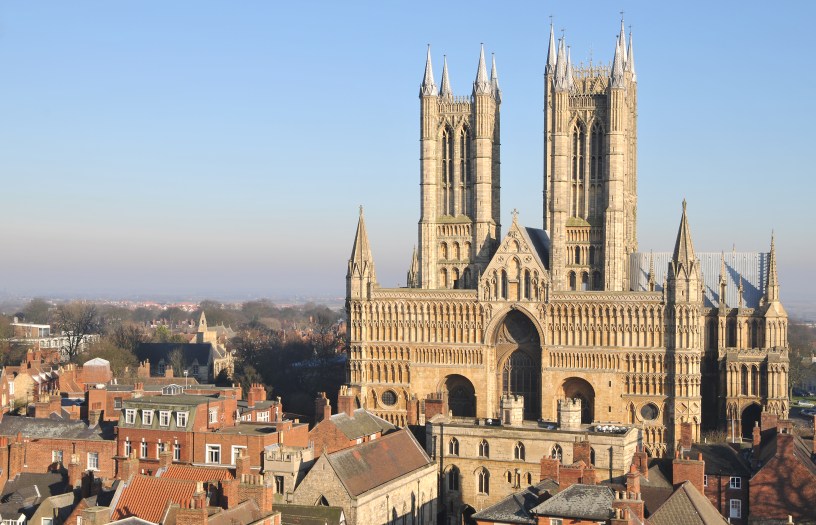
Textiles and footwear. Engineering built on an agricultural heritage and steel based on ore in Leicestershire and Northamptonshire. The image is of Lincoln Cathedral.
Nottinghamshire
Nottingham
One of the five towns of the Danelaw. Hosiery was centred on the East Midlands and so Nottingham along with Derby and Leicester. This led to framework knitting and then to Nottingham lace. I write about framework knitting in the page on Leicester (below). Nottingham suffered from dreadful overcrowding and this combined with a decline in the hosiery trade after the Napoleonic wars led to the action of the Luddites.
The city was home to Jesse Boot and pharmaceuticals, Raleigh Bicycles (later part of TI plc) and Stanton and Staveley steel and spun pipes (formerly part of British Steel and before that Stewarts & Lloyds). It was also home to John Player cigarettes and a good deal of Courtaulds and other textile manufacturers. Follow this link to read more about Nottingham.
Long Eaton
Long Eaton was home to lace making and furniture. In the late 19th century three large tenement lace mills were built one financed by the notorious financier Ernest Terah Hooley who was born in the town. You can read more about long Eaton manufacturing in this link.
Beeston
Just outside Nottingham, Beeston was home to Plessey Telecommunication following their purchase of Ericcson. Long before then it was home to the Humber Company before their move to Coventry. It was the vacant Humber factory that in 1901 was occupied by the National Telephone Company (later taken over by British Ericcson) to manufacture telephone equipment under licence from the American Bell and Edison. Nearby Chilwell had been home to a massive shell filling factory in the First World War and I wrote of this in Ordnance. In the Second World War it became home to the Army Centre for Mechanisation of which I wrote in War on Wheels.
Sutton in Ashfield
A coal mining town which became home to hosiery manufacturer, Pretty Polly. Parker-Knoll upholstery moved here
Mansfield
William Hollins set up its mill in Pleasley that same year, attracted by the availability of water and a climate kept damp by the number of trees. Labour was provided by a workhouse; many of the workers were children
At the Great Exhibition of 1851 I noted that William Hollins of Mansfield in Nottinghamshire exhibited both cotton and wool which when combined was patented as Viyella.
Worksop
One of the major producers of liquorice. Home also to hat making and furniture. Also Sharwoods, owned by RHM and then Premier Foods, make their famous curry sauces.
Newark
Home to British Sugar, later part of Associated British Food. Home to Worthington Simpson Pumps, later part of a joint venture between Ingersol-Rand and Dresser Pumps. Ransome and Marles Bearing Co became part of Ransome Hoffman Pollard bearings formed at the initiative of the IRC in the sixties. It became a subsidiary of Ingersol-Rand. After a management buy out, the bearings business eventually became part of the Japanese NSK.
Leicestershire
Leicester
One of the five towns of the Danelaw. Leicester embraced hosiery and foot wear from which came engineering to mechanise those industries, and then much more. Follow this link to read more of Leicester’s manufacturing history and framework knitters.
Ashby de la Zouch
United Biscuits produce McVitie, Crawford and McCoy’s biscuits and snacks
Hinckley
The first stocking making machine was used in the town in the mid seventeenth century. Much more recently Hinckley is home to a new factory manufacturing Triumph Motor Cycles.
Ibstock
The company began in 1825 as a colliery, but refocused on bricks with annual production of 3 million in 1914, 10 million in 1939 and 18 million in 1946. Ibstock Brick became a punlic company in 1963. By 1990 it had 5,000 employees expanded through acquisition including Redland and Tarmac brick businesses. The business weas bought by CHR but then sold to management in 2015. It was then re-floated. Its Eclipse factory near Leicester was opened in 2018.
Loughborough
Home to Brush Electric Machines . I write of the American Brush Company in my blog on American electricity. The British Brush company operated first in London but grew out of its premises and looked for a suitable place for expansion. The site selected was in Loughborough next to the Midland Railway where the Falcon Engineering Works had been built by Henry Hughes who had begun by building carriages, railways carriage and eventually steam locomotives. Brush Electrical Engineering became a major manufacturer of electric powered locomotives whilst continuing with steam locomotive particularly for export markets. Ladybird produce their children’s books in the town. Nearby Mountsorrel became home in 1941 to the Alvis workforce relocated from Coventry after the bombing of 14 November 1940. After the war the factory was bought by Rolls-Royce and only closed in 1994. British Gypsum producing plasterboard is at East Leake, now owned by St Gobain.
Market Harborough
Summingtons made Liberty corsets and the famous Liberty bodice.
Melton Mowbray
Promoted as the food capital of England, this market town is home to Samworth Brothers makers of sandwiches and porkpies and Clawson Dairy makers of Stilton and other cheeses. Until 2000, the neighbouring village of Old Dalby was home to the army depot maintaining our missiles. Mars chose the town for its Pedigree Petfood factory. Stanton & Stavely had an iron works manufacturing fitments and manhole covers at Holwell just outside Melton.
Derbyshire
Derby
One of the five towns of the Danelaw. Home to Rolls-Royce, railway and engineering history. I tell more about the city’s manufacturing story with the help of a visit to the Derby museum of making.
Spondon
In 1923 British Cellulose had changed its name to British Celanese and by the 1930s was producing Celanese filament yarn well suited to the fashions of the twenties and thirties. Its acetate drape was being used in competition with silk. British Celanese was later bought by Courtaulds. In the Second World War, British Celanese manufactured parachutes and underclothing. By the end of the war, they employed 20,000 people. In conjunction with Courtaulds, ICI formed British Nylon Spinners to exploit the Du Pont patent of Nylon for the manufacture of parachutes.
Belper
Was home to Glowworm and Parkray boilers, part of TI plc and then Hepworth Ceramic plc.
Langley Mill
The Valley works became a shadow factory producing a variety of armaments. It was then repurposed by Vic Hallam to manufacture prefabricated buildings. Aristoc manufactured silk hosiery and GR Turner manufactured wagons.
Chesterfield
John Robinson set up a business here in 1839 making pill boxes. In the fifties the company patented the first disposable nappies and now as Robinson plc make a whole range of packaging material.
Burton on Trent
At one time it was home to thirty breweries. The Branston pickle factory was repurposed as a Central Ordnance Depot for Army clothing in the Second World War. Read more in this link.
Burnaston
Toyota built a plant here in the early 1990s to manufacture motor cars for the UK and European market
Cromford
Richard Arkwright’s water frame massively increased the speed of spinning cotton. Cromford is the site of his first factory and also John Smedley wool knitters.
Alfreton
Home to Thornton’s Chocolates founded in Sheffield in 1911. Butterley was an engineering company at nearby Ripley and produced cast iron (for St Pancras Station and the Falkirk Wheel) and bricks, the latter became part of Hanson and then Heidelberg Cement. The engineering business was bought by Slater Walker and merged with Crittall. Read more in this link. Also nearby is the Denby Pottery.
High Peak
Home to Swizzles Matlow.
Northamptonshire
Northampton
New Town designated in 1968. Home to boot-making, becoming busy during the First World War with huge demand from the army. From this came shoe making which now is at the quality end of the market with Churches. The town was home to Express Lifts, Britain’s largest manufacturer of lifts, and their test tower built in 1982 is now a listed building. I tell more in this blog.
Corby
A new town designated after the Second World War in 1950. Stewarts and Lloyds in effect relocated their steel making in the interwar years but steel production ceased in the eighties. Tata Steel has a presence in the town manufacturing thin walled tube. I tell more in this blog.
Kettering
This was a home to footwear manufacturing along with Northampton. Weetabix is made at nearby Burton Latimer
Wellingborough
Another footwear town also home to flour mills. Read more by following this link.
Irthlingborough
Home to Whitworth’s dried fruit and to the Lantern Tower on St Peter’s Church which was built as a beacon to guide travellers through the ‘treacherous’ Nene Valley
Daventry
Cummins Inc power systems factory was set up here and combines with their UK logistics centre. Home to DIRFT, the International Rail Freight Terminal. At nearby Long Buckby is McLaren automotive.
Peterborough
New Town designated in 1967. A deeply agricultural town which embraced engineering as I tell more in this blog.
Lincolnshire
Lincoln
The Romans installed garrisons at strategic towns across England and Lincoln was one. One of the five towns of the Danelaw. William the Conqueror built a castle and cathedral and the town was one of the largest in medieval England, wealthy from wool. More recently famous for its cathedral and relationship with the RAF and Bomber Command. Follow the link to Lincoln’s manufacturing story
Grantham
An engineering town. You can read about it in this blog.
Scunthorpe
Home to United Steel Companies (Lincolnshire) now renamed British Steel and owned by the Chinese. I write more in this blog.
Stamford
One of the five towns of the Danelaw. A town famous for the Cecil family to whom we owe thanks for British patent law. The town, in its later years, attracted engineering. You can read more in this blog.
Boston
An ancient town with a busy port. In a county where chickens were grown in the hundreds of thousands Fogarty took advantage of byproduct of feathers for their pillows and duvets. Deep in farming country there is currently a plan to build a factory for a vegan food processor. Greencore produce prepared salads and vegetables.
Spalding
Home to vegetable processors including Greencore and FreshLinc.
Long Sutton
Home to Princes largest vegetable processing plant
Grimsby
Known for its fish as early as the thirteenth century. Fishing and fish processing dominated the town in the nineteenth and early twentieth century. In nearby Caistor, Sealord (now Japanese owned) make high end fish fingers for Waitrose.
Humberside
The south bank of the Humber was and is home to much heavy chemical industry. British Titan Products built a factory on the Pyewipe industrial estate on the outskirts of Grimsby. They were followed by Laporte also with titanium dioxide, Dunlop with industrial hoses, Ciba Chemicals and Courtaulds with man made fibre. Fisons had a factory at Immingham.
 British Manufacturing History