
A predominantly agricultural region with historically a heritage of farm equipment manufacture. The presence of one of the world’s top universities is of course significant. In much earlier history East Anglia was impacted by invasions from Rome and then Anglo-Saxons, Danes and William the Conqueror. Later it benefitted from successive influxes of Flemish weavers and Huguenots. Each of these invasions left their beneficial mark not least at Sutton Hoo near Ipswich.
Cambridge
The University is a major collaborator with British industry. It was from where ARM came. Read more in this link.
King’s Lynn
A fishing port for many centuries. British Sugar has a large factory at nearby Wissington
Great Yarmouth
Where the American Birds Eye began freezing fish in Britain. It became part of Unilever.
Lowestoft
Home to one of the Pye Radio factories. At nearby Bungay, Clays print books. Birds Eye frozen vegetables factory now owned by Nomad Foods.
Norwich
One of the great early wool towns. Home to Norvic Shoes and a centre of shoe making. The Boulton Aircraft company developed from a woodworking firm. The company was re-established in Wolverhampton in 1936 as Boulton Paul and in 1961 joined Dowty Group. Mackintosh of Halifax bought AJ Caley of Norwich and there developed Quality Street and Rolo. You can find more by following this link.
Thetford
Charles Burrell Ltd were the largest employer in Thetford and at one time were the largest manufacturer of traction engines in the world. In 1919 they joined Agricultural and General Engineers and when that company failed in 1932, Burrells closed with the loss of many jobs. Fisons first set up here.
Ipswich
Ransomes were the biggest employers and Fisons main factory was here having originated in nearby Thetford. I tell more by following this link.
Harwich and Felixstowe
Together with Ipswich, these are known as the three Haven ports on the North Sea thanks to their deep harbours.
Colchester
Thought to be the first English town a century before the Romans. A wool town in the middle ages and in the nineteenth century a centre of mechanical engineering with Paxman engines and Crompton’s dynamos. You can read much more by following this link.
Southend on Sea
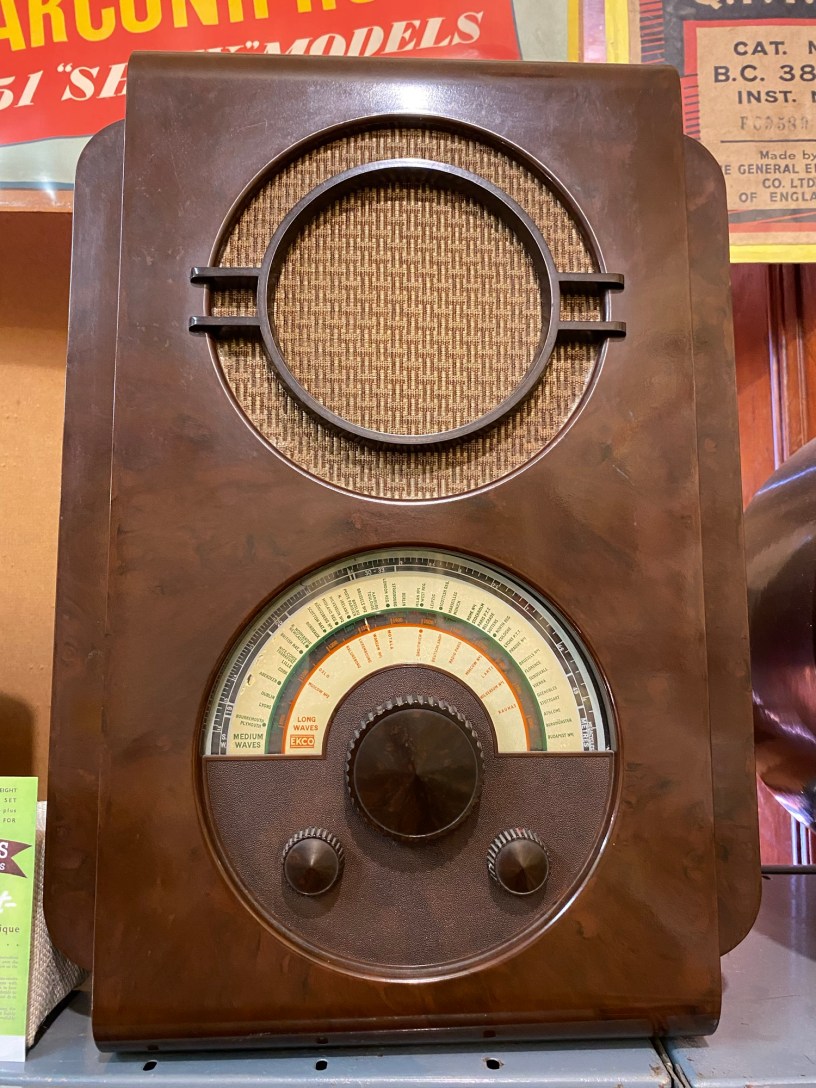
Ekco built a factory here in 1930 to manufacture radio and plastics. As I observed in the design review of the Festival of Britain, EK Cole was especially good at diversifying. In the Second World War, Ekco’s factory at Southend was considered too vulnerable to air attack and so they relocated in part to Aylesbury, and, in part, to a 19th century mansion near Malmesbury in Wiltshire. They made radio for bombers and airborne radars and walkie-talkies for infantry.
Basildon
The neighbouring village of Fobbing was where the Peasant’s Revolt began in 1381 with Wat Tyler leading a march on London. Basildon is a town with a distinctly agricultural heritage and which moved into the twentieth century with brick works producing seven million bricks a year. The works were used by the military during the First World War and thereafter were dismantled. It was designated a new town after the Second World War. New Holland tractors set up in 1964 and Marconi manufactured here. Read more by following this link.
Brentwood
Ilford Ltd opened a factory producing dry photographic plates in Great Worley.
Billericay
Home to one of three Marconi components factories (the others at Wembley and Hackbridge, Surrey)
Braintree
Samuel Courtauld began with a silk mill making mourning clothing. Read more about silk and Braintree but following this link.
Chelmsford
In nearby Great Baddow there is the BAE Systems AI laboratories, formerly the Marconi Research Centre. GEC Marconi had a big manufacturing presence in the town with Radar and Communications. You can read much more by following this link.
Ilford
Plessey manufactured radio components and a large range of electronics. You can read more by following this link
Langford
Home to CML Microsystems set up in 1968 and now with a worldwide market.
Sudbury
Lucas diesel components were made here. It has the last British silk weavers. I tell more in my blog piece on Braintree.
Brantham
The early British plastics manufacturer moved production of Halex from Hackney.
 British Manufacturing History