
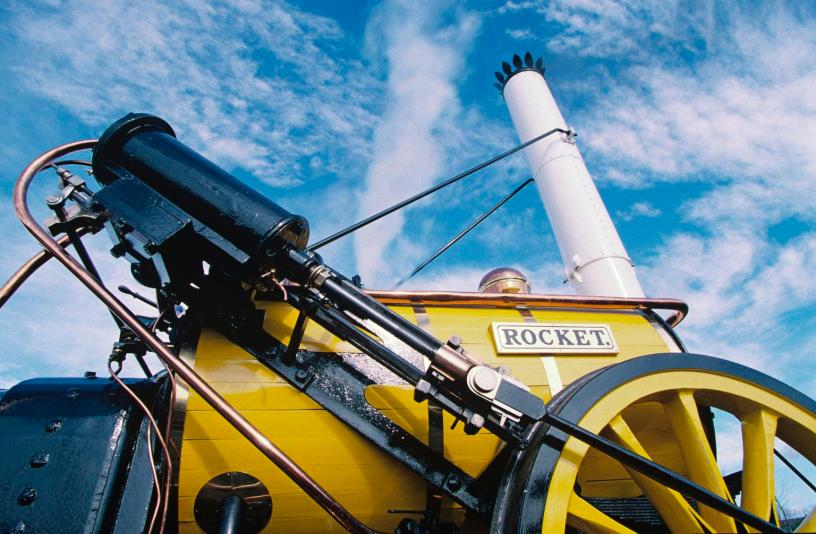
George Stephenson was born in 1781 into a mining community just inland of Newcastle near Wylam on the Tyne where his father worked as a fireman at the colliery. They lived with George’s mother, Mabel the daughter of a dyer, and two younger brothers and sisters in Street House only yards from the wagon way which transported coal from the pit. He was thus attuned to the unremitting life of mining families. The family moved from place to place as was the life of coal as mines were sunk, exploited and exhausted.
George grew up wiry and muscular and worked on a farm before becoming assistant fireman to his father. There is no evidence of much formal education, but George was gifted with things mechanical. At age seventeen he was given charge of a pumping engine erected by Robert Hawthorne, later a famous railway engineer. Here George became friendly with William Locke whose famous engineer son Joseph would be one of George’s later apprentices.
George married Frances Henderson in 1802 and a year later their only child Robert was born. George was now a brakesman at Willington on Hawthorn’s recommendation. Here he met William Fairbairn and took on clock repairs in his spare time. Tragedy stuck when Fanny died soon after childbirth in 1805.
George was intent on improvement and took arithmetic at night classes. His chance came when the pumping engine at Killingworth was failing to clear the pit. George quickly identified the problem and his offer to try to rectify it was accepted. Success built George’s reputation and he was appointed engineer at Killingworth and he gained ad hoc worked from many nearby pits. He was earning well and invested in Robert’s education.
We now come to the inventions attributed to both father and son. The story is though the same as elsewhere in the history I have tried to write, no single person can claim or indeed should claim the whole credit. This is not the picture of a scientist in a laboratory crying eureka, but of engineers working day in day out on the machinery used in daily work. It is natural that the more inventive will come up with ideas for ways to ‘do things better’. We can think of spinners and weavers of wool. With George Stephenson, one such was the practical challenge of having light underground that did not ignite escaping gas. The eminent scientists Humphrey Davy had been sent off to his laboratory to work out a solution. George took a candle and something that looked like a table lamp down into the most dangerous part of the most dangerous mine and by trial and error eventually found a lamp that seemed to work safely. To cut a long story short, they both emerged with a solution at about the same time; Davy’s became the better known. The term Geordie, is attributed to George and his lamp.
I have written elsewhere of the challenge of pumping mines clear of water, with the names Newcomen and Watt; indeed I have also described one of George’s successes with such machinery. Now George Stephenson had his sights set on locomotion powered by steam. It was hardly surprising that others were exploring the same challenge which all mine owners faced and it was the mine owners who would pay but only if they saw a clear benefit.
In 1804, Richard Trevithick attempted locomotion on the Merthyr Tydfil railway in the South Wales coalfield. He used a single piston and flywheel, but found that the power produced was insufficient to cope with the weight of the engine.
Problems remained to be solved. Locomotives were too heavy for the existing oak rails and did not promise enough benefit for them to be replaced. So yet more power was needed and weight needed to be reduced or at least more widely distributed. Bogies were added with some success.
In 1811, John Blenkinsop patented a mechanism something akin to a rack and pinion. He engaged the engineering firm of Fenton, Murray and Wood, and used steam engines with two cylinders working cranks at right angles to each other. It was a success. Blenkinsop wrote that, ‘an engine with two eight-inch cylinders weighing five tons, drew twenty-seven waggons, weighing ninety-four tons, up an ascent of two inches in the yard; when lightly loaded, it travelled at ten miles an hour, did the work of sixteen horses in twelve hours, and cost £400’.
Blenkinsop was followed by other inventors exploring variations on his theme, and Blenkinsop himself installed his engines at a number of collieries including at Wylam, the ‘Dilly’.
George was working with the installation of static engines and had been experimenting with differing boiler set ups. The problem remained a lack of power. Where Stephenson advanced on the work of Blenkinsop was that the railway was laid with cast iron edge rails and the locomotive, the Bulcher, had flanged wheels with power direct to them rather than for example to a rack and pinion.
The Northumberland coalfield was well served by the Tyne and the pit railways running to it. Not so the Durham field and so attention turned to a possible canal, iron plated tram route or railway from Darlington through to Stockton. The pit owners favoured the latter, after all the fuel would be free. They approached George Overton who had worked with Trevithick at Merthyr Tydfil. He in turn sought to work with the Newcastle Iron masters who had build Stephenson’s locomotives. The project stalled and Stephenson was approached by the Middlesborough businessman Edward Pease. They, together with George’s son Robert, still onlt twenty, put forward a scheme to Parliament which received approval. Work began. The project lacked an iron master to build locomotives and this gave birth to Robert Stephenson & Co which produced the four vehicles needed. In addition there were two static engines to pull the trains up two steep inclines; there was also to be a section where horsepower was used.
The line was opened to huge crowds and much anxiety on 27 September 1825. Thereafter it did its job but not without challenges.
A name comes into the story, now, which is perhaps lesser known, that of Timothy Hackworth ‘an ingenious mechanic’. He was manager of the works department of the new line and was thus in the perfect position to see problems as they arose and then fix them. Railways were always going to progress by learning on the job. In due course Hackworth persuaded the directors to allow him to develop an engine ‘after his own design’, which was, inevitably, a variation on the existing themes.
The new engine soon made those of Blenkinsop and Stephenson redundant, but still did not satisfy demands. The final twist in the early story of steam railways came with the Liverpool and Manchester railway, and it was the demands of cotton traders, led by corn merchant Joseph Sandars, that brought George Stephenson back into the picture. Manchester mills were transporting tons of cotton goods to the port of Liverpool by canal which took some thirty-six hours and which was expensive. What was needed was a steam railway.
Robert Stephenson left England for Columbia perhaps following in the footsteps of Richard Trevithic who spent some years in Peru working for mining companies because the English had banned his his pressure boiler as being too dangerous. Robert’s absence left his father without his right hand man and when a Manchester to Liverpool railway was mooted, the directors turned to the Scot Rennie. Rennie was not a team player and his proposal fell apart. Other engineers were tried and eventually George was appointed.
George Stephenson planned the rail route to Liverpool, which included sixty-four bridges and viaducts along thirty-five miles of track. Without Robert by his side, the project faltered. Eventually, Robert returned but with his focus on his locomotive building company. George struggled especially with money where his lenders expressed their dissatisfaction by withholding funds. They apppointed Thomas Telford to report to them on the state of the project. George, for ever a proud man, reluctantly accepted the recommendations of Britain’s top civil engineer and the project continued until it came to the choice of power.
The directors were far from convinced by locomotives and favoured static engines and ropes. This was where George’s character came into play. He was convinced that the railway locomotive was the answer on many grounds which he argued patiently. Even when the directors eventually relented, they insisted on three alternative locomotives including one by Hackworth. The three competed over a tough test and George’s Rocket won easily.
It was thought more likely that his son, Robert, designed and built his “Rocket”, ‘by the happy combination of the multi-tubular boiler and the steam-blast, Mr Robert Stephenson succeeded in producing an engine far superior to any previously built in point of speed and efficiency.’ Heavy rails were laid at considerable cost and, with heavier locomotives, ‘the superiority of the railway system to every other mode of conveyance was placed beyond question’.
Following the ground breaking Manchester to Liverpool railway, a number of smaller lines were built, some by the Stephensons. Robert Stephenson & Co were busy building locomotives for use on the growing number of railways across the world. It was far from plain sailing as landowners, coach operators, road builders and canal operators all opposed the iron beast. It was though here to stay.
The London Birmingham railway was the next major project and there were differences between the London committee and that of Birmingham, in addition to the opposition ranks already mentioned. The route also had challenging geology. What it didnt have was poor project management. George had lobbied hard for his son to be appointed and Robert had learnt from Thomas Telford and Locke, and from his father’s mistakes, the importance of planning and clear delegation. The line was divided into four each with its own engineer reporting to Robert. The grand entrance to Euston Station was an appropriate monument to northern grit as displayed by the Stephensons.
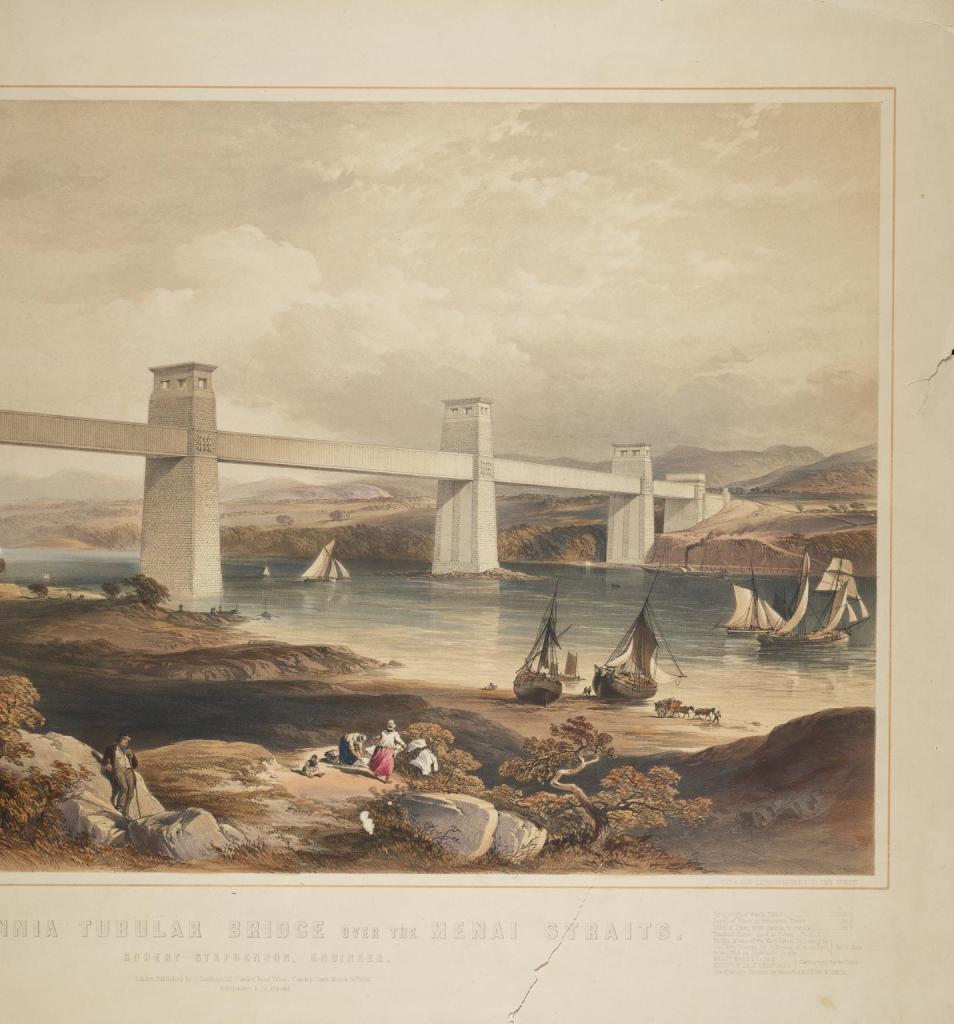
Robert did have a further legacy in mind. As is apparent, railways are about much more than locomotives. Bridges are not only vital components but works of genius in their own right. Robert’s bridge over the Menai straits is a classic example. There were to be two bridges one at Conway and one rather longer a mile from Telford’s suspension bridge. Robert had learnt a painful lesson from the Dee Bridge disaster after which he abandoned cast iron in favour of wrought iron sheets brought together to make long rectangular tubes through which the trains would run. These were both cumbersome and heavy and had to be fabricated on site and then floated adjacent to the pillars on which they would sit and then lifted into place by hydraulic presses. Sounds easy. Add currents and wind and the task becomes monumental.
Further reading:
L.T.C. Rolt, George and Robert Stephenson – the Railway Revolution (Westport: Greenwood Press, 1960)
 British Manufacturing History