
In his biography, Norman Atkinson makes the point that it is sometimes difficult to trace the early days of people who later became famous. With Joseph Whitworth, whom Atkinson describes as the ‘World’s Best Mechanician’, the problem was that contemporary writers were keen to give the great man as great a pedigree, so early biographers paint a relatively comfortable childhood accompanied by a good education. Atkinson’s and others’ later research reveal something rather different.
All agree that Joseph was born in Stockport in 1803 and that he had a younger brother John and a much younger sister Susan after whose birth their mother died. Their father, Charles, was a reed maker, that is a man who repaired machinery used in the cotton industry. This was not a well paid job and the family lived in a back to back. The family’s position became more precarious when steam power came in, to the sometimes violent opposition of traditional weavers. For a man who repaired steam powered machinery, daily life was dangerous with the ever present angry mob.
Charles found solace in the Congregationalist Chapel and eventually gave up his mill job for the even less well paid role of a junior minister. It was perhaps a lack of income that prompted Charles to place Susan in an orphanage and to find foster homes for John and Joseph.
Joseph ran away from his foster home to Manchester and found work with a textile machinery manufacturer.
At age 21, he set off to London hitching lifts by canal boat. The story goes that on one such boat he fell in love with the bargee’s daughter. They married in Ilkeston and together made their way to London.
His destination was the workshop of Maudsley which had become the go-to place for up and coming engineers. In 1825, Whitworth took the job of an ordinary bench fitter and turner. For Whitworth this was not enough and he took a succession of posts with different engineers to broaden his experience: Holtzapffel, Wright & Sons, and then Joseph Clement. He worked briefly for Charles Babbage on his calculating machine.
In 1832 Joseph and Fanny moved to Manchester arriving at a time when locomotive engineers were pioneering their craft, so Stephenson of Newcastle and Tayleur of Liverpool plus the local Fairbairn and Sharp Roberts. Into the mix came two young German engineers, Charles Beyer who would later join with Peacock and John Bodmer, plus Scottish engineer Naysmith. These three had an academic education and fitted well with the growing scientific community in Manchester born more of chemistry. Joseph joined in hungry to learn, and succeeded. Railway locomotives were becoming more sophisticated and demanded quality machine tools.
Joseph and Naysmith both set up in the Piccadilly area of Manchester, with Naysmith on a rather more substantial scale. He gained repair work from the growing number of mechanised cotton mills and was soon employing a number of men. Joseph was more intent on developing better machine tools. He is sometimes criticised for copying, but this misunderstands the process. Joseph would take a machine tool and see its shortcomings; he would then devise an often small modification which would significantly improve performance. The problem that faced Joseph was that mill owners would only invest in machinery if employee numbers could be reduced. Joseph’s improvement would enhance efficiency and improve the lot of the worker but only seldom replace people. His ventures into textile machine came to little avail.
Joseph gained the respect and friendship of Fairbairn who was by then the doyen of Manchester engineers and with Fairbairn’s encouragement he focused on machine tools and gained a glowing reputation, This led to his greatest achievement: a standard measurement.
A standard yard had been adopted by Elizabeth I but the iterations of this yard varied as did its subdivision into inches, so much so that the north of England used the ‘short inch’ and the south the long one. The establishment were content for standard measurement to be achieved by lines engraved on a metal bar. The first bench micrometer had been made by Maudsley building on the early work of James Watt. Whitworth was convinced that for a standard the distance between the ends of a bar offered greater accuracy.
It took argument of forty years for Whitworth’s method to be adopted, but thereafter it became possible to produce interchangeable parts accurate to one thousandths of an inch. Whitworth’s aim was to achieve on millionth but this was only attained in the 20th century. Standard measurement was followed by standard screws, and, again, this demanded years of arguments.
Whitworth was keen to be accepted by the Institution of Civil Engineers, for at that time Mechanical Engineering had yet to achieve that status. Whitworth was grudgingly admitted as an associate. When the Institution of Mechanical Engineers was formed in 1847 with George Stephenson as president and Charles Beyer as Vice-President. Joseph was granted full membership of both institutions in 11 January 1847.
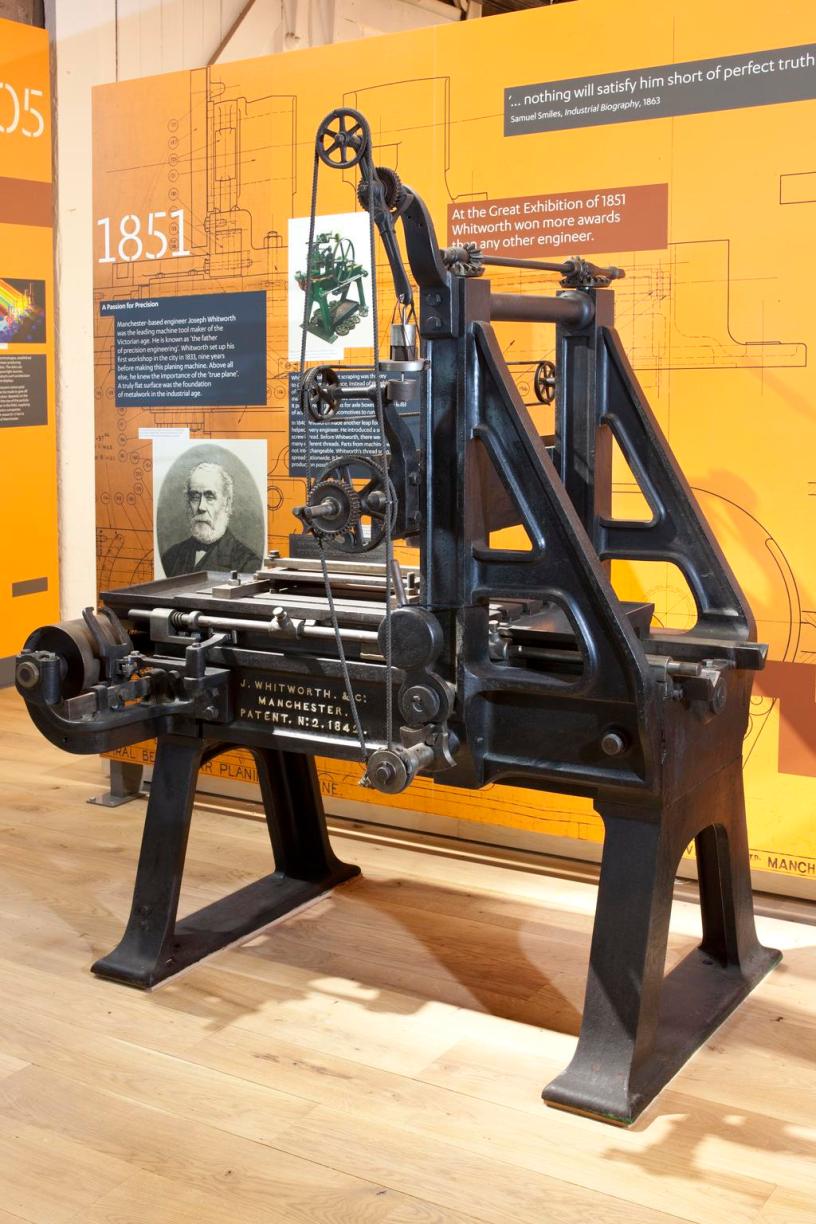
Joseph’s great claim to fame was as a maker of machine tools and I write of this in my post on Manchester’s 19th century tool makers since he wasn’t alone. He did stand for the advanced design of his workshop, build by William Fairbairn. A glass roof which formed the basis of the design for the roof of St Pancras Station spanned the whole workshop providing excellent natural light. It had a overhead crane and a power shaft driven by steam from which power tools would run from belt drives. He did attempt a clutch drive but this would have to wait a number of decades until a full solution was provided. He did make very large machine tools and the workshop had rails and a turntable for them to be manoeuvred. Among his successful projects were the screw cutting machine, but also a machine for the production of pottery of standard sizes and a massive brass cast screw of a steam ship.
Joseph Whitworth’s legacy was in the machine tools he made, his contribution to gun manufacture but more so universal measurement and universal screw thread. To this he added a personal fortune £1 million he gave to trustees in the knowledge that they would apply it to the advancement of technical education for men and women at all grades of engineering employment in the cities of Manchester and Salford.
After Joseph’s death in 1887, William Armstrong feared that Vickers may seek to purchase in particular the Openshaw armour plating works and so bid first and successfully, The machine tool business was sold to Craven Brothers in 1928.
Further reading:
Norman Atkinson: Sir Joseph Whitworth – the World’s Best Mechanician (Stroud: Sutton, 1996)
 British Manufacturing History