
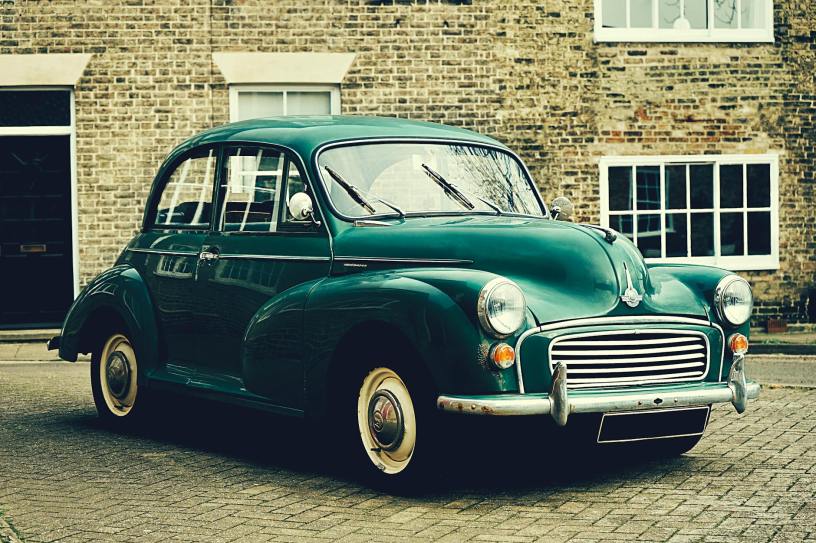
William Richard Morris was born on 10 October 1877 in Worcester where his father, Frederick, was working as a draper. Both Frederick and William’s mother, Emily Ann, were of Oxfordshire yeoman stock and both had received a sound education. The indoor life of a draper didn’t suit Frederick and so the family returned to Oxford and farming in Cowley. They had seven children of whom William was the eldest. Five died in childhood but William’s sister lived a full life in Oxford.
William attended the village school but left at age fifteen when his father had to give up his job through ill health. Frederick returned to bookkeeping which he had learnt at the drapers and he was by all accounts meticulous. The evidence was there to see in the early records of his son’s business.
William showed an early aptitude for things mechanical, particularly bicycles. He owned a penny farthing and an early solid-tired safety bicycle. His first job was in the bicycle trade where he learnt his basic skills. These he developed when he set up on his own. As an engineer he was entirely self taught.
William Morris was a remarkable man by any measure. Among my father’s books was a biography of Morris by P.W.S. Andrews and Elizabeth Brunner and I drew on this for my book How Britain Shaped the Manufacturing World in which I seek to tell the Morris story in the context of British manufacturing more generally. Here I record just four anecdotes which seem to me helpful in summing up the man who did of course found the Morris Motor Company and endow the Nuffield Foundation.
The first was the occasion of the 1906 General Election, and candidates were perceiving a benefit in having a motor car to carry them round on their electioneering. It seems the Morris’s reputation was spreading far and wide, for he was asked by a candidate in Stirling to find a suitable car. There were none available in Britain, and so Morris set off for Paris where he found a Lacoste & Batman car. This was a highly regarded make, and Morris must have felt thoroughly satisfied. That is, until twenty-five miles from Paris, when the car broke down with a seized gear-box and back-axle. He discovered that despite promises, oil and grease had not been filled before he set off. Morris returned to Paris, and bought the necessary parts, which he then fitted and set off again. Five miles short of Amiens, a broken exhaust valve stopped the car once more. Happily, spare valves had been provided, but they were one eighth of an inch too long. He did what many early motorists did in such circumstances, and spent one and a half hours grinding the valve down on the cobble stones to the required size. He then made it back to Oxford where his staff took over to drive up to Stirling. Late that night, he received a message that the car had broken down again, just short of York, with a broken bevel gear in the back axle. Morris set off for York, and, with the help of a local blacksmith, made and brazed two new teeth to the bevel. This sequence of break down and repair followed him all the way to Stirling, where he arrived two weeks late and much the poorer. He offered to rescind the contract, but the purchaser went ahead and no more was heard. Morris had though learned a great deal, all of which he incorporated into the design of the Morris Oxford. The other thing he learnt was not to make all the car himself, but to seek reliable suppliers of the key parts.
…………………….
In the mid thirties, a delegation from the War Office visited Moscow to witness the annual armaments parade and they saw a very basic but very fast tank. On making enquiries they discovered that it was built round a new suspension system developed by a man called Christie in the United States. The system enabled the tank to go fast, but also relatively smoothly, making it much safer for the driver, who previously would often be knocked out should the tank encounter a sharp undulation in the land it was crossing. Lord Nuffield purchased a Christie tank with his company’s own money and then proceeded to develop a new Nuffield tank employing the Christie suspension. The result was the Cruiser. In May 1940 the first few Cruiser tanks arrived in France.
………………………
Another major Nuffield initiative was that of the Civil Repair Organisation. This had begun as an RAF initiative, but, with increasing demands on their manpower, they were content to hand it over to Lord Nuffield as Director General of Maintenance – RAF, with headquarters and one of the six repair depots at Cowley. Throughout the Battle of Britain, RAF planes were being shot down, making forced landings or landing at base with battle damage. It soon became obvious that to carry out repairs to get the planes airborne must make sense. Andrews gives some numbers. The total number of people employed in aircraft production was 664,200; a further 63,600 carried out repairs on some 80,000 aircraft put back into service over the period. Ernest Fairfax, in his closer look at the wartime contribution of the Nuffield companies, Calling All Arms, adds some more detail. There were in effect three strands to the operation: those mobile units who would go round the country retrieving damaged aircraft; the repair factories themselves; but then the foundries where scrap metal would be recycled into new aircraft. He suggests that the metal recovered was enough to build five thousand new planes.
……………………..
Lord Nuffield, who had been to see Chilwell, had told the War Minister, Mr Hore Belisha, about all that was happening in the mechanisation of the army. So, when in the summer of 1939 the question of an appointment as Deputy Director of Ordnance Services (Motor Transport) came up, the War Minister asked, ‘why not Williams at Chilwell?’
Williams was my father and Chilwell the Army Centre for Mechanisation which he created. He went on to serve as Controller of Ordnance Services of which I write in War on Wheels.
 British Manufacturing History