
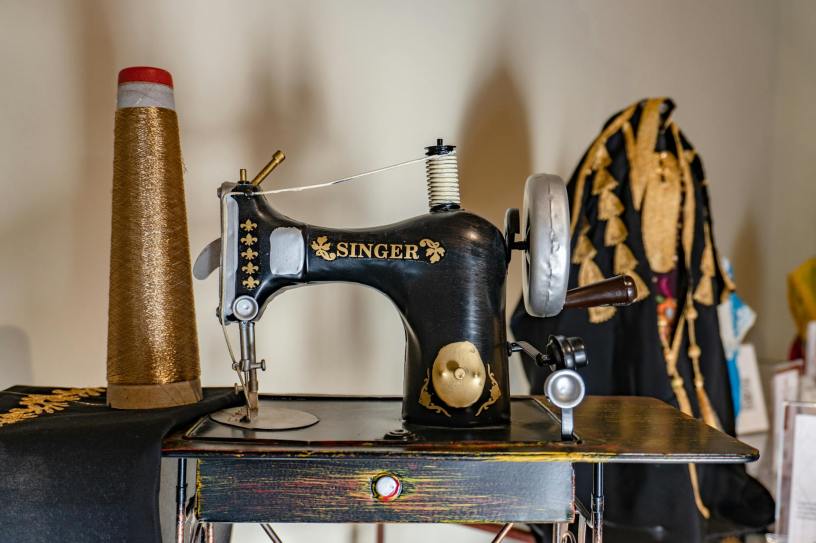
“No useful sewing machine was ever invented by one man; and all first attempts to do work by machinery, previously done by hand, had been failures. It was only after several able inventors had failed in their attempts, that someone with the mental powers to combine the efforts of others, with his own, at last produced a practical sewing machine.’
James Gibbs, the son of a Shenandoah farmer
It is the story of manufacturing: the way one idea builds on another, until finally an answer is found. The sewing machine was ultimately an American invention, vital to the textile industry but also to many homes across the land. It brings in another aspect, how more and more inventions were crossing borders, with people of different nations building on the work of others. It is also the story of how one invention leads to another: first the sewing machine, then the bicycle.
Alex Askaroff has written a number of books on the subject and in his Brief History quotes one of the sewing machine pioneers with the words with which I began this piece. Askaroff traces the development of the sewing machine back to England and a German named Charles Weisenthal who took out a patent for a needle to be used for ‘mechanical sewing’, but nothing else is known.
That was not the case with a patent of 1790, again in England, taken out by Thomas Saint, for he provided sufficient detail for a replica to be built. Sadly, this patent and detail did not come to light until 1873, but then it was made and could sew once a number of modifications were made. By this time other patents had been registered and machines built.
The first was in France by Thomas Stone in 1804, but little is known about this. That of 1810 by Balthasar Krems was used for stitching caps, and Askaroff tells that a replica of his machine is in the Eifel museum in Mayen. In 1815, an Austrian, Josef Madersperger, was granted the patent rights for a sewing machine, but it was not until 1839 that this was working as intended; it was awarded a bronze medal, but his machine was never used to any extent. In 1818, John Knowles and John Doge in America produced a machine that would stitch, but only for a few inches before it had to be reset.
The first sewing machine that we might recognise as such was made in France by Barthelemy Thimonnier in 1829-30. It was made of wood, and he used it to sew army uniforms. Its fate was not dissimilar to that meted out by the Luddites, in that, in 1831, the Paris mob broke into Barthelemy’s workshop at Rues to Sevres and destroyed all eighty of his machines. He fled to England, but never managed to resurrect his machine.
In America, Walter Hunt, a prolific inventor, produced a lockstitch, but never took out a patent and ended up selling the design which was taken no further. In England, in 1841, Newton and Archibald designed a chain-stitch machine, but little is known of it. In 1842 in America, John Greenough patented a machine with a stitch forming mechanism. The following year, Frank Goulding also created a sewing device, but did not take it any further. In 1844 in England, John fisher produced a lace-making machine, but did not pursue his invention.
The Coventry Sewing Machine Company started out as the European Sewing Machine Company, importing machines. They changed their name and, with the engineering input from William Hillman and George Singer (no relation to Isaac, and both better known later for motor cars), produced their own sewing machine. This native sewing machine industry would never really compete with the American Singer which set up production in Glasgow in 1867. By 1913, the Glasgow factory employed 14,000 people and produced one million sewing machines a year.
In 1868, the Coventry Sewing Machine Company bought a French ‘boneshaker’ bicycle (see below) and began manufacturing their own bicycles. The bicycle, which we see as common place, started life as a toy for rich, brave and possibly stupid young men. The British bicycle industry began as the sewing machine industry left off, with the names Starley and Hillman, and the Coventry Machinists Company as successor to the Coventry Sewing Machine Company. I highlight their manufacture of four hundred ‘boneshakers’ Velocipedes to a French design by Michaux and Lallement.
The ‘boneshaker’ was the successor of the ‘hobby-horse’ or ‘dandy-horse’. In his fascinating book Revolution: How the Bicycle Reinvented Modern Britain, William Manners describes these early machines, their popularity among young men, but also their discomfort and danger. The ‘hobby-horse’, which was a heavy machine with two wheels which the cyclist would sit astride and push forward with his feet, was succeeded by the ‘Ordinary’. This had the advantage of pedal drive to the front wheel and evolved into the penny farthing, so known in the 1890s for having a very large front wheel on the top of which perched the cyclist, with a much smaller wheel behind.
In Britain, it was Starley and Hillman who, in 1870, patented the ‘Ariel’, ‘the first all metal English bicycle to be mass-produced and weighed around fifty pounds at a cost of £8, which was not cheap. The bicycle was proudly declared to be ‘the lightest, strongest, safest, swiftest, cheapest, best-finished and most elegant of the modern Velocipedes’. The reference to safety is intriguing for the penny farthing was notoriously dangerous with the risk of serious accident if the rider took a ‘header’, that is went over in front of the large wheel, but also because they tended to be at the very least ridiculed.
Further reading:
- Revolution: How the Bicycle Reinvented Modern Britain, William Manners
- Alex Askaroff, Brief History
 British Manufacturing History