
The late eighteenth century saw James Watt and Richard Trevethick develop the power of steam, largely in the context of mining initially of tin, but then more importantly coal.
In 1811, John Blenkinsop patented a mechanism something akin to a rack and pinion. He engaged the engineering firm of Fenton, Murray and Wood of Leeds, and used steam engines with two cylinders working cranks at right angles to each other. The system was installed on the previously horse-drawn railway from Middleton Colliery to Leeds. It was a success. Blenkinsop wrote that, ‘an engine with two eight-inch cylinders weighing five tons, drew twenty-seven waggons, weighing ninety-four tons, up an ascent of two inches in the yard; when lightly loaded, it travelled at ten miles an hour, did the work of sixteen horses in twelve hours, and cost £400’.
In 1823 George and Robert Stephenson founded their company in Newcastle specifically to build steam railway locomotives.
On 27 September 1825, the Stockton Darlington railway opened, designed by George Stephenson with his son Robert who went on to produce the Rocket in 1829 and many more railway locomotives. R&W Hawthorne also manufactured first class steam locomotives in Newcastle not least for the Stockton Darlington railway. In 1885 the company merged with shipbuilder Andrew Leslie & Co. Hawthorne’s railway heritage can be trace through to English Electric in the 1950s.
Stephenson’s design of locomotives was improved upon by the manager of the Stockton Darlington railway, Timothy Hackworth, and this provoked further improvements which led to the Manchester Liverpool railway which by 1850 was carrying two million tons of cotton a year.
The 1830s were a period of great railway building. ‘In 1835 there were only 338 miles of railway open in Britain; but by 1841 the figure had risen to 1,775 miles.’ Places were being connected: London to Southampton, Portsmouth, Brighton and Dover; to Bristol and on to Exeter, to Birmingham and on to Liverpool, Manchester and towns in the northwest; to Hull, York and Newcastle. But also cross-country: Carlisle to Newcastle, Liverpool to Leeds, Derby to Bristol. This was becoming a connected country, indeed the first country in the world to connect its cities by rail.
Gateshead was home to the workshops of the North Eastern Railway Company which at one time employed 3,300 men before it moved to Darlington.
Railways came first to Glasgow in short runs from the coal fields, but then linked East to West, ventured further north and crucially linked the two countries. Glasgow built a great many of the world’s locomotives. The Caledonia Works at nearby Kilmarnock built many railway locomotives. Beardsmore too at one time tried their hand at locomotive manufacture. In 1903 the North British Locomotive Company had come into being by the merger of three smaller manufacturers. The new company had produced 5,000 locomotives by 1914 and towards the end of the war built the prototype of the British American mark VIII tank.
Crewe is a town cited by historian, Asa Briggs, as created in the 19th century by the railways for the railways. Diane Drummond, in her book Crewe: Railway Town , Company and People 1840-1914, offers a precise date, 10 March 1843, when the first employees and their families were settled there.
It was the Grand Junction Railway that decided Crewe was the place for its main works. It had become the place where a number of separate railway lines met what would become the west coast mainline and so it was a logical location for the factory that would maintain and manufacture locomotives and rolling stock but also rails.
Drummond offers a glimpse of the scale of railway manufacture by comparing Crewe with Swindon which was home to the works of the Great Western Railway. Crewe’s initial workforce in 1843 numbered 1,150 compared to Swindon’s 423. However by 1847 as a result of economic downturn, Crewe’s workforce had reduced to 1,000 whereas Swindon’s had increased to 1,800. Looking further ahead to 1900, Crewe employed 7,500 and Swindon 11,500.
Crewe might not have been the biggest, but it laid claim to be the most technologically advanced. Drummond suggests that, having a single customer, the works followed a path of vertical integration. At one time it made everything used in locomotive manufacture except copper piping. Famously it built its own iron and steel works being one of the first to embrace the Bessemer and then the Siemens-Martin processes. Carr and Taplin, in their History of the British Steel Industry, tell how the Chief Mechanical Engineer, John Ramsbottom was persuaded by William Siemens to instal open hearth furnaces for the conversion of old iron into new steel rails. In addition to furnaces, Ramsbotton installed a new rail-rolling mill to be added to ten years later by a second mill with an updated design by the next Chief Mechanical Engineer, Francis Webb. These two respected engineers followed in the footsteps of Francis Trevethick, son of Richard Trevethick, who set up the Crewe works.
It was said that Crewe built locomotives for economy, leaving GWR to win plaudits for power and speed. Nevertheless, Crewe earned respect for their training of young engineers among whom was Nigel Gresley. From the start, Crewe operated a division of labour with as many as nineteen different trades including: ‘smiths and their strikers; moulders and their assistant dressers and casters; pattern makers and coppersmiths; boilermaking trades of platers, riveters and ‘holders-up’; turners; coachbuilders and engine fitters’. Basic machine tools were employed such as lathes, ‘slotting, shaping and planing machines’. Under Ramsbottom new machine tools were introduced in the 1860s and 1870s resulting in increasing standardisation using interchangeable parts. In this Crewe was perhaps twenty years ahead of the so called Machine Tool Revolution which transformed other engineering companies in the 1890s. One consequence of the increase in mechanisation was a change in the composition of the workforce with a higher proportion of general labourers and fewer skilled men.
Drummond takes her reader through the essential elements of the process of constructing a railway locomotive which I simplify in the interests of highlighting the growing role of machine tools. The starting point is the foundry where the iron is made which can then be cast, or puddled to become more malleable wrought iron. The invention of steel eventually took the place of wrought iron. In the railway workshop, parts would first be moulded, that is a mould would be created and the molten metal introduced. Moulds varied massively in complexity and so the skill required in their making. Should parts need to be joined, this was then undertaken by the smithy. Welding, as we know it, came very much later. A locomotive could comprise some 5,000 parts each of which would require a degree of finishing using perhaps a lathe. This was the job of the turner. As time progressed the number of machine tools increased and so a larger proportion of the work was carried out by semi-skilled machinists. For a locomotive, the construction of the boiler was central. Again, this was a combination of skill, machine power and stamina – it was hard work. The final part of the process was down to teams of fitter-erectors who would put all the parts together; this was one of the last stages of the process to employ machine tools. (I can’t help having in my minds eye, as a contrast, the robots on the production line at today’s Derby works)
This was surely a complex process and one that had to be married with work in repairing locomotives. The whole was carried out in a cyclical economy presenting management with massive challenges in balancing the books. At Crewe a device of compulsory unpaid holiday was used to match the workforce with the hours needed for the work. This unsatisfactory arrangement was eventually superseded by lay-offs, inevitably met with resistance.
Swindon would become one of the great 19th century railway towns, but at the end of the 18th century it was a place largely passed by.
The canals changed this as the ambitious link between the Thames and the Avon was debated. What became the Kennet and Avon canal was the southern link through the Vale of Pewsey. A northern route branched north near Melksham and made its way between Calne and Chippenham to pass close to Swindon on its way up to Abingdon on the Thames. Later, the north Wiltshire canal would link from Swindon to the Thames and Severn canal at Cirencester.
From next to nothing, Swindon had become an ‘epicentre’, well nearly. The impact though was real with a big drop in the price of coal from the Somerset coal fields and access to hungry urban areas for the agricultural produce of north Wiltshire farmers.
No sooner was all of this in place than Isambard Kingdom Brunel was appointed chief engineer of the yet to be built Great Western Railway. Debate followed, but the route adopted would pass through Swindon after Didcot and before Chippenham and the Box tunnel through to Bath and Bristol. A little later a line would snake north west from Swindon through to Cheltenham.
These few lines of text belie the task. 1840 was in the middle of one of the 19th century’s downward economic cycles. Many railways were being built, but they were mostly short runs linking towns and neighbouring coalfields. The longer routes (The Grand Junction and the London Birmingham) were massive undertakings involving great financial risk. The GWR was no different, especially with the cost and complexity of the Box tunnel. Nevertheless it was built and opened to traffic.
The new line would need a repair workshop. John Chandler, in his Swindon – History and Guide, tells the story. Swindon was simply not suitable: it had an inadequate water supply and really no skilled labour. Surely Bristol would be better, closer to coal and with an already large population. Daniel Gooch had been appointed to create the workshops and he argued for Swindon. There were those who suggested that local landowners may have sought to influence him. Other factors also came into play. Land was available at Swindon by merging with Cheltenham railway. Swindon was also at that point along the route where a change of engine would be needed to take on the challenge of the route through the Box tunnel.
There was still no money until the idea emerged of a station at Swindon offering refreshment to passengers as the engines were changed. This resulted in grand three storey station buildings constructed along with a village of railway houses, all at the builder’s expense in return for the profits from the station. Anecdotes suggest that the quality of refreshment was not great and that prices were on the steep side – perhaps nothing changes.
The building of the workshops began during the economic downturn, but, by the time of the railway mania that followed, locomotives were not only being repaired but new ones were being built. The GWR had opted for a broad gauge railway in contrast to the narrow gauge adopted elsewhere. This had the advantage that locomotives could be bigger and more powerful – in 1846 a locomotive, the Great Western, could pull a full passenger train at 60 mph over a long distance. The emphasis on power and speed is born out by the contrasting comments on the Crewe works.
In terms of employee numbers, Chandler quotes 400 for 1843 growing to 1800 by 1847, but then shrinking back to 600. Towards the end of the century, tough economic conditions gave way to better times and employee numbers climbed to 11,500. Alongside a better economy, the GWR had diversified and expanded its routes. Crucially it had moved over to the new standard gauge in 1892. Possibly more important it had added a large carriage works in 1865 and was producing rolling stock built to the highest standards of luxury. Magnificent locomotives were built including the legendary Castles, Kings, Granges, Manors and Halls classes. The works expanded in area eventually covering 326 acres including 79 acres roofed over. Even in 1846 the engine shop could accommodate 36 locomotives in a building in the shape of a stable with separate stalls.
Swindon was ever more dependent on the railway with some 80% of adults males employed there. Clothing factories were attracted by the corresponding availability of female labour: Compton employed 1,000 including the manufacture of GWR uniforms.
Employment at the GWR works grew to 14,369 in 1925 but then begun its decline to 10,000 until 1960, 5000 in 1967 and just over 1,000 before it closed in 1986. I write about the massive changes in the post war railways in Vehicles to Vaccines.
Doncaster, in the early nineteenth century, was a town that had escaped the ravages of industrialisation. It had no iron or steel as had its neighbour Sheffield and had avoided the building of mills for cotton or wool. This was despite one of the town’s clock makers, Benjamin Huntsman, inventing the crucible process for steel making and Thomas Cartwright the mechanical weaving machine; both men had taken their inventions elsewhere. The town was well laid out with fine houses and an acclaimed race course; it was a good place to live.
The town had long been a place through which travellers passed; it was on the Great North Road. When the railways came, no fewer than seven eventually linked to the town and its surroundings. One of these was the Great North Eastern which ran the route from London to Edinburgh. It seems to have been good fortune or skilled argument that persuaded the directors to adopt the route close to the Great North Road rather than its rival through Lincoln and Gainsborough. The process of merger had resulted in the Great North Eastern Railway having a route from Peterborough through Spalding and Boston and on to Lincoln, and its first main workshop was in Boston. The re-routing prompted the directors to move the workshops to Doncaster where they became a major employer.
At Doncaster, Ernest Phillips writes in The Story of Doncaster that there were ‘forges, smithies, foundries, turning shops, erecting shops, joiners’, cabinet makers’, and wheelwrights’ shops’ manufacuring at the rate of a locomotive each week. In 1920, under the Chief Engineer, Mr H.N. Gresley, the workshop produced a giant engine weighing 71 tons capable of pulling 800 tons at 70 mph. Famously the workshop then built the Flying Scotsman and the Mallard. The Flying Scotsman was the first steam passenger locomotive to travel at over one hundred miles per hour and the Mallard holds the record of one hundred and thirteen miles on hour for the fastest steam locomotive in the world. This was engineering of the highest order.
With the growing demand for trains, the Birmingham Railway Carriage and Wagon Company manufactured in Smethwick. Joseph Wright’s Metropolitan Railway Carriage and Wagon company manufactured at Washwood Heath.
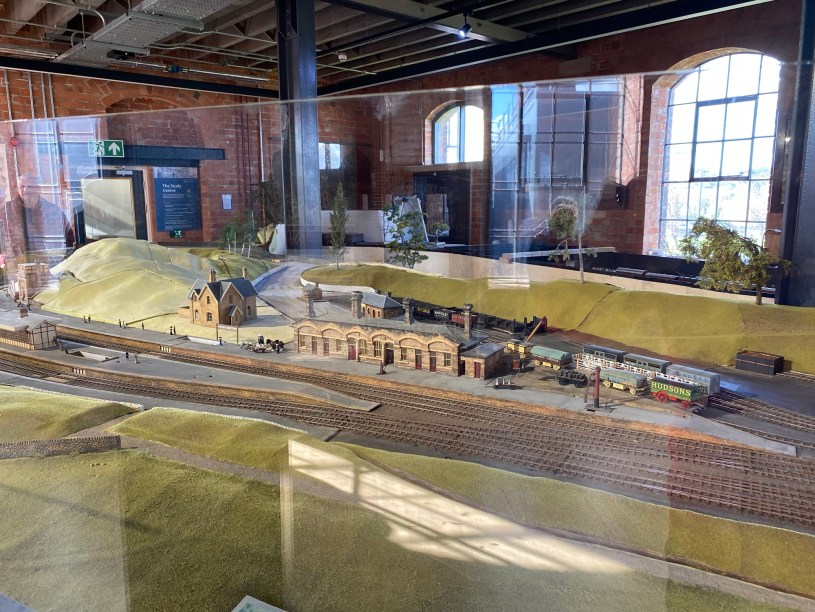
The canals opened up the Derbyshire coal fields to the Birmingham market. The railways were yet more ambitious linking Derby not only north and south but east and west with what became the Midland Railway promoted by George Hudson, the ‘railway king’. This company designed and built the first Derby manufactured locomotive in 1851. Its workshops became and their successor still is a major employer. The image is from the Derby Museum of Making.
The London Birmingham railway arrived in Rugby in 1838 and set up goods yards and workshops around which grew small engineering works. The Rugby railway story continued in 1937 when Sir Nigel Gresley proposed a Railway Locomotive Testing Station funded jointly by LNER and LMS. The war delayed its opening until 1948 and then it supported the development of the railways until the final test in 1965. The building was then used for railway research until demolition in 1984. Rail research continued in Derby.
Trams were appearing across the country and Birmingham’s Midland Railway Carriage & Wagon Company Limited were said to have built one of the first electric trams with Elwell-Parker Limited of Wolverhampton who manufactured and fitted the motor and all of the electrical equipment. Dublin engineer George Conaty joined the Birmingham and Midlands Tramsways Company which ran services between Birmingham, Smethwick, Oldbury, Tipton, Dudley, Sedgley and Crosley using both steam and electric powered trams. He went on to be manager of the City of Birmingham Tramways Company where he contributed his technical skills in patenting a new system for tramcar bogies. Conaty had been apprenticed to Thomas Green and Son in Leeds which built locomotive and tramway engines. Conaty may also have been inspired by the Aberford Railway on which he travelled daily and which had transported coal to the depot on the Great North Road. Other manufacturers included English Electric of Preston, Brush of Loughborough and Metro Cammell in Oldbury which had been set up by Jospeh Wright in 1846 and later merged with other railway manufacturers and was in 1928 owned jointly by Vickers and Cammell Laird.
I write more in How Britain Shaped the Manufacturing World and in Vehicles to Vaccines..
 British Manufacturing History