
The eighteenth century saw Glasgow transformed from a poor Scottish port to the second city of the British empire. This it did through trade with the West Indies and the Chesapeake area of Virginia. This was warehousing rather than manufacturing. Glasgow merchants would buy tobacco crops grown by slave labour in Chesapeake, ship it to Glasgow and store it in warehouses prior to onward sale often to France. Payment would be by means of exchange of linen often sourced from Ireland or Continental Europe and iron goods from Glasgow itself or from Scandinavia. It was immensely lucrative and merchants grew very rich.
Glasgow became the port of choice for America after the Act of Union with England and because the trade winds carried ships to the north west coast. At first the Port of Glasgow was used but cargoes then had to be transported by smaller ships further up the Clyde to Glasgow. Later a channel was dug to enable ocean going ships to travel up the Clyde.
The American war of independence put an end to Glasgow’s role in tobacco with the newly independent nation trading directly with customers.
Tobacco was succeeded by sugar which was already a significant Glasgow trade as evidenced by the Sugar House in which the McNair family processed the imported sugar close to ther similar establishments. The enduring memory of these trades is held by the names of key Glasgow streets:
Virginia Street (Tobacco/Colony/State)
Jamaica Street (Sugar)
Glassford Street (John Glassford, a Tobacco Baron )
Buchanan Street (Andrew Buchanan, member of family of Tobacco Barons)
Dunlop Street (Colin Dunlop, Virginia Merchant and founding partner in the Ship Bank.)
This birth of international trading gave to Glasgow the seeds from which shipping lines would grow, but also the international trading companies and from them banking. For shipping, P&O stands out owned by Lord Inchcape chairman of the international trading company of the same name. Possibly of greater significance to Glasgow as a city was William Burrell whose successful shipping company created the wealth which he used to create the Burrell Collection which he bequeathed to the city. In terms of traders, Jardine Matheson trace their roots to Glasgow.
The demise of tobacco left many formerly wealthy men nursing losses. Fortunately there were those who spied opportunity first in cotton and then in iron.
Coal mining was huge and large quantities were exported as well as being used to produce pig iron from local ore. This was a low value bulk industry. There was comparatively little local demand for iron and the cost of transporting Glasgow pig iron to the manufacturing areas discouraged expansion.
Ireland was far from being the whole linen story. In Glasgow, linen was produced from locally grown flax. At the time of James VI this was a cottage industry with spinning and weaving in the worker’s own home. Demand for Scottish linen leapt when the kingdoms were united in 1707 and by 1770 Glasgow was probably the largest manufacturer of linen in Britain. In time as elsewhere mechanisation crept in. The north of Glasgow was blessed by two rivers of fast flowing clear water. The river Levin taking water from Loch Lomond served the Turkey red dyeing industry and the river Kelvin supplied dye-works but also paper mills. Water also powered spinning and weaving mills meaning that steam power came much later to Glasgow. Later skills were adapted to the spinning and weaving of cotton. In 1860 there were 20,000 looms being operated in the city. The New Lanark mill run by Robert Owen set an example of rare good employment practices.
Cotton, which had started in the country with Scotland’s first mill at Penicuik, was important for Edinburgh but it spread throughout Scotland so to Dumfriesshire, Stirlingshire, Aberdeenshire and Perthshire using water power. The adoption of the steam engine changed all this, with a migration to the coal rich areas around Glasgow and Paisley.
It was possibly the cotton industry which attracted the American Singer to build his British sewing machine factory on the Clyde.
Castle Precision Engineering offers a wonderful story of the history of manufacturing in this great city. Its founder was Polish from Krakow, born in 1921 Jack Tiefenbrun arrived in 1938 and studied engineering. His first job was in the textile industry, maintaining machinery. In 1951 he set up his own company, Textile Engineering Company whose major customer was Singer Sewing Machines. This became Castle Precision.
Iron and steel were to be fundamental to the Clyde’s industries. The Clyde Ironworks were built in 1786 by the Edinburgh Cramond Ironworks run by the the Cadell family and their manager Thomas Edington, in conjunction with two Glasgow iron men. A young man, David Mushet, came to the works in 1791 and discovered a rich deposit of native ores – the black band ores. The works were supplied with coal by James Dunlop and in 1810 his son Colin Dunlop bought the Clyde Works from the Cadell family. (Colin Dunlop was the grandson of the Virginia tobacco merchant of the same name) In 1798 the Calderbank Iron Works was formed at the end of the Monklands Canal. These two works used the black band ores to meet the relatively small local demand.
A breakthrough came in 1828 with Neilson’s patent of an improved application of air to produce heat in fires, furnaces and forges – the hot blast, the rights to which Dunlop bought together with two others. The use of hot air massively reduced fuel consumption and allowed the use of coal rather than coke. All this worked to reduced the cost of Glasgow pig iron to below or equal that of other iron producing areas. The hot blast worked well with black band ores. Within seven years the method had been improved and spread and blast furnaces sprang up like mushrooms. The Clyde steel industry was set for a meteoric rise. In 1897 the Dunlop family bought the Calderbank Steel works , the iron works having closed, adding it to the Clyde works which were also exploring steel.
Thomas Edington gradually moved his investment into engineering and foundry work at the Phoenix Iron Works where together with his sons he manufactured steam engines and boilers and well as a large variety of iron castings. Thomas became a respected mineralogist and Fellow of the Royal Society of Edinburgh, lending his name to a newly discovered barium-bearing zeolite mineral “Edingtonite”.
Andrew Carnegie was a Glaswegian who left for the USA and there created the major steel company that bears his name.
Colvilles at their Motherwell works were set to become a major steel producer. David Coleville had built the Dalzell Iron and Steel Works in 1872. This works supplied the steel for the replacement to the Tay Bridge. By 1914, the company’s works in Motherwell had some thirty open hearth furnaces. The Ministry of Munitions encouraged them to increase capacity which they did at Glengarnock and Clydebridge. Their total production increased from 318,000 tons in 1914 to 792,350 tons in 1918. I write in chapter x about the major manufacturing effort in Glasgow in the First World War.
In 1911, Harland & Wolff had taken a presence among the city’s shipbuilders. In 1916, they, together with John Brown, took a share in David Colville’s Motherwell works. Four years later the Harland increased to gain control.
In the 1930s they brought together in Colvilles the Dalzell, Clydebridge and Glengarnock works with, from James Dunlop and Company, the Clyde Iron Works and the Calderbank Steel Works at Airdrie with their associated collieries. They also took over from Beardmore their plate, section and rail business. Four years later they took over the plate business of Stewart & Lloyds and also that whole of Lanarkshire Steel and the Steel Company of Scotland.
The Clyde Iron Works were bought to provide hot metal to their Clydebridge Steel Company. Colvilles rebuilt the former and created a massive integrated business. One part of this rebuilding involved building a bridge across the Clyde to carry molten iron to the steel works. Colvilles were already technologically advance having embrace massive rollers manufactured by Davy.
In the sixties, Colvilles Ltd at Ravenscraig had the largest hot strip steel mill in western Europe. It closed in 1992 and is now being developed as a New Town. There was also Gartcosh Iron and Steel Co and indeed many more. Another major player was Stewarts which would join with the Birmingham tube maker Lloyd & Lloyd and in the thirties promote the building of a major integrated tube steel plant at Corby in Northamptonshire of which I write more in this link.
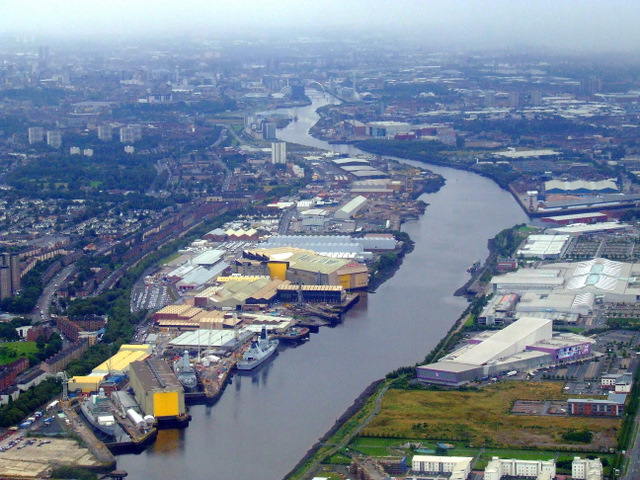
Shipbuilding has a long history on the Clyde with its banks, at the turn of the twentieth century, having yards side-by-side for seven miles. Such was its capacity that at one time it produced getting on for one half of the world’s shipping. As elsewhere, it began with wood and sail and then progressed to iron, steel and steam, although its clippers would be launched until the 1890s given the need for steam ships to carry massive quantities of coal to fuel their boilers. Fuel consumption improved as advances in the use of steam made engines more efficient and the days of sail became restricted to yachts, a major pastime of wealthy Glaswegians although yachts too were increasingly steam powered.
I tend to think of shipping as ocean going; for Glasgow and the Clyde a good deal was for more local transport with paddle steamers making their way up and down the river and as far as Fort William and even Ireland. The city has entrepreneurs such as John Bell and David MacBrain to thank for this. The canals too helped with communication, linking East to West.
Ships built of iron on the Clyde look first to Robert Napier and the Parkside Iron Works. Shipbuilding was seen as a logical extension to iron and steel making and so John Brown of Sheffield bought the J & G Thompson Yard on the Clyde and later built the Queen Mary and both Queens Elizabeth along with many others. Thompsons had already built the first steel ship used to carry the Royal Mail, RMS Servia owned by Cunard. Among the other great yards were Yarrow and Fairfield. Howden invented the Scotch boiler, ‘which, combined in a cylindrical tank, raised pressures to 80 lb psi’. The American Babcock and Wilcox developed the design with a water-tube boiler aimed at increasing temperatures and pressure further. It seems that the water-tube system did not catch on with the British, and the full potential of the Scotch boiler would only be realised somewhat later, when combined with the triple-combustion engine. Babcock set up a manufacturing facility in the UK in Renfrew in 1895. Barclay Curle brought diesel powered ships to the Clyde.
The Lithgow family at onetime owned all the yards in Port Glasgow. The company expanded vertically by acquiring the steel makers, James Dunlop & Co. In 1931 they later joined with David Colville and sons to create Colvilles. In the interwar years, they were the largest shipbuilder on the Clyde.
Ships were not only built on the Clyde, they were operated by Glasgow shipping lines, not least Cunard, and crewed by Glaswegians with Scots engineers renowned for their skills. As well as the trans-Atlantic trade, they also journeyed to the East with Glasgow manufactures.
One of Scotland’s great engineering companies, the Weir Group, is based at Cathcart in Glasgow and comprised a foundry, machine shop and fitting areas. A later building was the first in Scotland to be built of reinforced concrete and was designed and constructed by Weirs based on the influence of the Packard building in the USA. From the start, Weirs were most emphatically international in their outlook. This company was founded by two brothers who had been drawn into steam engine developments particularly for shipping. Steam power was all very well, but early steam engines used massive quantities of coal which both restricted the length of journeys between stops for coaling and limited the amount of cargo that could be carried; coal is bulky. So the challenge for Wears was to improve the efficiency of engines. This they did by improving feed pumps and then through the invention of the closed feed heating system which still remains in use for power stations. A further issue was corrosion caused by the impurities in water. Weirs addressed this by evaporating sea water, a technique which they later developed for major land based desalination plants. The equipment which Weirs produced had to made to fine tolerances and this lead to the development of machine tools and the use of standard parts.
With this marine background, the principal business of the Group became heavy duty pumps with applications in the electricity generation and oil industries. An early oil application was the the Glasgow based Burmah Oil from which a contract for Anglo Persian was won in connection with their Abadan refinery.
Glasgow was known as the second city of the Empire and boasted buildings that spoke clearly of its civic pride. Like all cities of the industrial revolution, the living and working conditions for most of its population were dire and only started to improve as the nineteenth century drew to a close.
William Beardmore probably stands out as the most ambitious and entrepreneurial of the Clyde shipbuilders. At the turn of the twentieth century, the British government increased its demands for naval vessels most particularly for the giant Dreadnaught class battleships. These would require much larger births than were generally available and so Beardmore set about building a truly giant yard on Clydebank. Financed in part by Vickers, Beardmore bought first the Parkside Iron Works and then went on to build a state of the art production facility for naval vessels at Dalmuir on Clydebank. It had a fitting out basin of 7.5 acres and had a massive hammer head crane capable of lowering boilers and engines into the ships. I noted that the crane was German made, but that British manufacturers followed its design for similar cranes in other yards.
Guns for both the navy and army were made by Beardmore and I wrote of this in Ordnance, my book on how the army was supplied for the Great War. One prewar project was for an early aircraft carrier which never became a reality; another was for airships which were produced.
In the First World War, National factories were built in Glasgow for shell filling and cartridges and at Cardonald for the production of fuses and tubes. Beardmore manufactured 18 pounders and 6 inch howitzers at their plants at Parkhead and Dalmuir. Beardmore became involved in aircraft production when, in late 1914, it acquired the licence to manufacture Austro-Daimler engines. It later worked as a subcontractor for Sopwith Pup biplane fighters and went on to design and manufacture their own aircraft. Weir Group also became heavily involved principally in supplying the navy with pumps and related equipment but also in the production of armaments and aircraft.
The ravages of the twenties sounded the death knoll for Beardmore much as they inflicted pain on so many others – unemployment reached 30% at one point. In the 1930s National Shipbuilders Security Limited (NSS) was set up ‘for the purpose of purchasing redundant and obsolete shipyards, the dismantling and disposal of their contents, and the resale of the sites under restriction of further use for shipbuilding.’ Among the largest were, in 1931, Beardmore which relinquished thirteen berths and one hundred thousand tons of capacity. The yards finally closed in 1936.
The Bearmore site was repurposed as a Royal Ordnance engineering factory in the Second World War and had 2,500 skilled and unskilled workers producing gun barrels, anti-aircraft guns and other heavy armaments. At Cardonald another Royal Ordnance factory produced three and a half million 25lb shells and many thousands of heavy bombs. A Rolls-Royce shadow factory at Hillington manufactured Merlin engines. Albion Motors manufactured heavy vehicles: an artillery tractor for towing 7.2 or 6 in howitzers, the Albion CX 24S, a 20 ton semi-trailer which could take a Crusader; the Albion BY 1 used to move mobile bridge sections and the Albion CX22 6×4 also a heavy gun tractor. West of Glasgow is the village of Bishopton where a Royal Ordnance factory made munitions; it is now run by BAE Systems. The Clyde dockyards, John Brown and Barclay Curle which had survived the depression, produced many tons of shipping. Alongside all this production, machine tools companies gravitated to Johnstone and contributed greatly to the war effort.
The Second World War was significant for Weirs in two particular ways. William Weir had become very much a public figure. I write elsewhere of the Weir Report which lay the foundation for the National Grid. In the William Weir conceived what became the Shadow Factory scheme of which I write elsewhere. Weirs themselves operated a shadow factory to manufacture field artillery as well as continuing their core business.
In the fifties, Weir comprised they Cathcart operation plus Drysdales which made diesel centrifugal pumps north of the Clyde at Yoker. In response to the nation’s need for housing, the Weir Housing Corporation at Coatbridge began making prefabricated dwellings firstly with steel frames and then, as steel became scarce, wholly out of wood.
Weir’s history was proudly told by Viscount William Weir in The Weir Group – the first 150 years of a Scottish Engineering icon. He relates how, in the sixties, the company well known for pumps and valves, looked to diversify. Perhaps a core diversification was into foundries and it both acquired existing plant and built new. The existing plant was Hadfields in Sheffield and the new one at Knowsthorpe just outside Leeds. These were very much state of the art and had capacity to produce precision castings of many types. Weir provided plant for desalinating of water where drinking water was in short supply in the Channel Islands and in the Middle East.
William Weir offers a perspective on the seventies. In short, they were dire: rampant inflation, a worldwide recession, strikes and a stock market collapse. Weirs went through a painful refinancing and eventually a change of direction and location into minerals extraction plant manufactured worldwide. I write about it in Vehicles to Vaccines.
Following the end of the war, the Clyde like other shipbuilding areas was busy replacing what had been post in war. Thereafter the Clyde in common with the rest of the British shipbuilding industry began to feel the pressure from overseasmany of which had had to re-equip their shipyards after the devastation of war. The sixties saw the new Labour government intervening first to save Fairfield at Govan but then to support proposals for consolidation. On the Clyde this meant Upper Clyde Shipbuilders comprising the Yarrow naval yard, Barclay Curle and Connells merchant yard and three mixed yards: Fairfields, Stephens and John Brown. The mix simply didn’t work; the new group started as insolvent and ended in liquidation in 1971.
The Upper Clyde presented an unusual problem in that the workforce staged a sit-in, keeping work going whilst the liquidator looked on. The government responded by appointing four wise men to come up with a proposed solution. This took the form of Govan Shipbuilders with a vastly reduced workforce and the Clydebank yard sold to Marathon Oil for work on North Sea Oil rigs. It is worth reflecting that this was the famous John Brown yard which had built many great ships most recently the QE2. Marathon sold the yard to Union Industrielle d’Entreprise, a subsidiary of the French Bouygues Group, in 1980.
BAE Systems now build naval ships at their yards at Scotstoun and Govan.
Railways came first to Glasgow in short runs from the coal fields, but then linked East to West, ventured further north and crucially linked the two countries. The Caledonia Works at nearby Kilmarnock built many railway locomotives. Beardsmore too at one time tried their hand at locomotive manufacture. In 1903 the North British Locomotive Company had come into being by the merger of three smaller manufacturers. The new company had produced 5,000 locomotives by 1914 and towards the end of the war built the prototype of the British American mark VIII tank.
The Glasgow steam exhibition of 1891 highlighted Robey & Co of Lincoln, whose horizontal cross-compound engine powered a Mavor & Coulson dynamo producing 350 kw at 550 volts. Mavor was an established manufacturer of mining machinery who had contracted to start the supply of electricity to Glasgow.
The Leblanc process for producing soda for the textile industry had been embraced by Tennants of Glasgow which brought together the other Leblanc companies into the United Alkali company. Charles Tennant’s Rollox Street bleaching agent factory was the largest in Europe, at the same time polluting the surrounding area. The far less polluting Solvay method was better suited to the minerals of Cheshire, and the Glasgow factory eventually shut. Also in Glasgow, Charles Macintosh discovered a way of using rubber to provide waterproofing which resulted in the garment that bares his name; the company later moved to Manchester and became part of Dunlop.
McVitie made biscuits, perhaps picking up on the city’s sugar history. Equally Scottish but much bigger is whisky. The Clyde welcomed steamers laden with malt whiskies from the islands. In the city itself William Teacher set up a chain of tied houses selling his whisky in clean and respectable surroundings. Nearby was grocer Thomas Lipton who would become equally famous for his teas the world over. Teacher built the Ardmore distillery in 1898 from which came the famous Teachers Highland Cream. In support the Eddington Group manufacture casks. Whilst much distilling moved out of the city Strathclyde distillery remains. At Shieldhall, Govan, Diagio run the largest Scotch Whiskey plant producing millions of bottles of Johnny Walker each year for export to growing markets.
Burroughs of Detroit set up adding machine manufacture in Strathleven.
Glasgow remains home to BAE Systems shipbuilding and then has more of a focus on the service and financial sector.
Further reading:
- Maurice Lindsay, Glasgow: Fabric of a City (London: Robert Hale, 2001)
- Ian Johnson, Beardmore Built: The Rise and Fall of a Clydeside Shipyard)
- Anthony Slaven, British Shipbuilding 1500-2010 (Lancaster: Crucible, 2013)
- The Glasgow Region, Ronald Miller and Joy Tivy (Ed’s.) (Glasgow: The British Association, 1958)
- Michael Meighan, Glasgow A History (Stroud: Amberley, 2015)
- You can read more in my books How Britain Shaped the Manufacturing World and Vehicles to Vaccines
- I am grateful to Thomas Edington’s descendent, Russell Arthurton, for his research into the family history.
 British Manufacturing History