
The Romans set up forts across the land including Mamucio near Manchester, the latter name derived from Mamucio, in latin ‘a hill shaped like a breast’.
In many ways Manchester was the home of the Industrial Revolution. The mass production of cotton fabrics began there and its was this that drove the British economy. I tell much more on my book How Britain Shaped the Manufacturing World (HBSTMW)
Manchester like much of south east Lancashire benefited from a damp climate perfect for spinning. There were rivers with fast running water to power mills but also as a means of transport to the sea. Later there followed canals, first of all the Bridgewater and much later there followed Manchester ship canal. The railways added to the ease of transport. Coal was available locally to power steam engines. The soft water was ideal for washing textiles. Skills in weaving came with Flemish refugees. Spinning and weaving were first of wool and linen, but then of cotton.
The eighteenth century saw Manchester textile merchants grow their networks of outworkers to spin and weave the cotton that was being imported in ever increasing quantities. In time a factory system emerged with incremental steps of mechanisation and I describe these in the chapter on textiles in HBSTMW. Cotton mills were visible throughout Lancashire. The Museum of Science and Industry tells much of Manchester’s story. The early part was all about textiles, but then the machinery that made textiles and the other machinery that served this world.
Opinions differ on the both the significance and date of the introduction of machinery into the cotton industry and in particular the factory system. Roger Lloyd-Jones and M.J. Lewis, who also wrote the book on Alfred Herbert which shed so much light on British machine tools, explored these questions in Manchester and the Age of the Factory. Their methodology is interesting. We are talking of a period before the census and so the first question was just how to measure the relative importance of factories compared to the warehouses that stored and distributed the production of our workers. They chose rateable values taken from the Manchester Poor Rate Assessment Books which attribute to properties a market value which the authors argue reflect economic activity. I won’t go into the reasoning offered in support of this but rather refer readers to their book. I will, however draw upon their findings.
In looking at the properties in Manchester categorised as factories or warehouses and used in the cotton trade, the authors found firstly very few large businesses occupying whole buildings. Rather, the trade was fragmented with multiple occupation of both warehouses and factories. Looking at the factories, many were small workshops spinning yarn using the recently invented machinery. Weaving looms were predominantly hand operated since the early iterations of mechanisation were by their nature experimental. Manchester warehouses would act as merchants for yarn supplying the hand weavers and taking the finished product for onward sale. Spinners and weavers alike could be in the city or elsewhere in Lancashire.
To me this sounded like a sensible division of labour in an integrated process. Not so the reality of business in Manchester before and during the Napoleonic wars. The evidence is of a schism with the spinner selling their yarn to continental weavers. The Lancashire weavers suffered with unemployment the result. In HBSTMW I referred to the unrest and its expression in the Peterloo massacre. These were hard times.
Looking at living conditions, Gary Messinger paints a picture. ‘Streets were narrow, unpaved and usually muddy because of the frequent rains as well as slops thrown from the dwellings, refuse and human waste.’ Houses were usually in lengthy terraces built back to back such that there was no possibility of air passing through the building. Two stories were common as were cellars where new arrivals from country areas much live along with their few livestock. The terraced houses would be punctuated by large buildings belching smoke from their furnaces, sucking in their city’s 80,000 inhabitants drowning any chance of conversation with the clatter of machinery. A visitor in 1808 observed ‘the town is abominably filthy, the Steam Engines pestiferous, the Dyehouses noisesome and offensive, and the Water of the River as black as Ink of the Stygian Lake.’
In the aftermath of war and after much argument, the overall good of Lancashire business prevailed not least as looms became steam powered under a factory system. One line of argument was that factory based spinning was exploiting child labour just as the country was becoming aware of the damage caused by unregulated factories. In HBSTMW I noted that competition had driven down prices putting pressure on weavers to mechanise.
Looking at some of the mills, one of the biggest was owned by McConnel and Kennedy. They were spinners but later classified also as doublers. Tracing their story forward in time, they become McConnel and Co and then in 1898 were bought by the Fine Cotton Spinners and Doublers Association. This can then be traced through to Courtaulds, which, as I tell in Vehicles to Vaccines, brought together a large number of mills to secure the market for their man-made fibres.
Another mill developed into an integrated cotton manufacturer, Tootal Broadhust Lee, which carried out spinning and weaving under the same roof. The name Tootal readers may recall in the context of men’s shirts. The company became part of Coates Viyella in 1991.
Possibly the greatest name in Manchester cotton was John Rylands who had started business in St Helens. He set up mills in Manchester, Bolton and Wigan and the then largest bleaching and finishing works in the world at Chorley. His business achieved world-wide fame. The company was bought by Great Universal Stores in 1953.
Mechanisation began in the factory or workplace often by the spinner or weaver making his own quite basic machinery. Larger entities could employ engineers both to maintain machinery and develop and make new. At some point between 1815 and 1825 the demand for machinery became such that separate machine making businesses set up to serve the market of spinners and weavers. Lloyd-Jones and Lewis write of such establishments being located beside the Ashton and Rochdale canals. Business names are mentioned: Peel and Williams (the subject of a chapter in the book ‘Science & Technology in the Industrial Revolution’ by A. E. Musson and Eric Robinson), Ebeneezer Smith, Hewes and Rwen, Richard Ormerods, Radford and Waddington, Galloway and Company and the Fairburn Engineering Company. William Fairburn also built some of the early steamships and I write of him and other Manchester engineers in a blog with its focus on engineering. In another survey of Manchester, Alan Kidd, in Manchester, adds Mather and Platt in Salford and Curtis and Madeleines, Hetherington and Sons and Samuel Books in Manchester itself.
Lloyd-Jones and Lewis add to the metal workers, Dyers and Printers and describe all three as the ‘modern sector’. We are talking about the developments in bleaching with the use of chlorine, but also the experimentation with different dyes. These then combine with the metal workers when we bring in cylinder printing machines powered by steam. In terms of production, spinners, weavers, dyers and printers sometimes combined in single businesses. Thomas Hoyle is an example of integrated dyeing and printing. The company became part of the Calico Printers Association, which employed the inventors of terylene which ICI then developed, and which later became part of Tootal. Nonetheless a good part of the business remained in small units. An exception was Hyams which produced clothing from the textiles. For them, in Class 6 of the Great Exhibition catalogue, I came across an entry for C.T. Judkins of Manchester who was displaying a sewing machine capable of sewing five hundred stiches per minute. The relevance of such a machine shouts loud and clear when we look back at the 1851 census and the ‘third of a million milliners, dressmakers and seamstresses’. A sewing machine would have transformed their lives, but also massively have increased capacity for making clothes. I write more about the invention of the sewing machine in How Britain Shaped the Manufacturing World.
In 1914, the newly built Royal Mill in Manchester alone employed 30,000 and the Calico Printers Association with 20,000 dominated the market in printed cloth. Manchester had become a modern industrial economy and other developments followed.
The First World War highlighted a major shortcoming in the British’s chemical industry in relation to dyestuffs. In Blackley, Manchester a major firm was Levinstein and in Huddersfield Reed Holliday. During the war these companies and a number of smaller ones rose to the challenge and ensured that cloth for uniforms were dyed. They did not address underlying inefficiencies and the absence of chemical research. This was addressed in 1919 by the joining of the companies in the British Dyestuffs Corporation in Manchester. On the formation of ICI in 1926, they became ICI Dyestuffs division headquarters and its was from here that the Pharmaceuticals division began in the thirties.
Cussons made soap including Imperial Leather in Salford. Sarsons have been making malt vinegar for two centuries
For cotton, competition from overseas countries after the war resulted in a crash in demand. At the initiative of the Bank of England, the Lancashire Cotton Corporation (LCC) was formed in 1929 to try to merge some of the many hundreds of spinning companies operating millions of spindles. It was very much an uphill task and the industry continued to decline. LCC was eventually taken over by Courtaulds in 1962.
In the nineteenth century Joseph Whitworth (located opposite Richard Ormerod) was manufacturing screws following his own design. (I write more about him in my blog on Manchester engineers). His company expanded into arms production and as such was a rival to Armstrongs in Newcastle.
Joseph Whitworth was becoming tool maker of repute. At the time of the Crimea he was invited by the War Office to put forward proposals for rifled guns. Whitworth conceived a rifle barrel cut and drilled from a solid iron (later steel) bar. It would fire a hexagonal bullet or shell. The Army establishment wanted to stay with the tried and tested. The War Office favoured William Armstrong’s offering which I described in How Britain Shaped the Manufacturing World. Yet there is much evidence that the Whitworth performed better in trails; it was more accurate, had a superior range and was more powerful in terms of breaking through armour plating. The competing arms were observed in action in the American Civil War on both sides, although more so for the Confederacy; Whitworth guns were viewed as clear winners both at sea and on land. However, they only really performed well if supplied with hexagonal ammunition. The problem was that in the heat of battle, artillery men would use what was to hand and inappropriate ammunition damaged the Whitworth guns. The Manchester Ordnance Works at Openshaw run by Whitworth could have produced more but Whitworth was reluctant to make the necessary investment without War Office backing. In spite of all this, Whitworth is acclaimed for his contribution to the design and practice of arms production.
The matter was settled by a merger followed in due course by a further merger with Vickers. The works at Openshaw became part of the English Steel Corporation owned by Vickers and Cammell; it was brought into British Steel on nationalisation. Lancashire Steel’s plant at Irlam was developed further in the 1930s to take advantage of its proximity to the Manchester Ship Canal. Beyer and Peacock built railway locomotives in Openshaw. Charles Beyer had been chief engineer at Sharp, Roberts & Co and Richard Peacock had spent time with both GWR and the Manchester & Sheffield railway. Together with Scot Henry Robertson they developed a business that in a little over a century manufactured some 8,000 locomotives for railways around the world. One of their most famed though was for the Metropolitan railway in London (the early Tube).
Openshaw was also home to Crossley, beginning as general engineers but then with a focus on motor transport. Crossley Road is home to the United Biscuits factory making McVitie’s, Jacob’s and Twiglets.
Trafford Park in Manchester, built by the notorious entrepreneur ET Hooley, in 1897 became home to British Westinghouse. I write of them in my blog on the American Electricity Industry. The British market was becoming attractive and Westinghouse set out to compete with his fierce rivals British Thomson Houston and Thomas Edison who had combined in General Electric and set up in Rugby. In Manchester, British Westinghouse later became part of Metropolitan Vickers by series of financial moves which I describe in HBSTMW. It then joined with its fierce rival as part of AEI and in turn became part of GEC which had a significant presence in the city: GEC Turbine Generators and Switchgear and GEC Traction. GEC had started life in Manchester in 1886 by the coming together of Hugo Hirst and Gustav Byng. They began investing in lamp manufacture in 1893; in 1909 this part of their business would become Osram. GEC under Hugo Hirst came into its own during the First World War supplying lamps and motors for ships, arc generators for wireless sets, cables and electrical instruments for telephones and carbons for searchlights. It was also able to acquire the whole of Osram which previously it had only part owned. In the early twentieth century, they had Telephone Works in Manchester and the Instrument Works in Salford. Telephone manufacture moved to Coventry in 1919. Metro-Vick made radio sets in Trafford Park.
British Insulated Cables which produced cables and overhead transmission systems in Prescot. One of its founders had visited America and seen how paper could be an excellent insulator. A company was formed with Sebastian de Ferranti, Colonel Pilkington of St Helens and others and paper insulation was adopted into cable manufacture. Ferranti used paper insulation for his cables carrying 11,000 volts at the Deptford Power Station. British Insulated Cables became the largest employer in Prescot manufacturing many miles of cable for customers across the world, including Britain’s national grid. The company merged with Callenders Cables of Erith in 1945. BICC entered into a joint venture with Corning to make fibre optic cable on Deeside. In addition to Prescot, BICC had factories in Kirkby, Melling and Helsby. BICC power cable business was sold in 2000 and some factories were bought by the Italian Prysmian.
Trafford Park was also home to Ford UK, before the latter moved to Dagenham, and part of the Dyestuffs division of ICI which first manufactured Penicillin. Courtaulds had a chemical works on Trafford Park. The Kellogg company of America manufactured the breakfast cereal in Trafford Park but are moving production to a massive new factory in Wrexham.
Withenshaw to the south of Great Manchester was home to the AEI (later GEC) transformer factory. AV Roe began building aircraft in Brownfield Mill and later moved to Newton Heath where Mather & Platt’s vast works produced pumps and electrical machinery.
W and B Cowan made gas meters and appliances and later became part of Parkinson and Cowan.
In the Second World War, Patricroft Royal Ordnance factory was built on the site of the former Naysmith Engineering Works, originally established in 1834, by the Bridgewater Canal in Eccles on the outskirts of Manchester. Employing 3,000 people, it specialised in welding and fabrication, also making parts for Bofors guns. As a precursor to the city’s role in alloys and new materials, a shadow factory run by Magnesium Elektron (now part of Luxfor Group plc and still manufacturing in Manchester) produced magnesium alloys.
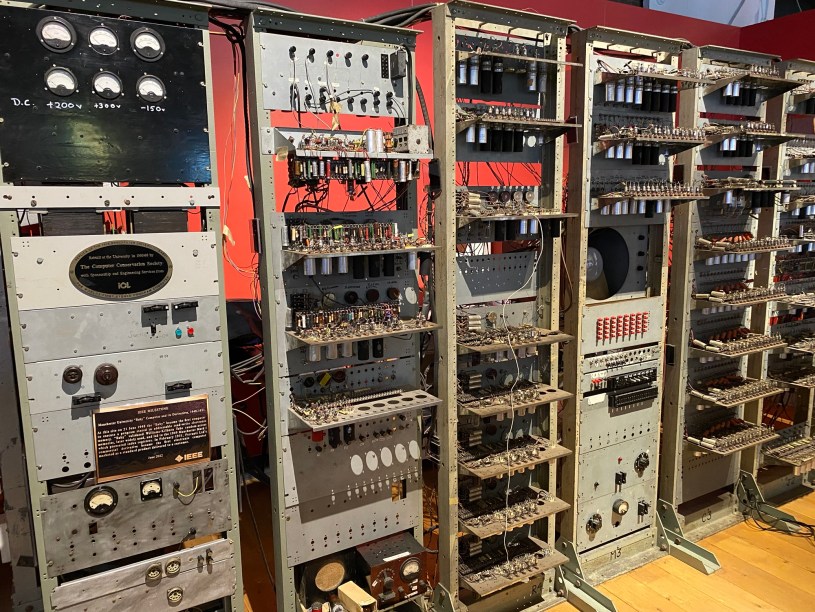
The city was home to one of the early computers manufactured by Ferranti in conjunction with Manchester University. You can discover more at the Museum of Science and Industry. I tell more about the evolution of the British computer industry in Vehicles to Vaccines.
Ferranti had a significant presence. In Hollinwood they made electricity meters and at Chadderton power transformers and testing equipment and also semiconductors and opto-electronics. Moston was where they made instruments, aircraft equipment and fuzes. Process control computers were made at Withenshaw and simulator, sonar and civil computer systems at Cheadle Heath. Computer systems and (post 1975) the company HQ were at Gatley. I am grateful to John F. Wilson for including this detail in his Ferranti A History. The images are of some of the early computers on display. Many of Ferranti’s buildings became part of ICL – some of their products are shown below and are on display at the museum.
The significance of Manchester University needs to be recognised. It was home to Rutherford and Nuclear Physics and to Bernard Lovell and Jodrell Bank. Manchester Metropolitan University brought together a wide spectrum of colleges committed to furthering access to education; Joseph Whitworth was one of the founding fathers.


Manchester is a city that does not stand still. One successful piece of exploration was graphene, and the Museum of Science and Industry describes how this thinnest possible material was ‘first isolated by scientists at the University of Manchester in 2004 using ordinary sticky tape’. The scientists involved, Andre Geim and Konstantin Novoselov, were later awarded a Nobel Prize for their work. In his paper on nano materials, Robin McIntyre from PERA sets graphene alongside other carbon-based nano materials, and other such non carbon-based materials nano titanium dioxide and nano-ceramics. These materials are already being used to enhance properties of more common materials such a concrete which graphene strengthens allowing smaller quantities to be used. I also refer to graphene as a material for use in semiconductors. Their potential uses are manifold. Siemens UK manufacturer automotive and drive technologies at Sir William Siemens House, an echo of the former British Siemens Brothers.
Further reading:
- Alan Kidd, Manchester (Keele: Rayburn Publishing, 1993)
- Roger Lloyd-Jones and M.J. Lewis, Manchester and the Age of the Factory (London: Croom Helm, 1988)
- Gary Messenger, Manchester in the Victorian Age (Manchester: Manchester University Press, 1985)
- You can read more in my books How Britain Shaped the Manufacturing World and Vehicles to Vaccines
 British Manufacturing History