
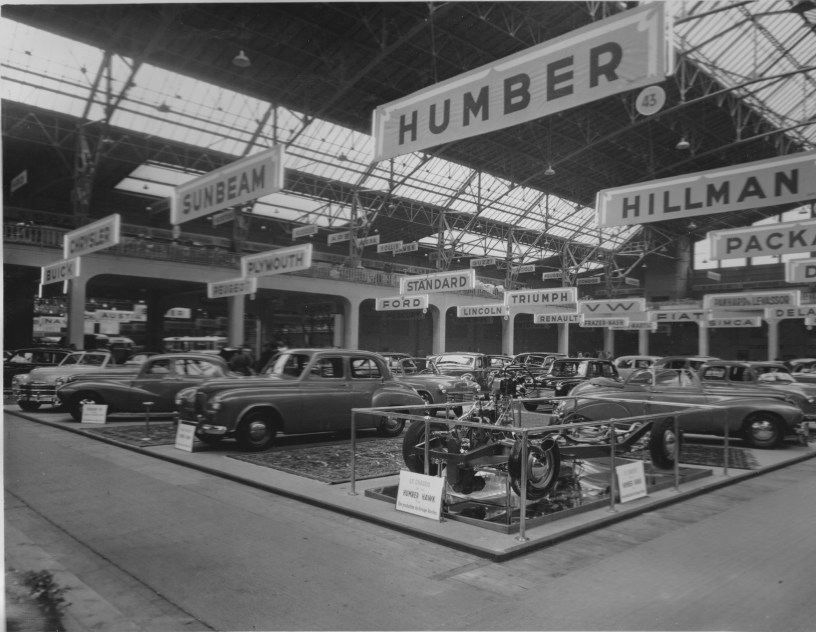
I write of the motor industry in How Britain Shaped the Manufacturing World (HBSTMW) and in three chapters of Vehicles to Vaccines: Volume Car Makers, Speciality Car Makers and Commercial Vehicles and Motor Component Manufacturers. The image is of the Geneva Motor Show in 1948 where the Rootes Group, one of Coventry’s finest, are seriously engaged in the post war export drive. Rootes did of course make commercial vehicles: Commer in Luton and Karrier in Huddersfield.
The city of Coventry, long associated with the story of Lady Godiva, had as its early industry the making of soap. Then a major industry developed in the making of ribbons. This trade it shared with neighbouring Nuneaton, Bedworth and much of north Warwickshire. The trade prospered until 1860 and the passing of a law which allowed imports; thereafter Coventry and its neighbours found themselves undercut except for woven tapes. J & J Cash remains in Coventry as manufacturers of name tapes amongst much else.
The other Coventry industry, a child of the industrial revolution when time became relevant to people’s lives, was the making of clocks and watches. The city wasn’t alone in this but it was significant. Nearby Lutterworth was home to the Corrall family who started making clocks in 1727.
Things mechanical had been made by skilled and inventive people for centuries. The clock and watch are perhaps the most visible, but there also many tools used in the workshops of Birmingham, for example, which meant that in Britain there were skilled ‘mechanics’ a plenty. The story of British clockmaking is told in a lovely short book by Kenneth Ullyet, British Clocks and Clockmakers. It is a story of craftsmen, taking an idea which came from Italy and developing it in a very British way. He tells of the City Livery Company of Clockmakers, aimed at keeping foreign craftsmen at bay, but also of the famous clockmakers, not least Harrison and his chronometer which mastered the calculation of Longitude. Whilst Britain had many skills, it didn’t have a watch or clock manufacturing industry of any magnitude. The same was true of the sewing machine. As I shall show, it was in the bicycle that British manufacturing once again came to the fore.
Kenneth Richardson in his book Twentieth Century Coventry writes of how in the nineteenth century ‘watchmaking was beginning to supplant [the ribbon trade] in the affections of young men who wished to acquire a skill’. From this grew many small workshops, working in much the same way as their counterparts in London’s Clerkenwell, but also factories such as Rotherhams and the Coventry Movement Company. The industry largely died with the impact of Swiss competition but it did equip the city with skills it would need for its push into vehicles of all kinds. In How Britain Shaped the Manufacturing World I suggest that the skills employed in making sewing machines also translated into the industry of bicycle making.
Richardson does take one important step back by bringing onto centre stage Alfred Herbert. I write in Vehicles to Vaccines of the fundamental importance to manufacturing industry of machine tools. Herbert, the son of a builder, began in 1887 in general engineering but he gravitated toward machine tools and in 1914 was employing 2,000 men making him the largest machine tool maker in England. In time Coventry attracted other machine tool makers including Charles Churchill who brough American machine tool practice from his native USA. Another American, Oscar Hamer, joined Herbert as his general manager. Alfred Herbert subsequently moved to larger premises in Lutterworth. It was taken over by the TI Group. I write more of the machine tools industry in Vehicles to Vaccines and of its early days in Coventry on this link.
The manufacture of bicycles in numbers sufficient to supply the market required these machine tools but also entrepreneurs.
The Coventry Riley family had been a ribbon manufacturers but turned their hands to bicycles. From Sussex came the Starleys and George Singer. William Herbert, Alfred’s brother, joined Londoner William Hillman. Thomas Humber came from Beeston just outside Nottingham and Daniel Rudge came over from Wolverhampton. I write about the development of the bicycle industry in How Britain Shaped the Manufacturing World.
Crucial to the success of the bicycle was the pneumatic tyre. Scottish born John Boyd Dunlop, whilst living in Belfast, developed the pneumatic tyre which both greatly improved the comfort of riding a bicycle but also its speed. With Harvey du Cross, he set up, in 1888, what would become the Pneumatic Tyre Company. It began producing tyres in Dublin but then moved to Coventry and in 1896 taking new premises and also premises vacated by the Singer Motor Company. du Cross would also become an investor in the Triumph Motor Cycle Company founded by Siegfried Bettmann. Financier Ernest Terah Hooly purchased of the Pneumatic Tyre Company for £3 million and its immediate floatation as the Dunlop Pneumatic Tyre Company for £5 million. The Economist of 30 July 1898 wrote:
‘On the strength of the Dunlop deal, Mr Hooley came to be regarded as the Napoleon of Finance. At his word, Capital could be created by the million and fortunes could be made as if by a magician’s wand. There have been many successful company promoters, but Mr Hooley was to eclipse them all alike, in the variety of his schemes and in the gigantic profits provided by them not only for the great financier but that everybody connected with him.’
John Siddeley set up the Clipper Tyre Company but would later move into making motor cars forming the Siddeley-Deasy Company which then merged to become Armstrong Siddeley. A parallel business Armstrong Siddeley Developments focused on engines for aviation and later became part of Hawker Siddeley and eventually BAE Systems.
At the start of the twentieth century the making of artificial silk from viscose fibres was being explored in a number of place including Kew. Courtaulds decided to enter the business when much of the experimentation had been done but before it was complete. They took a licence on the Kew process and acquired land at Foleshill just outside Coventry. This city had a history of silk by ribbon making and had available female labour given the coal mining in the area. Water was on hand from the nearby canal. Courtaulds insisted on having a controlling influence on the Kew activity. The chemical processes became central to Courtaulds business, but inevitably it took a few years for the processes to be refined and for profits to flow. By 1912, Coventry was employing more people than the Essex textile mills. The textile mills, however, were fundamental to the success of Courtaulds viscose yarn since they could and did explore a wide range of uses for the new material and fead back the results to both chemists and sales force. Before the First World War the company had been successful in knitting stockings with viscose yarn which offered a crucial extension. Courtaulds was having influence outside Britain not least in setting up American Viscose Corporation which would in time contribute over half of their profits.
The First World War, with its insatiable demands on industry about which I wrote in Ordnance, provided a major boost to Coventry as a growing city of manufacturers. The City of Coventry official handbook reports that ‘it is safe to say that no English city was so completely absorbed in munitions production as Coventry…It was not merely a question of adaptability of existing facilities. New factories sprang up in such numbers and on such a scale as to change the whole face of the city in the matter of a few months. New suburbs grew up like mushrooms, thousands of strangers of both sexes flocked to Coventry from all parts of England in answer to the call for munitions.’ Cammell Laird and John Brown joined with Fairfield Shipbuilders in investing in a business begun by carriage maker HH Mulliner and F. Wigley. The result was a massive and advanced Coventry Ordnance Factory built beside the Coventry canal which manufactured guns so big that machine tools were moved to them rather than the more conventional production line. I write of this in How Britain Shaped the Manufacturing World and my book on army supply in WW1, Ordnance.
Motor cycles and motor cars followed the bicycle. In March 1896, Harry Lawson set up the Daimler Company with fellow director, Gottlieb Daimler, and bought the Daimler patents from The Daimler Motor Syndicate Limited; Frederick Simms became a director as consulting engineer. The new company took a lease on a fourteen acre site in Drapers Field, Coventry and began production. It was Britain’s first motor factory.
The city telephone and other electronics companies including British Thomson Houston (BTH) from neighbouring Rugby. BTH manufactured radio equipment in the First World War.
In 1915 GEC bought the Copeswood estate at Stoke in Coventry to build a new factory in which it made radios and other domestic electrical equipment. Six years later it moved its Peel-Conner telephone manufacturing operations from Manchester to the site, a move that coincided with the GPO (Post Office) standardising their accepted telephone designs. In 1920 it added the Magneto Works. Over the years the company expanded, taking over a number of former Coventry factories producing a large proportion of the Strowger telephone system for the UK. By 1970 GEC, which had combined with AEI and English Electric, had seven factories in the city employing 30,000 people. Its production of the Strowger system ceased in Coventry in 1974. I write in Vehicles to Vaccines of the struggle for supremacy in the subsequent electronic telephone systems. GEC Telecommunications in Coventry was a keen contender.
Motor car manufacture grew like topsy following the end of the war. By 1931 there were eleven separate motor companies and forty that had tried and failed in the same period. I wrote in How Britain Shaped the Manufacturing World of how Daimler was first but with Lanchester, Siddeley-Deasy close behind. Morris bought the French Hotchkiss. Daimler was bought by BSA of Birmingham in 1920 who later also bought Lanchester. The Rootes brothers combined Humber and Hillman. Vickers had a presence in Coventry through their Wolseley subsidiary later bought by Morris. William Lyons brought the Swallow Sidecar company to the city where it became Jaguar. The Rover company had made bicycles but under the guidance of the Wilkes brothers became producers of luxury cars and, after the Second World War in which the Coventry factory suffered severe bomb damage, production including the new Land Rover moved to Solihull. Alvis set up in the city in 1919.
It wasn’t just the main manufacturers, components companies came. Birmingham’s Dunlop bought a wheel and rim manufacturer in the city and added to this its Aviation and Engineering Divisions. White and Poppe made carburettors and engines and Carbodies was established by a former Daimler employee. In 1921 Sir W.G. Armstrong Whitworth Aircraft Ltd was formed in Coventry and became pioneers in the development of all-metal aircraft. Armstrongs had bought the Siddeley Deasy Car Co Ltd in 1919. A move to Coventry and a reorganisation gave rise to the Armstrong Siddeley Motor Company with John Siddeley as chairman. Siddeley Deasy had manufactured airframes in Coventry during the First World War, its workforce growing from 500 to 5,000 over the war years.17 This avionics arm of Siddeley Deasy found a home in Sir W.G. Armstrong Whitworth Aircraft Ltd.
The Second World War presented yet further challenges for the manufacturers of the city. As I argue elsewhere, the war for the manufacturers began in the mid thirties with the building of the shadow factories for aircraft production and I write about this major initiative in How Britain Shaped the Manufacturing World. As well as providing vital capacity for the motor companies to supplement the production of the main aircraft companies, they provided space for the motor companies and others to expand when, after the war, the nation was desperate for exports to pay for imports of food and materials.
In Coventry, Humber supplied staff cars for all three services. The Humber FWD was a four wheeled drive small all purpose vehicle based on the Humber Super Snipe, and the BBC operated a fleet of these for war correspondents. The Humber 8 cwt 4×4 light field ambulance fulfilled a vital role in rescuing the wounded from the battlefields. The Humber scout car, also based on the Snipe, was essential equipment for almost all army divisions. The scout car and staff car were also manufactured by Daimler. Hillman produced a 5cwt 4×2 light utility based on pre-war 10 and 12hp passenger saloons, the Minx, which had been its best-selling model in the 1930s.
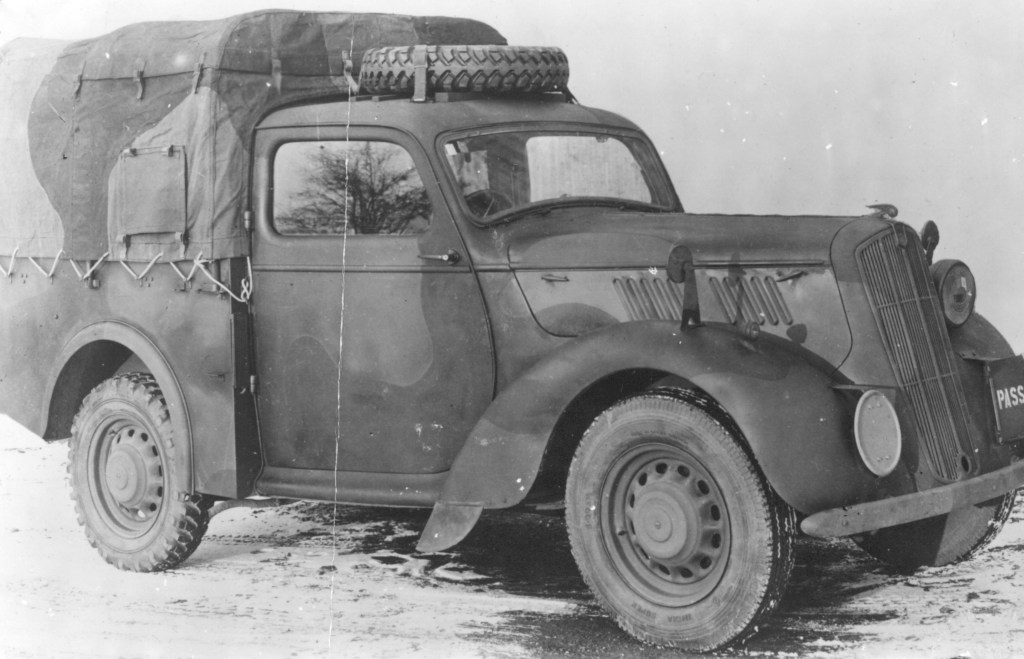
Between 1939 and 1945, BTH in Coventry and Leicester provided 500,000 magnetos for the RAF. BTH later became part of Lucas Aerospace. J.D Siddeley expanded his aircraft production at nearby Bagington. T.G John of Alvis became in effect a subcontractor to Rolls-Royce for the repair of engines. GEC manufactured the VHF radio link for the RAF enabling the Squadron Leader to communicate in flight with all his aircraft. Alfred Herbert manufactured some 65,000 machine tools and Gauge and Tool provided measuring devices for the huge armament industry. Morris had a large engine plant in Coventry and also a body plant. In the late 1930’s it built a further plant to manufacture Bofors Guns from the Swedish design. Hillman based at Ryton-on-Dunsmore close to Coventry, produced a 5cwt 4×2 light utility, commonly know as ‘Tillies’ and based on pre-war 10 and 12hp passenger saloons, in Hillman’s case the Minx, which had been its best selling model in the 1930s. Tillies were also produced by Austin at Longbridge (as shown in the image), by Morris at Cowley and by Standard Cars also in Coventry, based on the Standard Flying 14. Standard also took on the management of two shadow factories in the city producing aero engines. HM Hobson, producer of carburettors for aircraft, took on the management of a shadow factory which later passed to Standard.
The Second World War also brought a devastating night of enemy bombing on 14 November 1940 which destroyed the greater part of the cathedral and many factories including old cycle factories: the Coventry Machinists’ Works, the Rover Meteor Works, and the Triumph factory which relocated to Meridien in 1942. I write in War on Wheels how the people of the city rose to the challenge of the disaster.
Aviation came to Coventry with the shadow factories. Armstrong-Whitworth moved their aero business to the old RAF airfield at Whitley a little outside the city where they built a supersonic wind tunnel linked to a Ferranti Pegasus computer. Hawker Siddeley chose the site at Baginton that would become Coventry Airport for their production. Lucas aerospace had a presence in the city. I write of post-war aviation in Vehicles to Vaccines.
Sir Frank Whittle and the invention of the jet engine belongs to Midlands manufacturing towns. One of the two prototype engines was made by BTH at Lutterworth; the other by Metrovick in Manchester. Subsequent development through the company Power Jets was based at Whetstone just south of Leicester. I write of the early development of the jet engine in How Britain Shaped the Manufacturing World.
Coventry thrived with this combination of machine tools, motor cars, aeroplanes, manmade fibres and electronics. Courtaulds produced viscose fibres, had their acetate and synthetic fibres laboratory in the city and at Little Heath an acetate plant.
In 1950, Standard-Triumph manufactured 112,000 cars and the Rootes Group flourished producing 90,000 cars. Although smaller, Jaguar was exporting the Mark V and XK120 to the USA. In 1960, Jaguar bought Daimler and massively increased its production. My father was Export Director of Rootes in the fifties and I recall his frequent trips to Coventry as well as overseas.
For a whole variety of different reasons of which I write in Vehicles to Vaccines, the city’s manufacturing shrunk but did not disappear. Jaguar Land Rover have their corporate office at Whitley, the Manufacturing Technology Centre is based at Ansty Park and Aston Martin Lagonda is at Gaydon.
Away from the motor industry Coventry is home to Amtico Flooring.
Further reading
Kenneth Richardson, Twentieth Century Coventry (London: Macmillan, 1972)
Graces Guide
https://www.britishtelephones.com/
You can read more in my books How Britain Shaped the Manufacturing World and Vehicles to Vaccines
 British Manufacturing History