

Nottingham was the world’s centre of lace making. It had the largest manufacturer of bicycles in Britain and supplied pharmaceuticals to every British high street. How did it all begin and what happened?
Nottingham was one of the five Boroughs of the Danelaw along with Leicester, Derby, Lincoln and Stamford and certainly in common with the first two had an early traditional of frame knitting and I write of this more generally in my blog on Leicester manufacturing history. Duncan Gray, in his book Nottingham: Settlement to City, suggests that the knitting frame may have been invented in nearby Calverton by William Lee in 1589, but that the invention failed to catch on because of a lack of patronage from Elizabeth I. He took his machines to France but then in 1610 returned to London where the machine based manufacturing was established ; some machines made their way to Nottingham and from there the trade grew and became the town’s principal industry.
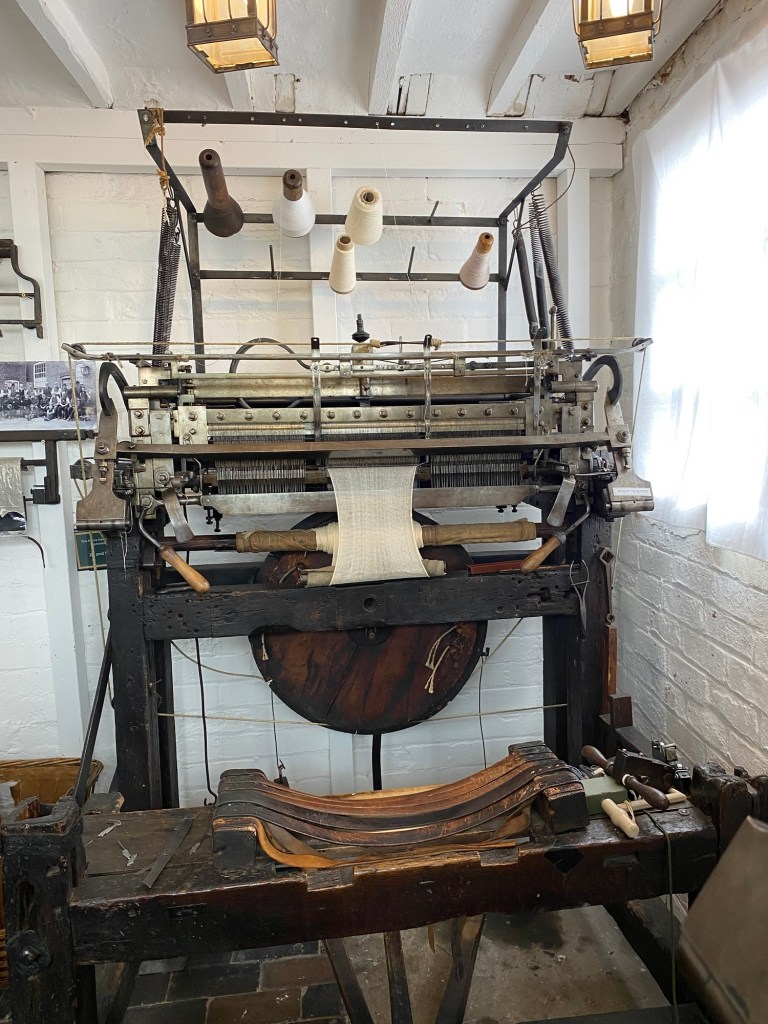
Merchants would supply yarn and rent frames to families who would knit in the upstairs room of their dwellings. With the coming of mechanisation in the spinning of yarn, production increased.

The image is from the Frameworkers Museum in Ruddington just outside Nottingham where there were four hundred frames working in 1851 both in single dwellings and collected together as here in Parkers Yard. The machines are astonishingly intricate with needles that I am sure would pass muster with the needle makers of Redditch. The machines were made in and around Nottingham with certainly later machines made by the Nottingham Manufacturing Company established in 1851.
The world around was changing, as, across the country, rural dwellers were moving to the new urban areas in search of work. In the countryside enclosures were reducing the amount of common land and new agricultural techniques led to fewer jobs. In the case of Nottingham, the city fathers resisted increasing the urban area which thus became more and more crowded. Poor harvests, the Napoleonic wars and the Corn Laws led to ever increasing food prices and ever squeezed incomes for the knitters. Inevitably rioting broke out and in particular a movement, the ‘Luddites’ set about destroying new larger frames used in the new low cost technique of ‘cut ups’, stockings made up of pieces cut to size. In parallel with this violence was a more reasoned movement by the Nottingham Frameworkers Association to sue parliament for better conditions. Their efforts fell on deaf ears, but slowly with the Factory Acts working conditions improved and, with the 1835 Municipal Corporation Act, common land was released for building and chronic overcrowding slowly decreased. The railways followed.
Lace saved the day for Nottingham. The patent for bobbin net by John Heathcote, which adapted the frame for lacemaking, expired in 1823 and the new machines were adopted across the town leading, at least in the short term, to prosperity for merchants and knitters alike. Nottingham would become the greatest lace centre in the world. Richard Birkin stands out as a champion of lacemaking and the Nottingham Lace Market owns him and those like him its later prosperity. Birkin & Company was probably the largest of the lace makers.
The 19th century saw other industries establishing. In 1888, Frank Bowden bought the workshop on Raleigh Street where Woodhead, Angois and Ellis had been developing the bicycle. In 1895, ET Hooley invested in Bowden’s company. By 1896 Raleigh had the biggest bicycle factory in the world covering seven and a half acres with 850 employees producing 30,000 bicycles a year. Six years later Bowden bought Sturmey-Archer gears. I wrote more of Raleigh bicycles in How Britain Shaped The Manufacturing World.
John Player founded his tobacco company in 1877.
WJ Furse was founded in 1894 as electrical engineers. They went on to manufacture electrical equipment. They went through the ownership of a number of conglomerates before becoming part of ABB.
Jesse Boot opened his first shop in 1884 and then expanded across the country both with shops and their own healthcare products. In the First World War the company produced aspirin and became ‘the main government supplier for vermin powder, anti-gas cream, water steriliser, anti-fly cream (flies were a big problem on the front). Also, iodine tubes, matchless tinder lighters, peppermint, compressed medicines, quinine’. In the wake of the war, Jesse Boot, seeing no family succession, sold his company to the American Louis Leggatt who continued the company’s expansion eventually selling it back to the family in 1933. In the meantime Jesse Boot had used a good proportion of his original sales proceeds to found the University of Nottingham.
In the nearby village of Chilwell a major shell filling factory was established and I wrote of this in Ordnance. Both Raleigh and Boots lent their weight to the national effort in the First World War.
In the twenties Lace suffered from foreign competition but hosiery prospered. The national strike hit the city hard not least because of the importance of coal mining to the area.
The Thirties saw further expansion of both Boots and Raleigh. William Hollins & Co, famous for Viyella, built a major factory and head office on Castle Boulevard. The former shell filling factory at Chilwell became the army centre for mechanisation and I wrote of this in War on Wheels. In the forthcoming war both Raleigh and Boots once again rose to the challenge.
In the early postwar era, Raleigh and Boots continued expanding, Gunn & Moore made all manner of sports equipment. Raleigh had 7,000 employees in 1952 and had under its control: Sturmey Archer, Rudge and Humber. The Stanton iron works spun pipes for the nation’s drainage. Pretty Polly, Charnos and many more made hosiery. Stag made furniture which was also made in neighbouring Castle Donnington and Long Eaton. Speedo made sports wear. Dobson Park and Dosco (part of Hawker Siddeley) made mining equipment. Dobson Park would later buy Britains Toys and change its name to Britains Petite. At the University of Nottingham the MRI scanner was invented. I write of this post war manufacturing in Vehicles to Vaccines.
In the late 19th century, Burroughs of Detroit set up manufacturing in Arkwright Street.
I worked in Nottingham for many years and would drive in passed the Royal Ordnance Factory to the smell of Pork Farms! It was a vibrant place. During the Second World War, the factory made some 13,000 guns, 23,500 gun barrels and 60,000 spare parts
The image is of the Grantham canal meeting the Trent which offered Nottingham outstanding communications
Further reading
Duncan Gray, Nottingham: Settlement to City (Nottingham: Nottingham cooperative society and S.R.Publishers, 1953, 1969
Sheila A. Mason, Nottingham Lace 1760s-1950s (Stroud: Alan Sutton, 1994)
John Beckett, The Book of Nottingham, (Buckingham: Barracuda Books Ltd, 1990)
Chris Weir, Nottingham: A History (Chichester: Phillimore, 2002)
You can read more in my books How Britain Shaped the Manufacturing World and Vehicles to Vaccines
Local residents will know their towns far better than I possibly can. Please use the feedback to highlight any glaring errors or omissions.
 British Manufacturing History