
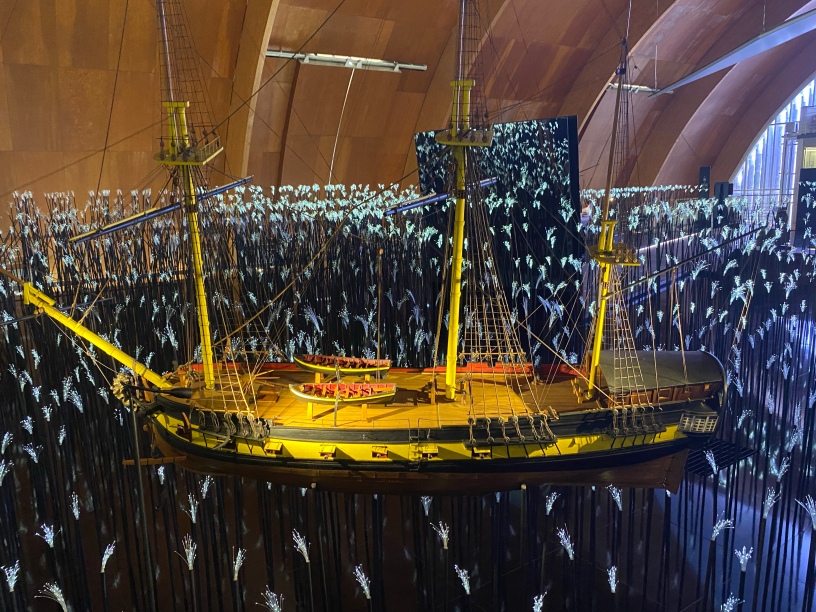
In How Britain Shaped the Manufacturing World, I argued that the explosion in industrial activity had its origin in our tradition of seafaring adventurers.
In his remarkable book, 1599 A Year in the Life of William Shakespeare, James Shapiro paints the picture of what was going on in Britain that year that may have influenced Shakespeare’s writing. One particular matter was the trouble in Ireland where Protestant England as long term invader was being resisted by the native Catholic population. For Shakespeare this had loud echoes of England’s chivalric past explored in Henry V. In 1599 it was the Earl of Essex and his knight followers who were the reality and the Irish and the Irish climate proved more than a match. Shapiro sees this as marking the end of the age of chivalry.
We can also bring to mind the famous names of the Elizabethan era: Drake and Raleigh. It was, though, a different kind of adventurer that was emerging in England, that of the merchant. He had been in existence for some time as a Merchant Adventurer, perhaps in the Levant company importing exotic goods overland along the silk road from the east. The Dutch though had been more adventurous creating a thriving trade by sea from the Dutch East Indies. This sea route became essential as the Ottoman empire took hold of the silk route. A further part of the picture comes in the form of the Spanish discovering the new world through Christopher Columbus and thereafter raiding it for silver through Cortez, much of it minted into coinage in Segovia. The Portuguese, under Vasco da Gama, went down the coast of Africa and to the indies and China and traded in porcelain, ivory and silk. All this placed Antwerp at the centre of European trade both amongst European countries and with far flung places. London merchants through the Merchant Adventurers Company both bought and sold through Antwerp.
England needed to respond if it was not to lose out on extremely profitable trade. One answer was the East India Company which was formed by London merchants without overt encouragement from the ageing Queen Elizabeth. Elizabeth was not only ageing, she feared for succession and her treasury was being drained by the military activity in Ireland but also by a mustering for a feared second armada from Spain. Spain had already invaded Holland. It was the London merchant community which provided the ‘loans’ that Elizabeth needed to pay her soldiers.
Shapiro describes a meeting of merchants in the Founders Hall in London where a petition was to be put to the Queen for the formation of the new merchant company This was needed for other initiatives were seen to be failing: colonies in America were struggling, England could not break into the lucrative Caribbean slave trade and had not created a sea route to the East. For Shakespeare the contrasts between the lost past and the uncertain future were explored in Hamlet. For England the new merchant adventurers would ignite activity that would transform the country – the East India Company was born. More though was needed.
If Britain was to succeed it had to replace Antwerp. Edward VI, Mary and Elizabeth each benefitted from the financial advice of Thomas Gresham who was determined to achieve the supremacy of Sterling in international trade which he did by restricting the flow of Stirling to Antwerp and creating in London the Royal Exchange where British international trade could be transacted.
British adventurers would gain access to North America, Australasia and the greater part of Africa.
You can read more in How Britain Shaped the Manufacturing World
 British Manufacturing History